

MELBOURNE Park has barely shaken off the Australian Open.
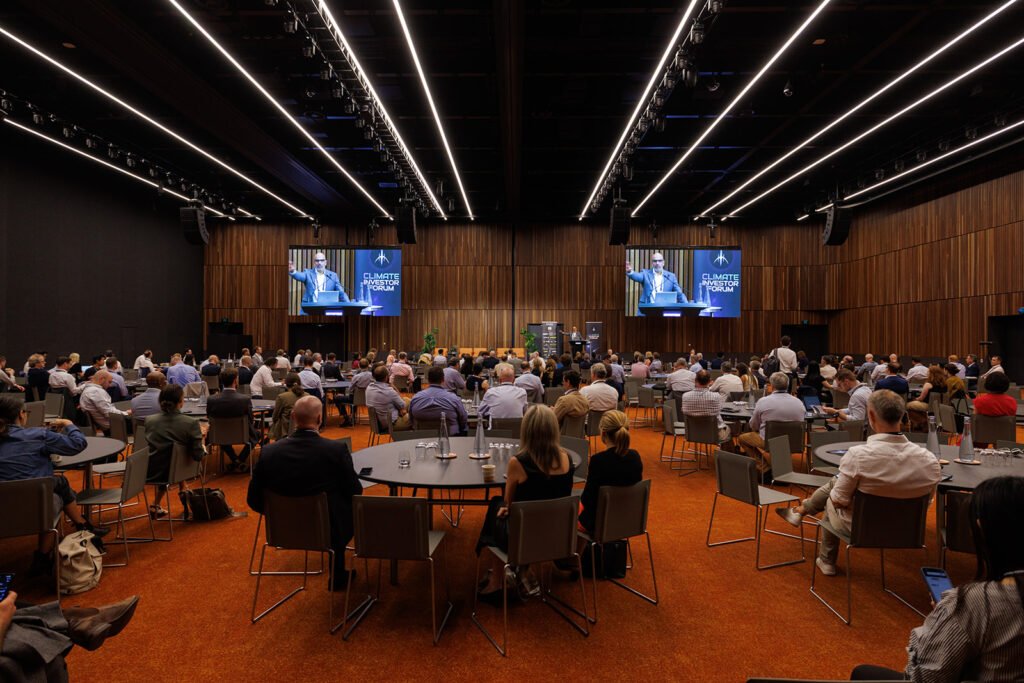
Two weeks ago, this precinct was sun, noise and the soft commerce of sport. This week, it was something entirely different. A room of investors, corporates, entrepreneurs, policymakers and innovators gathering under one premise that the transition isn’t a theoretical challenge any more, but more an architectural one.
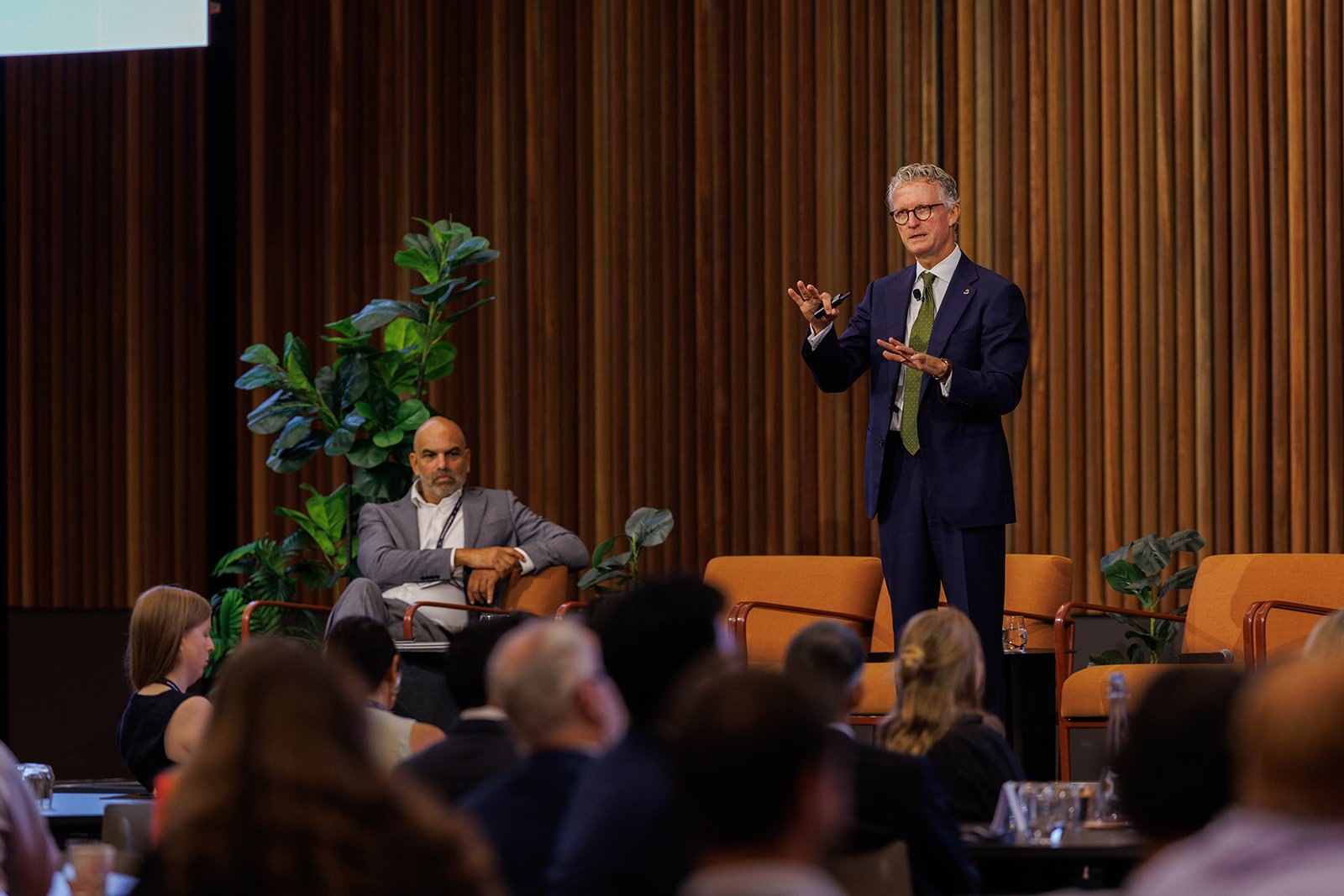
Peter Castellas opened the 2026 Climate Investor Forum the way these events should be opened, with a clear-eyed reminder that the point isn’t the stage, it’s the room. Castellas, who has spent much of his career working at the intersection of climate, finance and policy, is now in his fourth year convening the Climate Investor Forum, a gathering that has quickly become a focal point for investors and decision-makers shaping the transition.
“What makes this room in this moment so powerful is… alignment,” he said, naming the mix without romanticising it — “the people here are self-selecting, yes, but also capable.”
He framed the forum in its original sense: a civic space where ideas collide, where relationships form, where people argue, trade, negotiate and occasionally perform. The ancient Rome reference landed because it was operational. This was a gathering designed to produce outcomes, or at least remove the excuses for inaction.
And then, almost immediately, the morning’s sharper theme arrived: we have a momentum problem and not so much a capital scarcity problem… not one bit.
The room: alignment, candour, and the quiet work of trust
Castellas was selling permission rather than optimism, permission to speak in the corridors, at coffee, at drinks and to generally use the forum as intended.
“It’s a safe space,” he told delegates. “So you can say what needs to be said… be open and be candid.”
It’s an underrated point in a market that is increasingly performative. Capital moves on conviction, but it also moves on trust, and trust is built in rooms like this, not only through plenaries and panels, but through the semi-private conversations where risk is assessed honestly, where founders admit what isn’t working, where investors reveal what they will and won’t fund, where policy people explain the constraints they can’t say on stage.
For my own first CIF, it was an eye-opener. I learnt quickly that if the transition needs an architecture, its foundations are relationships. CIF, at its best, is not a conference; it’s a market-making environment.
The economist’s view: liquidity is plentiful, resilience is real
ANZ’s Richard Yetsenga took the baton and did what good economists do, widening the frame until it became uncomfortable.
Start with the headline number: liquidity is abundant. He pointed to money market funds in the US approaching US$8 trillion (roughly double pre-GFC peaks!) and argued that the story isn’t merely “lots of cash sloshing around”, it’s improved balance sheets across much of the private sector. China, he noted, is a different dynamic. In Australia, he made the comparison brutally simple: excluding property and superannuation, household liquid assets exceed household liabilities by the largest margin ever seen. In Europe, non-performing loans sit around 2%, far below post-crisis levels.
Even after a volatile stretch — aggressive tightening cycles, war shocks, banking failures, fiscal scares, tariff threats, and fresh geopolitical flare-ups — the global economy, he argued, has remained resilient. Strong balance sheets don’t prevent problems, but they limit contagion, and that resilience matters because a resilient system can finance long projects.
Australia actually has never had more of it.” — Richard Yetsenga, Group Chief Economist, ANZ
Then came the part that climate audiences sometimes glide past: climate is competing for capital, and not merely seeking it. Technology is a major claimant, government borrowing is another, and the competition is likely to intensify.
Yetsenga’s remarks on tech were blunt without being gleeful.
AI is not just software; it is physical infrastructure, reflected in balance sheets as property, plant and equipment surging 50–200% in two years among major AI-related firms. Physical booms face physical constraints, and return hurdles are climbing. His dinner anecdote — Nvidia’s CEO in a Korean fried chicken restaurant and the next-day market reaction — worked as a warning shot: bubbles don’t always announce themselves with a bang; sometimes they wink.
Governments, too, are absorbing capital, and he flagged a risk investors are already pricing: fiscal positions that require a premium.
“What keeps me awake at night?” he said, pointing squarely at public debt trajectories and the political behaviour that often follows tightening fiscal constraints — not neat policy solutions, but widening political difference. The point wasn’t to predict default; it was to show how quickly long-term agendas can be crowded out by short-term pain.
And yet, when Castellas put the question directly (“is there enough capital to fund Australia’s transition?”), Yetsenga didn’t hedge.
“Yes,” he replied, and grounded it in market reality: Australia’s current account is far more balanced than in the era when the country “invested more than we saved,” and domestic capital markets have deepened. He noted Australia’s investment-grade bond market climbing global rankings, eclipsing larger legacy markets.
Capital is present. The constraint, increasingly, is priority.
The strategist’s signal: investment is up, electrification is winning — and 2.6°C still looms
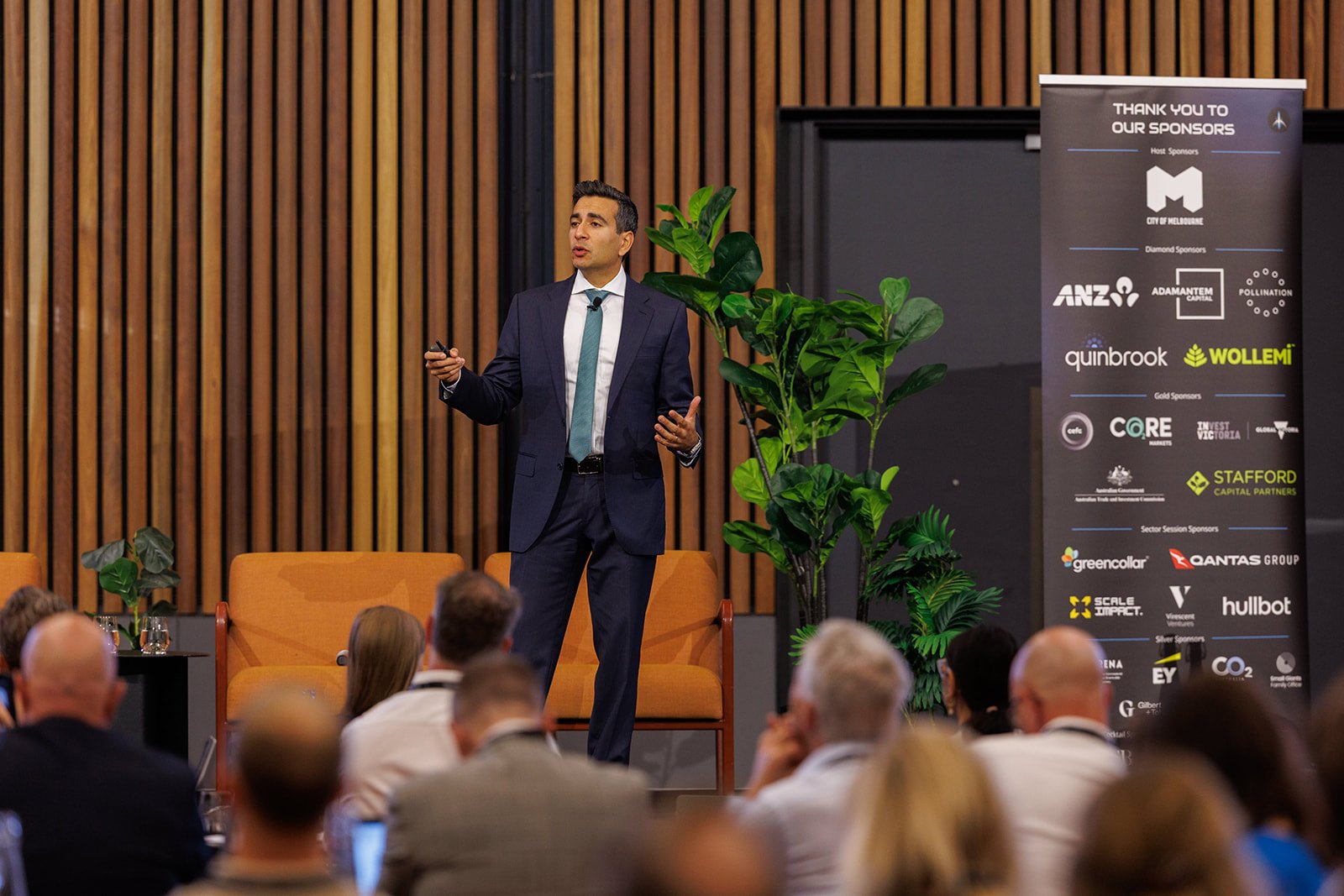
BloombergNEF’s Kobad Bhavnagri arrived with a framing that felt made for this moment. Separate the signal from the noise.
There is plenty of noise, much of it political, much of it amplified, much of it designed to make people doubt whether the transition is inevitable. Bhavnagri’s message was, in essence, to “watch the flows”.
Global energy transition investment rose again, up 8% to US$2.3 trillion. EV sales rose 21%, “strong almost everywhere except the United States,” where the withdrawal of tax credits has been felt. The more honest story, he argued, wasn’t an EV slowdown but rather an internal combustion slowdown, with ICE sales down 25% from their 2017 peak, and they are not coming back. The stack is diversifying: hybrids and plug-in hybrids appear as behavioural “reassurance” technologies, likely to fade as batteries improve.
The grid is the other major signal. Investment is rising because renewables require connection, and because demand is rising — data centres are part of it, but Bhavnagri made the sharper claim: electric vehicles will be a bigger incremental driver of electricity demand in the medium and long term, alongside heat electrification and cooling.
He also acknowledged the awkwardness in the data: renewable investment fell last year for the first time in a decade, driven largely by China’s power market reforms and the disruption of liberalising electricity pricing. That detail matters because it’s easy to misread. “China is down” can become a lazy narrative about retreat; Bhavnagri’s point was more precise: a pause driven by market redesign, with likely rebound once confidence returns.
Then he went to the irreversible economic underpinning: wind and solar remain the cheapest forms of generation in most markets, and EVs are now the cheapest cars to buy upfront in major markets, decisively in China, increasingly in Europe, approaching in the US (helped by Chinese exports).
It all points to an economics-led transition, where electrification technologies including solar, wind, batteries, EVs keep winning.
And still, he said, the world is tracking to around 2.6°C.
That’s the heart of the morning: the transition is real, the money is moving, the economics are improving… and it is not enough.
The hard lanes: what doesn’t scale without policy
Bhavnagri’s diagnosis of the slow lane landed with the kind of candour that makes a room go quiet. Some solutions are simply “out of the money” under current policy settings.
Hydrogen, he said, was “unlikely to scale” at the pace once promised, with investment falling as cost realities bite. Carbon capture and storage remains limited. Nature finance and sustainable agriculture remain stuck. Least developed countries remain underfunded because sovereign risk and market conditions don’t support deployment.
Not so much a dismissal of ambition, it’s an exposure of the gap between targets and delivery.
Bhavnagri named the phase we’re in: the “messy middle”, past peak euphoria, past the easy work of setting targets, now forced into execution, trade-offs, supply chains, grid bottlenecks, political risk, and the uncomfortable truth that some pathways are still expensive.
When Castellas asked for the next great economic tipping point (the one that could bend 2.6°C down) Bhavnagri didn’t claim certainty. He returned to fundamentals highlighting deeper electrification of end-use sectors is the clearest lowest-cost bet. Hydrogen is physics-challenged. Carbon capture, controversial as it is, could matter if it can be done at scale and within a politically tolerable price band — he nominated US$100 per tonne as “political striking distance.”
In essence, without stronger policy, the market will fund what’s already cheapest and easiest, and the rest will lag.
INSIDE THE CLIMATE INVESTOR FORUM
A cleaner summary of Day 1’s opening truth
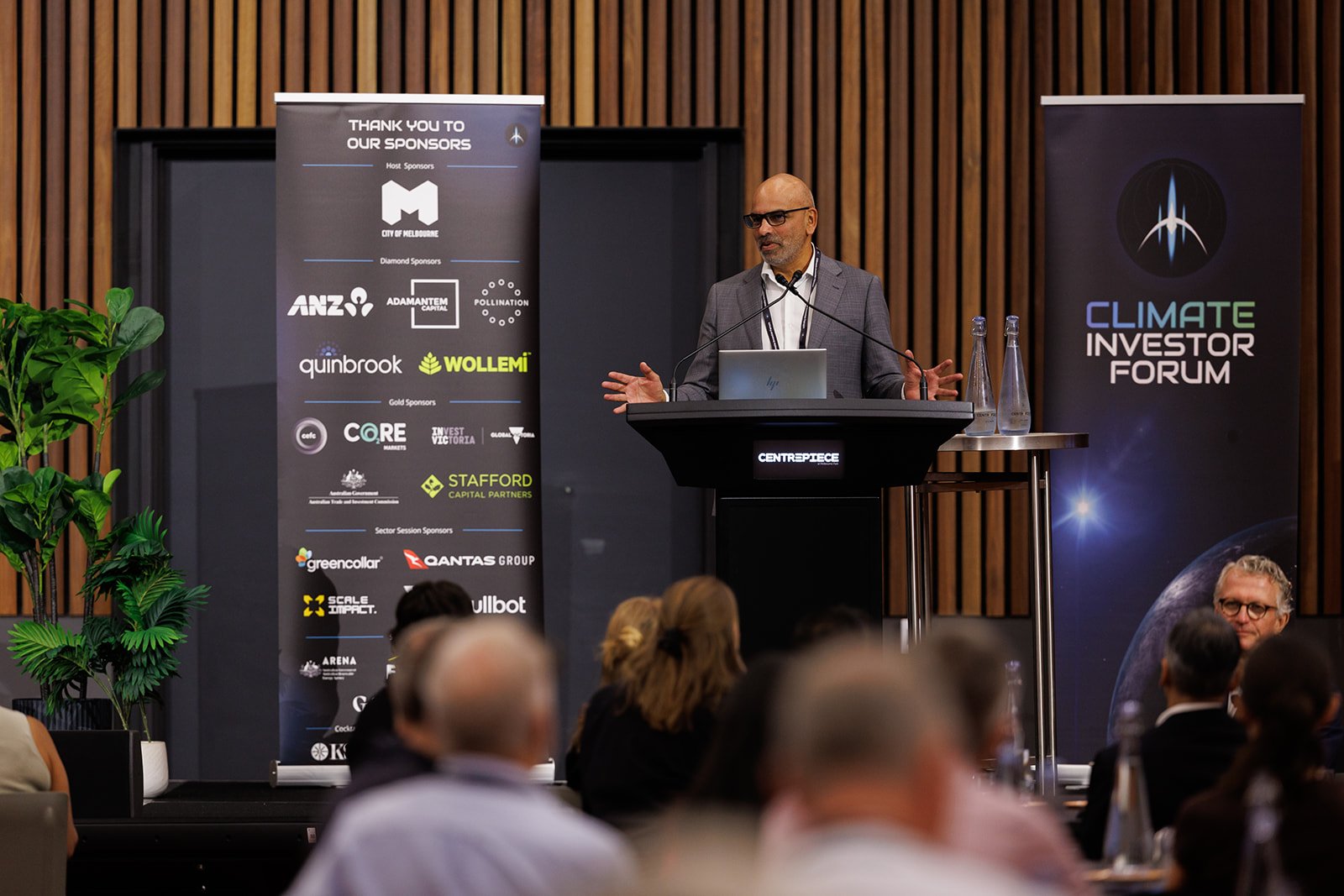
Castellas gave the room its role: speak, challenge, align, and build trust.
Yetsenga gave the system its context: capital is abundant, resilience is real, but competition for capital is intensifying from tech, from governments, from geopolitics and demographics.
Bhavnagri gave the transition its scoreboard. Investment is rising, electrification is accelerating, yet the world still points to 2.6°C and nature continues to decline.
This is reality, and reality is useful because it forces choices.
If the early years of the transition were about declaring ambition, the next phase is about the more difficult work: allocating capital at speed, building grids at scale, electrifying end-use sectors faster than demand growth, and confronting the slow lanes with policy that is strong enough to make uneconomic solutions deployable.
In other words, plenty of capital and not enough momentum… yet.
STAY TUNED FOR MORE COVERAGE OF BOTH DAYS FROM THE CLIMATE INVESTOR FORUM 2026
Future Now Green News is a forward-thinking media platform dedicated to spotlighting the people, projects, and innovations driving the green & blue economy across Australia, Asia and Pacific region. Our mission is to inform, inspire, and connect changemakers through thought leadership and solutions-focused storytelling in sustainability, clean energy, regenerative tourism, climate action, and future-ready industries.