


FUTURE Now Green News has always been interested in how progress unfolds over time, rather than how it presents ‘in the moment’.
Much of what we cover — from energy transition and sustainability to infrastructure and regional investment — tends to resist simple narratives. These are fields shaped by long development cycles, policy settings, capital patience and relationships that take years to form. They don’t sit comfortably in a news cycle built around immediacy.
One of the recurring themes in Invested: Australia’s Southeast Asia Economic Strategy to 2040 is the importance of regional literacy, a recognition that Australia’s engagement with Asia has often been transactional, episodic or surface-level. The report points instead to the value of deeper understanding of markets, cultures, decision-making norms, and the human relationships that underpin trust.
That emphasis resonates strongly with what we see on the ground. Durable joint ventures, bilateral investments and cross-border collaborations rarely emerge from formal agreements alone. They are usually built person by person, over time, through familiarity, continuity and mutual confidence.
It’s from that place that we’ve launched a new LinkedIn newsletter, The Long View.
The intention is straightforward. It’s a space to step back from daily announcements and look more closely at how ideas, capital and engagement are actually evolving across Australia and the Asia-Pacific region, and how understanding, presence and long-term relationships shape those outcomes. This all through observation and not through prediction.
Starting with Southeast Asia
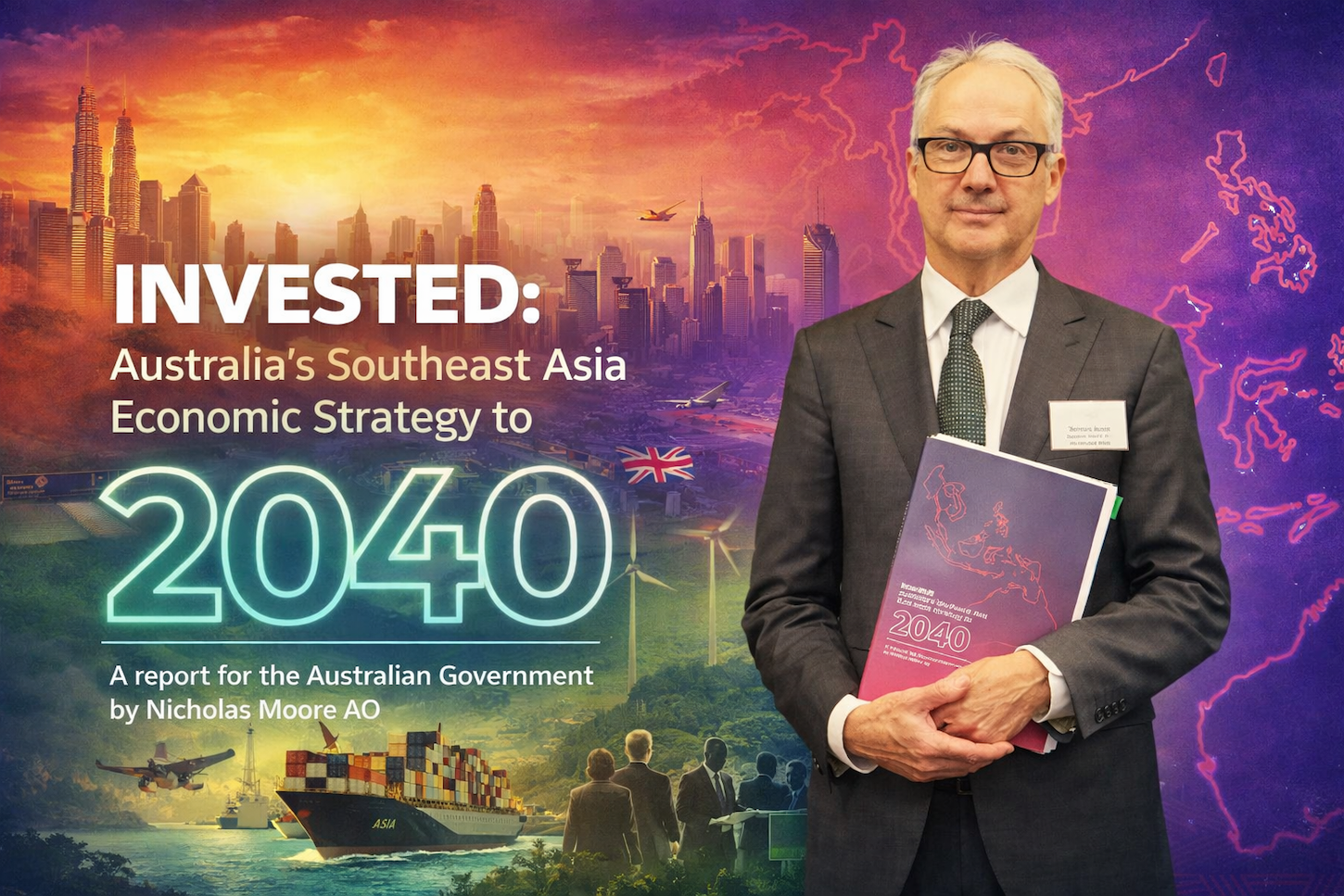
The first edition reflects on Invested: Australia’s Southeast Asia Economic Strategy to 2040, authored by Nicholas Moore for the Australian Government. It’s a document that has circulated quietly among policymakers, investors and institutions since its release, and one that influenced some of the early thinking behind FNGN.
What’s notable about the report is not its ambition, but its restraint. It avoids promises of quick returns and is candid about the depth of engagement required for Australia to play a meaningful role in Southeast Asia’s economic future. It speaks in terms of trust, presence and sustained involvement — concepts that sit outside the usual language of start-up culture or short investment cycles.
For anyone working across the region, that framing feels familiar.
From policy to lived experience
Australia’s relationship with Southeast Asia is often discussed in broad terms. In practice, engagement tends to be uneven. Some companies and investors build long-standing partnerships and local understanding. Others approach the region episodically, testing interest before moving on.
The difference is rarely technical capability. More often it comes down to time, continuity and an understanding that progress is incremental.
This is where The Long View hopes to be useful. Not as a guidebook or a point of view to be adopted, but as a place where these realities can be examined without urgency or expectation.
The newsletter will draw on conversations across the ecosystem — with founders, investors, corporates, intermediaries and policymakers — and reflect on what is being attempted, what appears to be working, and where friction persists.
ALSO DON’T MISS OUR FREE FRIDAY NEWSLETTERS EVERY WEEK
Who it’s written for…
The Long View is written for readers who are already engaged, or preparing to engage, with longer-term work:
- Founders building technologies or services that require patient capital and regional relevance.
- Investors thinking beyond domestic markets and short time horizons.
- Institutions and intermediaries involved in trade, policy, infrastructure or energy transition.
It assumes a level of familiarity with complexity and avoids simplifying it for effect.

A small additional lens
Alongside longer reflections, the newsletter will occasionally include a short segment On The Radar looking at a specific piece of technology or initiative that has caught attention: because it reflects how some organisations and regions are thinking ahead, not because it promises near-term outcomes.
The first edition introduces this through a brief look at a hydrogen-powered robotic prototype developed by Kawasaki Heavy Industries. Whether it ever reaches commercial use is uncertain. Its value lies elsewhere, as an illustration of how technological ambition, narrative and long-term intent often intersect.
These kinds of examples are useful not as forecasts, but as reference points.
A steady pace
The Long View will be published twice a month. That cadence is deliberate. It allows space for developments to unfold and for ideas to be revisited as context changes.
As with all FNGN work, the aim is to contribute to understanding rather than add to volume.
The first edition of The Long View is now available via our Future Now Green News Aust-Asia LinkedIn page.
Future Now Green News is a forward-thinking media platform dedicated to spotlighting the people, projects, and innovations driving the green & blue economy across Australia, Asia and Pacific region. Our mission is to inform, inspire, and connect changemakers through thought leadership and solutions-focused storytelling in sustainability, clean energy, regenerative tourism, climate action, and future-ready industries. Feel free to contact the editor at editor@futurenowgreennews.com