


While wheels are highly capable, creating another wheeled mobility would not deliver true novelty… to envision a completely new mobility experience, we intentionally moved away from wheels.” ~ Shinji Tanaka (Kawasaki Heavy Industries)
THERE is a point at which mobility stops being about getting from A to B and starts becoming something else entirely.
For more than a century, transport has followed a familiar logic: wheels, roads, speed. Even as the energy source shifts from petrol to electrons, the underlying architecture has remained largely unchanged. Faster, cleaner, smarter but still bound to the same physical paradigm.
Kawasaki Heavy Industries is quietly asking a different question. What if mobility didn’t rely on roads at all?
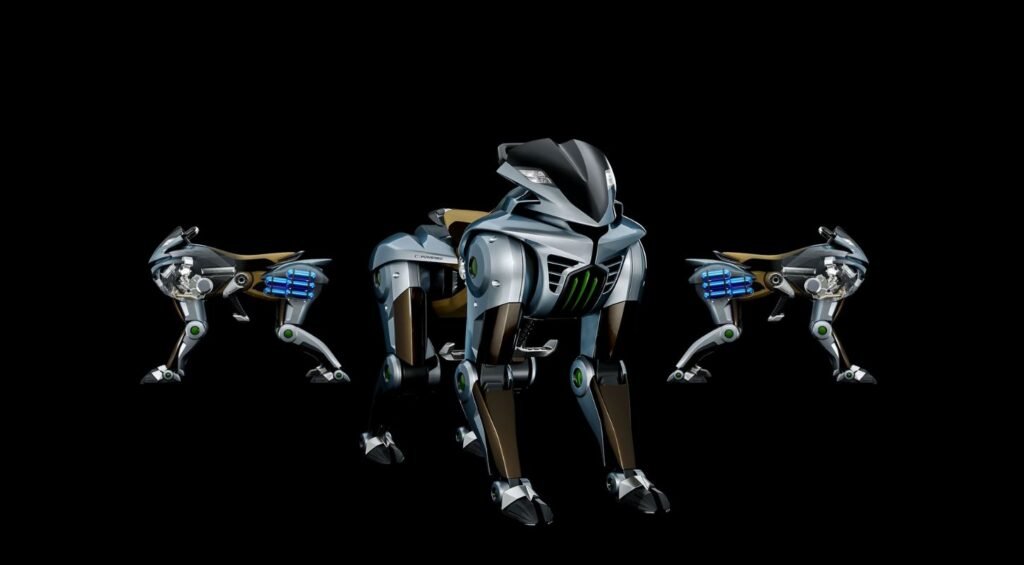
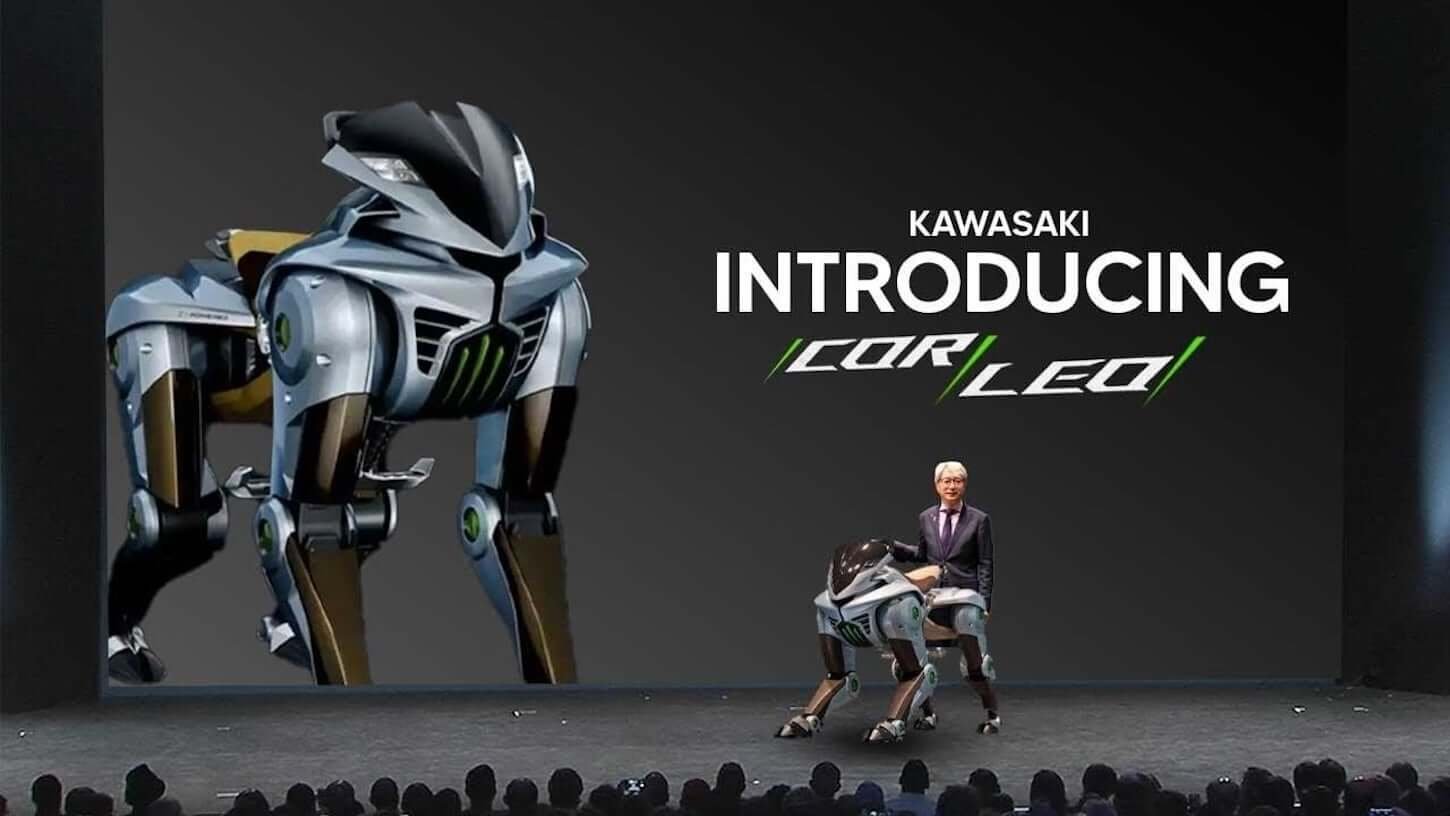
At Expo 2025 Osaka, the company unveiled CORLEO, a hydrogen-powered, four-legged robotic vehicle designed to traverse terrain that conventional transport simply cannot reach. It is not a motorcycle, nor is it a robot in the traditional industrial sense. And it is not, strictly speaking, a vehicle as we currently define it.
It is something new.
Kawasaki Heavy Industries’ Shinji Tanaka describes it as a form of “future personal mobility” built around what it calls the human “impulse to move”, a deeply ingrained instinct to explore, to travel, to experience the world beyond familiar boundaries.
That framing is important because CORLEO is an attempt to rethink how movement itself is experienced and not simply a technical demonstration.
Leaving the road behind
The most obvious departure from conventional transport is structural. There are no wheels.
Instead, CORLEO moves on four independently controlled legs, drawing inspiration not from a horse — as many assume — but from a lion.
The design choice is deliberate, combining stability, strength and a sense of confidence for the rider. Even the name traces back to Cor Leonis, another name for Regulus, the brightest star in the Leo constellation.
But the rationale is more than aesthetic.
“While wheels are highly capable, creating another wheeled mobility would not deliver true novelty,” Tanaka explains. “To envision a completely new mobility experience, we intentionally moved away from wheels.”
The implications are significant. Wheeled vehicles perform best with speed and surface continuity. Remove either — in mountainous regions, disaster zones, or remote terrain — and performance quickly degrades.
Legged mobility operates differently. Stability does not depend on momentum, movement can be controlled, deliberate, even at walking pace, and it can stop, rebalance, and adapt to uneven ground in ways wheels cannot.
The trade-off is complexity, but that is precisely where advances in robotics and control systems begin to shift the equation.
Hydrogen beyond the road network
If CORLEO reimagines the physical form of mobility, its energy system points to a parallel rethink.
The platform is powered by hydrogen and not batteries.
That choice reflects Kawasaki’s broader strategy.
The company has spent years building out the hydrogen value chain, from liquefied hydrogen carriers to storage systems and hydrogen-powered turbines, and CORLEO extends that ecosystem into mobility.
The reasoning is practical as much as strategic.
Unlike electric vehicles, which rely on charging infrastructure and time-intensive recharging cycles (although that tech is improving), CORLEO is designed for environments where neither is guaranteed. Hydrogen can be replenished by swapping a canister; a far more viable solution in off-grid or remote settings, Tanaka says.
It is not an argument against electrification. It is an acknowledgement that not all mobility use cases are the same.
As terrain becomes more complex, so too do energy requirements.
A vehicle for terrain, not roads
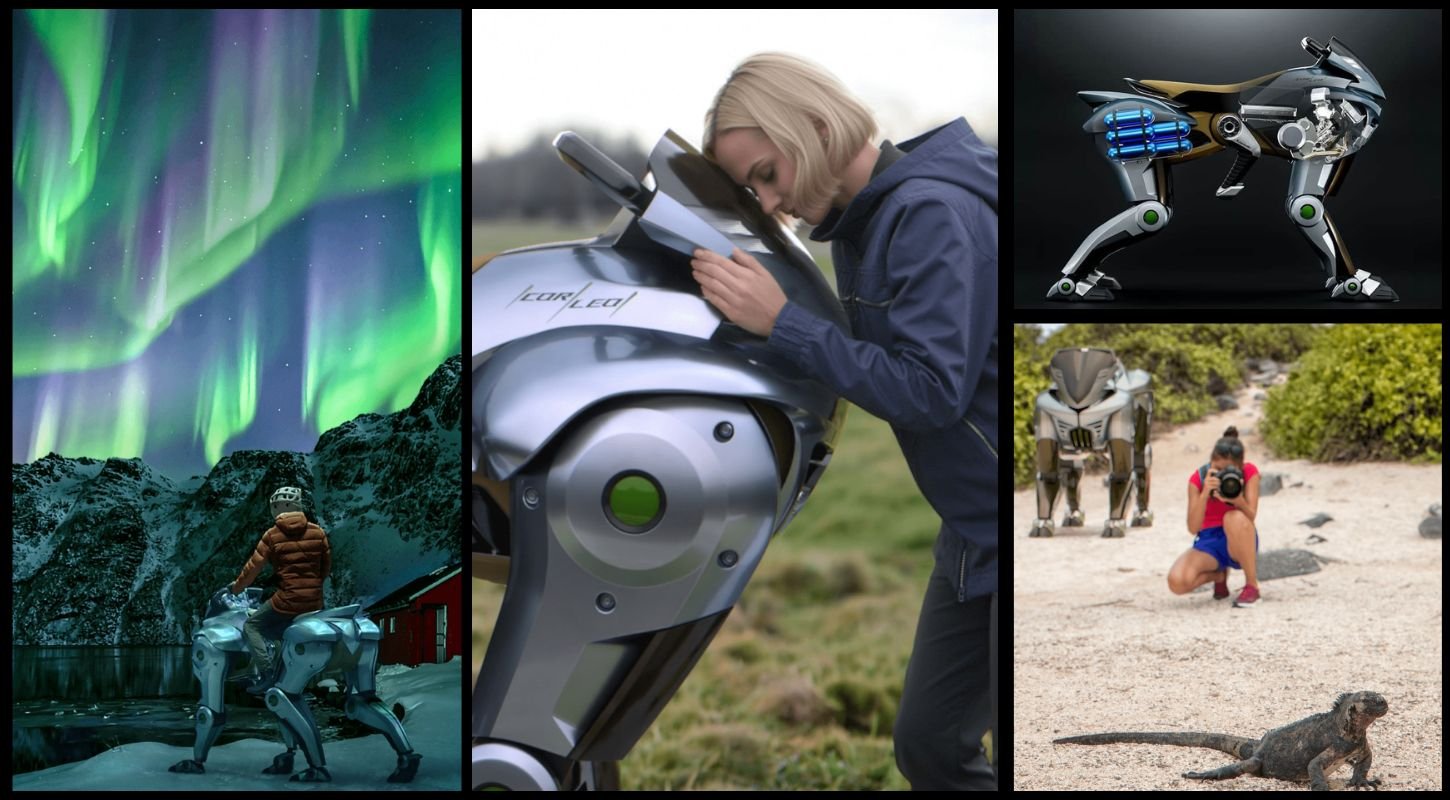
In its early conception, CORLEO is aimed at the tourism sector — an industry where access to remote, natural environments is both a drawcard and a logistical challenge.
“Kawasaki is targeting deployment at Expo 2030 Riyadh, with a view to commercialisation by 2035,” Tanaka says.
But the potential use cases extend far beyond leisure.
A platform capable of stable, low-speed traversal across uneven terrain has clear applications in disaster response, remote logistics, defence and environmental monitoring. In areas where roads are damaged, non-existent, or impractical, mobility becomes a constraint. CORLEO offers an alternative.
Importantly, it lowers the skill threshold.
Navigating difficult terrain on a motorcycle or off-road vehicle requires experience and physical capability. CORLEO, by contrast, is designed to be stable even at walking pace, controlled through the rider’s natural weight shifts and supported by AI-assisted terrain interpretation.
The ambition is not just to reach difficult places, but to make them accessible to more people.
The human-machine interface
At the centre of CORLEO’s design is a different relationship between rider and machine.
Control is not based on throttle and steering in the traditional sense. Instead, the system responds to shifts in body weight detected through the footrests and handlebars. The rider leans: the machine interprets and responds.
It is a more intuitive interface — closer to riding an animal than operating a vehicle.
Behind that simplicity sits a complex system architecture. AI is used to interpret terrain conditions, anticipate movement, and maintain balance. Kawasaki’s proprietary control systems handle the execution, ensuring stability and safety.
The instrument panel provides real-time data (hydrogen levels, navigation, centre of gravity) but much of the operational complexity is designed to remain invisible to the user.
The goal is not to make the rider think harder, but to make movement feel natural.
A hybrid future, physical and digital
Perhaps the most unexpected dimension of CORLEO is not the machine itself, but its digital counterpart.
A riding simulator — scheduled for completion in 2027 — forms a central part of the development process. But Kawasaki’s ambitions extend beyond engineering.
The simulator is intended to become a product in its own right.
Gaming, e-sports, and remote experiences are all part of the vision. Users could explore distant landscapes virtually, control real-world machines remotely, or compete in entirely new forms of interactive sport.
The line between physical and digital mobility begins to blur.
It is a reminder that future transport systems may not be confined to physical infrastructure alone. Experience, access and immersion are becoming part of the equation.
CHECK OUT SAPPORO EYES GLOBAL GREEN CAPITAL HUB STATUS
An undefined category
For all its promise, CORLEO sits in unfamiliar territory.
There is no existing market category for four-legged personal mobility. No established regulatory frameworks. No clear consumer expectations.
That, Kawasaki acknowledges, is one of the core challenges.
We must create a riding experience that feels exciting and truly enjoyable,” Tanaka says. “Four-legged mobility does not yet exist as a defined category in society.”
It is both an opportunity and a risk.
Innovation at this level is not just about engineering. It is about defining a new space — and convincing people it is worth entering.
Looking further ahead, Kawasaki’s vision is less about vehicles and more about access.
A system like CORLEO could allow people — regardless of physical strength — to explore environments that were previously out of reach. Mountain regions, remote landscapes, even virtual worlds could become more accessible.

The company refers to this as “safe adventure”.
It is an idea that resonates beyond the machine itself. As transport systems evolve, the question is no longer simply how we move, but where we can go — and who gets to go there.
The significance of CORLEO is not that it will replace cars or motorcycles. It won’t.
The significance is that it challenges an assumption that has held for more than a century — that mobility must be built around roads.
If that assumption begins to shift, even at the edges, the implications are far-reaching.
Mobility, in that sense, is no longer just about efficiency.
It is about possibility.

Future Now Green News is a forward-thinking media platform dedicated to spotlighting the people, projects, and innovations driving the green & blue economy across Australia, Asia and Pacific region. Our mission is to inform, inspire, and connect changemakers through thought leadership and solutions-focused storytelling in sustainability, clean energy, regenerative tourism, climate action, and future-ready industries.