
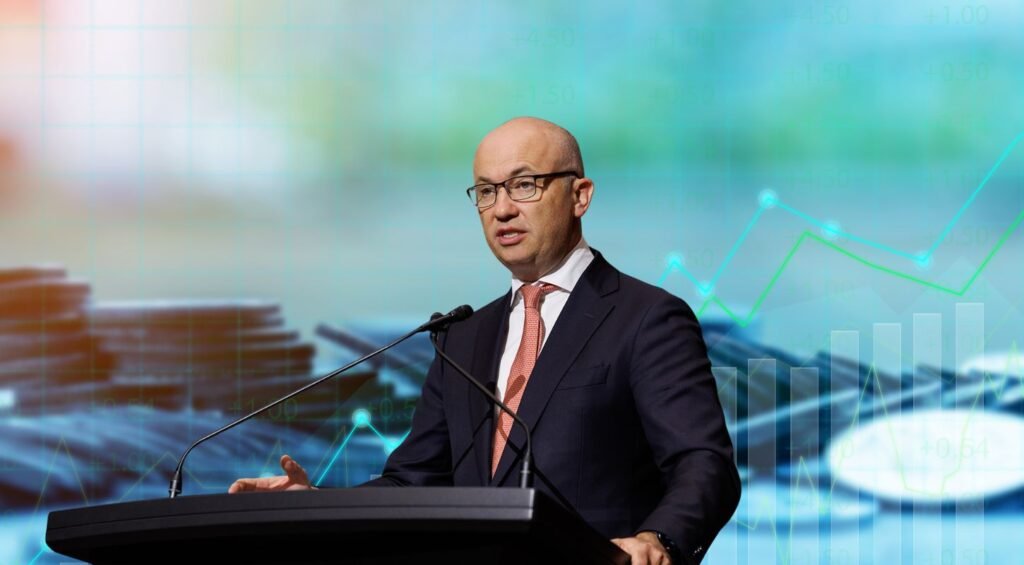

Australia’s transition will succeed or fail on our ability to mobilise capital — at speed and at scale.” ~ Matt Kean, Climate Change Authority Chair
The conversation has shifted
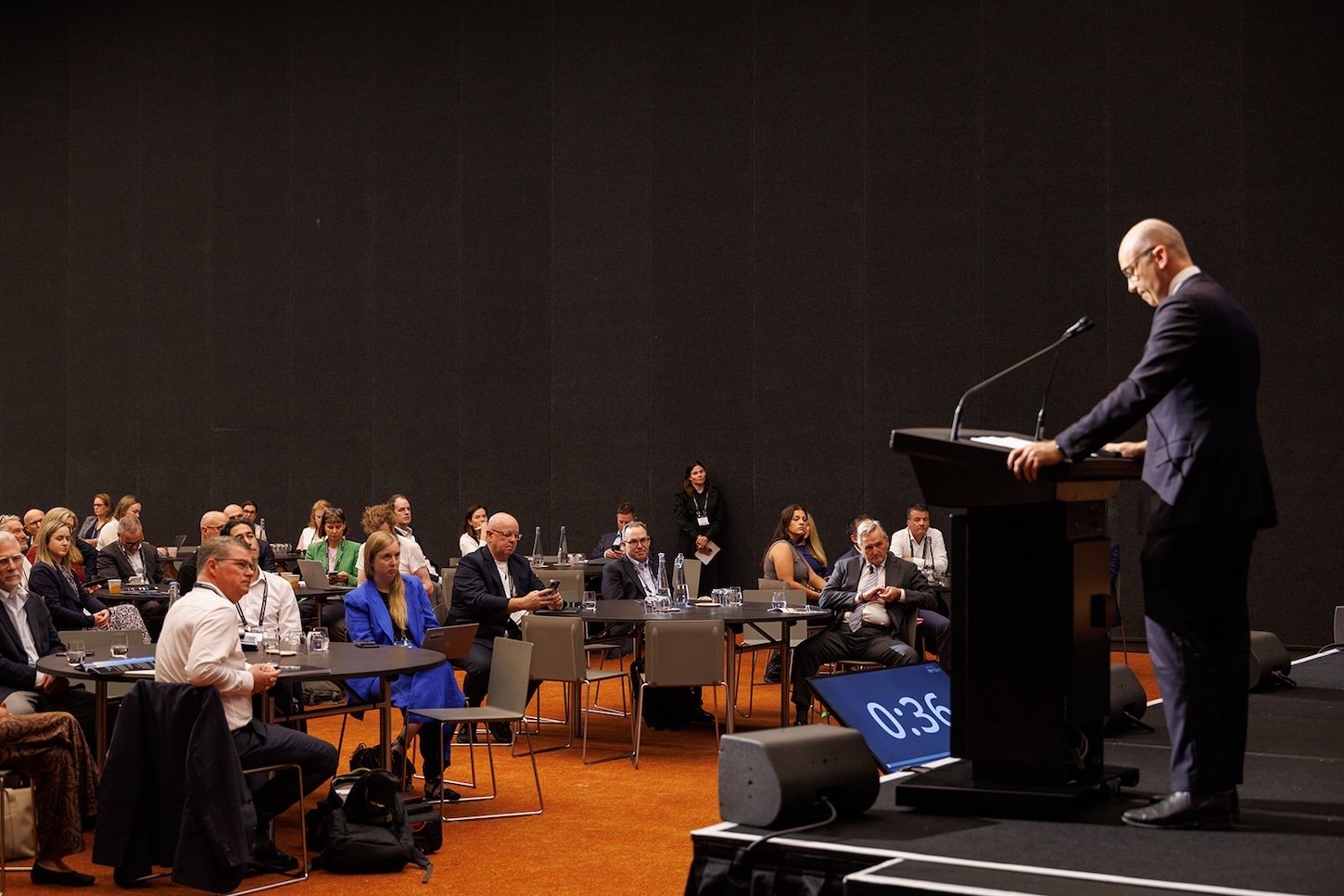
MATT Kean did not come to the Climate Investor Forum to revisit the climate debate, and there was no attempt to restate the science or re-argue the urgency. Those questions, he suggested, have already been settled.
The task now is more practical and far more difficult. How does Australia turn climate ambition into something investors will fund?
Standing before a room of institutional capital, developers and policy leaders in Melbourne at last week, the Chair of the Climate Change Authority reframed the transition in unmistakable terms. A 62 to 70 per cent reduction in emissions by 2035 is not a policy objective sitting alongside the economy, it is a transformation of the economy itself.
And that transformation will only happen if capital can move and the scale of the task leaves little room for abstraction.
Meeting Australia’s 2035 target will require between $475 billion and $630 billion of investment over the next decade — roughly a billion dollars a week. At that level, climate policy becomes a capital markets question, where decisions are driven not by targets, but by risk, return and certainty.
Kean’s argument was that the global context has already moved on. Decarbonisation is now tied to industrial competitiveness, energy security and economic positioning and no longer defined by environmental obligation alone. Capital is responding accordingly.
China’s clean energy expansion continues at a pace that is reshaping global supply chains and electric vehicles now account for a majority of new car sales in the world’s largest auto market. Renewable capacity is being added at a scale that compresses decades of build-out into a matter of years.
He pointed out in the United States, political cycles have not halted investment. Previously allocated funding continues to flow, reinforced by state-level policy, while Europe’s industrial strategy remains anchored in its green transition, and countries across Asia and the Middle East are positioning themselves to attract capital into emerging clean industries.
Australia, for all its advantages, is part of that competition.
Advantage is not enough
Australia’s starting position is strong with abundant renewable resources, a stable regulatory environment, engineering capability and one of the largest pools of long-term capital in the world through its superannuation system.
But Kean’s message was poignant. Advantage does not guarantee investment and capital does not allocate based on potential, but instead is based on conditions.
Investors are funding projects (not targets): projects with predictable revenue, stable policy settings and a credible path to delivery. Where those conditions exist, capital is willing to move, and where they do not, capital finds other markets.
In a world where capital is mobile, even small differences in certainty and execution can redirect billions.
For all the focus on ambition and technology, Kean was blunt about where the real constraint lies: It is not a shortage of capital. Global liquidity remains deep, and institutional investors are actively seeking long-duration assets aligned with decarbonisation pathways.
It is not a lack of technology. Many of the core solutions required to reduce emissions are already commercially viable.
The constraint is the ability to convert ambition into investable opportunity and that conversion challenge becomes more complex as the transition moves beyond electricity into transport, methane reduction and heavy industry. These sectors are harder to decarbonise, more capital intensive and often more exposed to global competition.
Closing coal plants is only part of the task, he explained, rebuilding the system that replaces them is where the real work sits.
Beyond the cost narrative
Kean also challenged a familiar framing of the transition as an economic burden. Much of the required investment, he noted, reflects the natural turnover of capital within the economy. Vehicles are replaced, infrastructure is upgraded, industrial systems evolve. The question is not whether capital will be spent, but where it will be directed.
Electric vehicles are not simply a lower-emissions alternative. They are a more efficient use of energy, with significantly less loss between input and output. Electrification across buildings and industry offers similar gains, often reducing operating costs over time.
In that context, the transition is not only about emissions reduction. It is also about productivity, efficiency and long-term competitiveness.
For investors, that alignment is super important.
The transition is also reshaping the global industrial landscape as cheap, clean and reliable energy is emerging as a defining competitive advantage. Countries that can deliver it at scale will be well placed to build new industries around green commodities, from steel and aluminium to ammonia and silicon.
Australia has the potential to play a significant role. Its renewable resources, critical minerals and institutional depth provide a strong foundation. But the opportunity extends beyond supplying raw materials. It lies in building value across clean industrial supply chains and exporting higher-value products into global markets.
That, Kean suggested, is what a “future made in Australia” could look like.
What investors need to see
Turning that opportunity into reality depends on the conditions in which capital operates, as investors require policy settings that extend beyond electoral cycles, providing confidence that direction will not reverse. They need credible price signals that shape behaviour over time and reduce uncertainty around future returns.
They need revenue frameworks that make projects bankable, whether through long-term contracts, underwriting mechanisms or other forms of support that reduce exposure to volatility.
And they need execution systems that can deliver projects without delay.
Each of these factors feeds directly into the cost of capital. Uncertainty raises risk. Higher risk increases required returns. In a competitive global market, that can be enough to shift investment elsewhere.
Execution is emerging as one of the most significant challenges as delays in planning approvals, grid connections and transmission development are increasing project risk and slowing deployment. These are not minor administrative issues but they are factors that directly influence investment decisions.
Without transmission, new generation cannot connect. Without coordinated delivery, electrification cannot scale.
As projects become more complex, the ability to deliver infrastructure in a timely and predictable way becomes a central determinant of success.

Where capital will flow
The priority areas for investment are already clear – electricity generation and storage remain foundational, but must be supported by expanded transmission and distribution networks. Transport electrification, including charging infrastructure, will be critical as fuel emissions remain a major contributor.
Methane reduction and carbon removal technologies will also play an increasing role, particularly in sectors where direct electrification is more difficult.
These are not future opportunities. They are sectors where capital is already seeking entry.
The challenge is ensuring there are enough bankable projects to absorb that capital.
Kean was equally clear about the role of government. Public funding alone cannot deliver the transition, nor should it attempt to replace private capital. The objective is to create the conditions that allow private investment to scale, that includes taking on early-stage risk, structuring co-investment models and providing revenue certainty where needed. Blended finance, long-term offtake agreements and asset aggregation models are already being used in other markets to unlock capital.
The issue is not the absence of tools but the pace and consistency with which they are applied.
CHECK OUT ‘AUSTRALIA: PLENTY OF CAPITAL BUT WE NEED MOMENTUM
Why timing is super important
For investors, the window is not static.
Grid connections are becoming scarce, transmission corridors are constrained, and approved, bankable projects remain limited. These constraints create value for those able to move early, securing positions in parts of the market where demand is likely to exceed supply.
As the transition accelerates globally, the cost of entry is unlikely to remain constant.
Those who move early will shape the system and those who wait may find themselves paying a premium to enter it.
Kean’s closing message returned to the broader stakes:
The transition is not only about emissions reduction. It is about industrial competitiveness, energy security and long-term economic leadership. For Australia, the opportunity is significant. But it is not guaranteed.
The ambition is already in place. The capital, in many cases, is available.
The challenge is converting that ambition into projects that investors are prepared to fund — and doing so quickly enough to remain competitive in a global market that is moving faster than many expected.
Because in the end, the transition will not be delivered by targets. It will be delivered by capital that can move.
Read Hon. Matt Kean’s full speech here
Future Now Green News is a forward-thinking media platform dedicated to spotlighting the people, projects, and innovations driving the green & blue economy across Australia, Asia and Pacific region. Our mission is to inform, inspire, and connect changemakers through thought leadership and solutions-focused storytelling in sustainability, clean energy, regenerative tourism, climate action, and future-ready industries.