
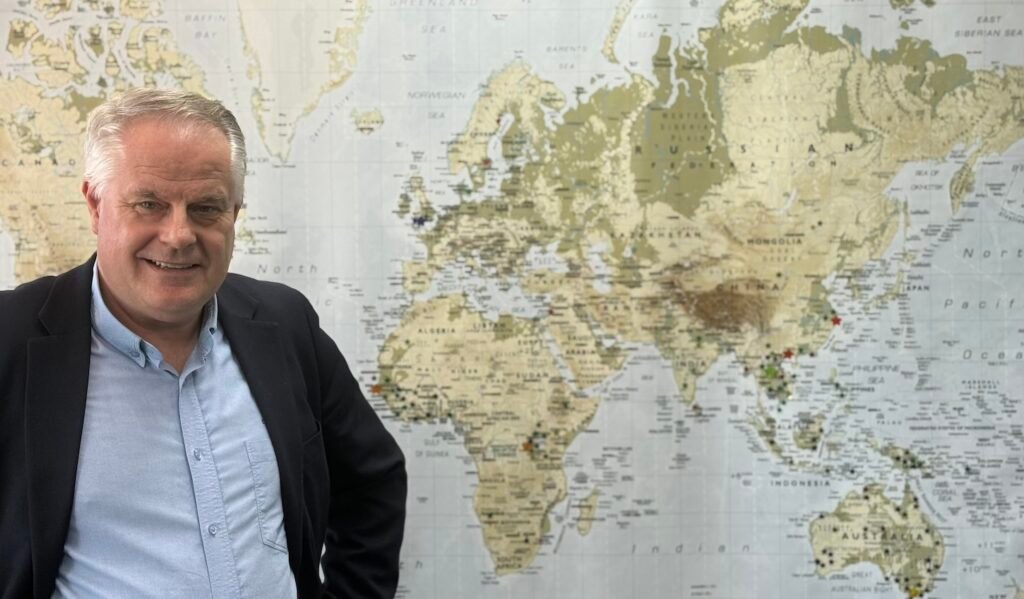

THERE’S a world map on the wall in Nigel Murphy’s office, studded with pins and stars. Papua New Guinea. Southeast Asia. Africa. China. Australia.
Each marker tells a story of a project delivered, a system assessed, a problem wrestled with. It’s the quiet cartography of a career spent not talking about sustainability but rather trying to make it work.
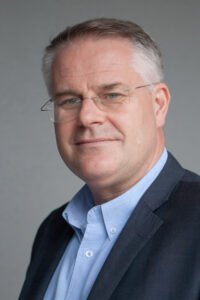
For more than 35 years, Nigel Murphy has operated at the intersection of environmental science, engineering, policy and industry. He is best known as the co-founder and director of Earth Systems, an international consultancy that has delivered more than 1500 major projects across six continents. But increasingly, Murphy’s focus has shifted from assessing impacts to building solutions: practical technologies designed to close the widening gap between sustainability ambition and real-world outcomes.
It’s a shift born of experience, not of impatience.
From helicopters to hard questions
Murphy’s professional life began not in a laboratory or lecture hall, but in the field. Fresh out of university, he was hired by Rio Tinto as an exploration geologist and sent to Papua New Guinea. His days were spent jumping in and out of helicopters, working in remote and often pristine environments, at a time when the environmental profession barely existed as a formal discipline.
“In the mid-1980s, the environment side wasn’t really a science,” Murphy recalls. “Mining engineering was done professionally. Geology was done professionally. The environment was more like an ethical add-on — we’ll do the right thing if we can.”
It was confronting, he says. Working in places like Bougainville and Ok Tedi, Murphy began to see a disconnect between economic progress and environmental responsibility. The tools to bridge that gap simply didn’t exist yet.
So, he went back to university and completed one of the first postgraduate degrees in environmental science in Australia (possibly one of the first anywhere). The decision marked a turning point.
“I decided then that I wanted to devote my working life to creating a more sustainable future,” he says. “One where humanity can have a good standard of living without trashing the planet.”
Building a different kind of consultancy
Murphy co-founded Earth Systems in 1993 with a simple but ambitious vision: use rigorous science and engineering to enable better decisions, and then push through to implementation. From the outset, the firm rejected a narrow compliance mindset in favour of outcome-focused problem-solving.
“Many consultancies thrive off regulation,” Murphy says. “They optimise for the regulatory system. Our focus has always been on the sustainability solution itself, regulations change; the problems don’t.”
That global, solution-oriented mindset took Earth Systems well beyond Australia. The company now operates across Asia, Africa, Oceania, Europe and the Americas, often in regions where environmental, social and economic pressures collide most sharply.
Murphy’s worldview was shaped early by international exposure, and it remains central to how he assesses progress today; particularly when comparing Australia’s trajectory with that of Asia.
The cost of lost momentum
Murphy is candid about what he sees as a failure of vision in Australia.
“Absolutely we’ve been left behind,” he says, describing his most recent trips to China where high-speed rail, electrification and large-scale infrastructure projects are delivered with speed and clarity of purpose. “They set a vision and say, ‘This is where we’re going — let’s get there’.”
In contrast, Murphy argues Australia has become bogged down in bureaucracy and individualism, mistaking comfort for progress.
“Our quality of life is definitely diminishing,” he says quietly. “Our children will likely be less wealthy than our generation, which is the opposite of what most societies aim for.”
For Murphy, the lesson isn’t ideological. It’s structural. Societies that align community, government, finance and industry around long-term outcomes move faster. Those that don’t, fall behind.
CHINA SHOWS AUSTRALIA IT’S LOW CARBON FUTURE
Sustainability as systems engineering
Perhaps Murphy’s most consistent refrain is that sustainability is more a systems challenge and not a moral debate.
“Climate change is a symptom. The root cause is our lack of sustainability — our overuse of resources, degradation of soils and water, and erosion of natural capital,” Murphy says.
He’s impatient with polarised climate debates because they distract from the core issue: how modern societies function.
“People aren’t going to reduce their standard of living,” he adds. “They won’t drive fewer kilometres or produce less waste. And history shows technology is almost always the answer.”
That belief underpins his support for electrification, renewable energy, and clean manufacturing. Sustainability, in his view, is not about going backwards but more about redesigning systems so people can live well with less impact.
When regulation lags reality
If technology is the answer, regulation is often the bottleneck, and Murphy is blunt about the limitations of process-driven environmental frameworks.
“Regulation typically lags real-world problems by five, 10, sometimes 20 years,” he says. “In that time, the damage continues.”
He gives a telling example. Earth Systems produces biochar — carbon-rich material made through controlled thermal processes that can improve soils and lock away carbon for centuries. Yet because some regulators lack appropriate classification frameworks, biochar production can be mistakenly grouped under waste incineration, triggering hazardous waste rules.
“It’s wrong,” Murphy says plainly. “And one day we’ll look back and ask what we were thinking.”
For him, the fix is straightforward: regulate for outcomes, not processes. Set clear environmental goals, then allow innovation to reach them.
Enter The CharMaker
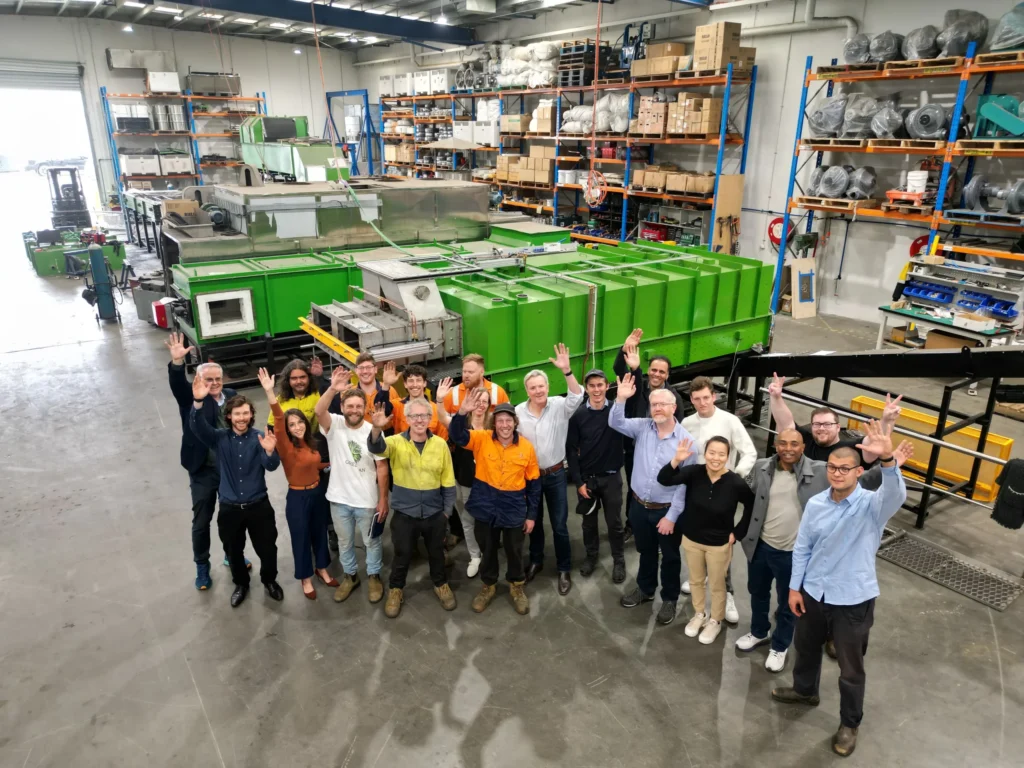
That philosophy comes into sharp focus with The CharMaker, a mobile biochar production system developed by Earth Systems.
The idea is deceptively simple: take organic waste — green waste, agricultural residues, biosolids — and convert it into biochar using controlled pyrolysis. The result is a stable form of carbon that can be returned to soils, improving water retention and fertility while permanently sequestering carbon.
But what excites Murphy is the deployment more so than the chemistry.
“The CharMaker is modular and mobile,” he explains. “It can operate where the waste actually is… on farms, at council facilities, in regional communities.”
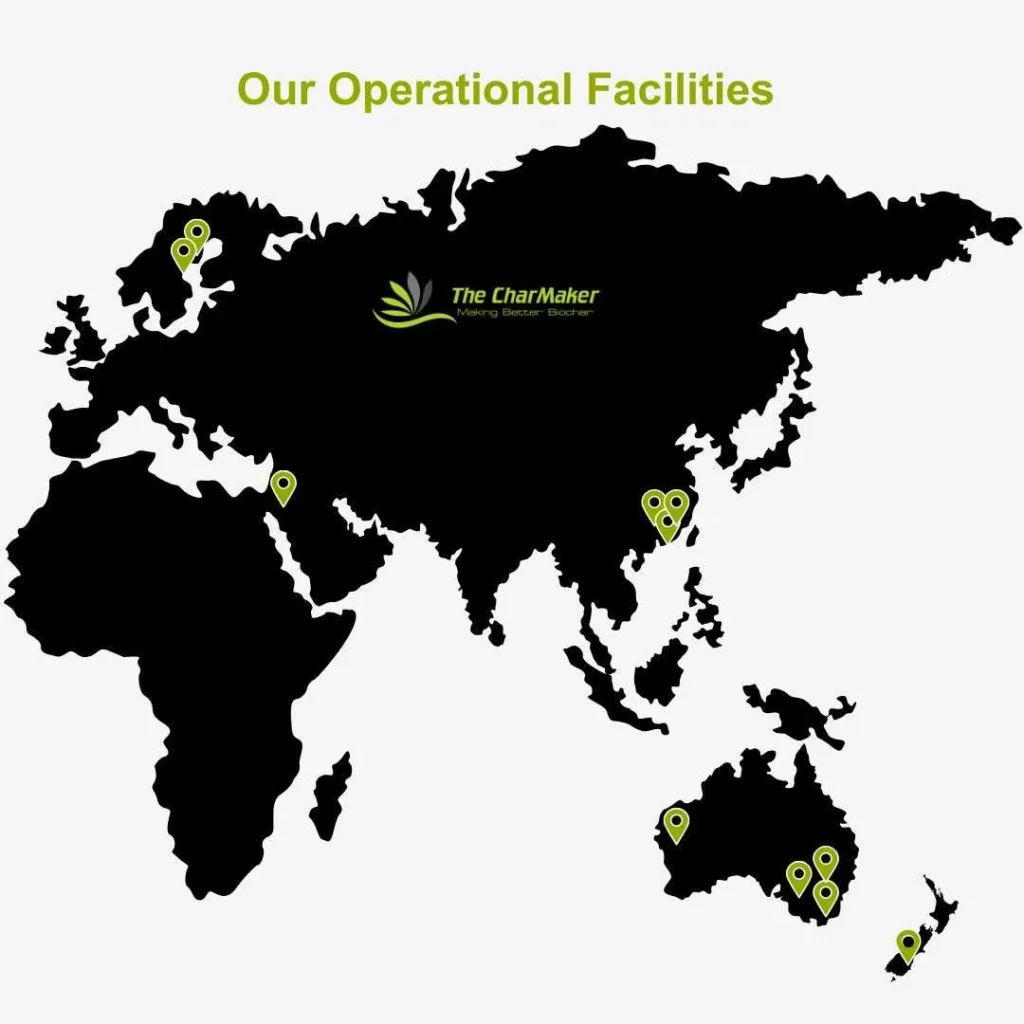
In Australia’s Yarra Ranges, a CharMaker unit is already operating at a council site in Lysterfield. Murphy’s question is disarmingly practical: why aren’t there 200 more like it across the country?
The answer, he suggests, isn’t technical. It’s financial and institutional.
This is where Earth Systems’ ambitions are evolving again.
Murphy describes the early stages of an Earth Repair Initiative, a vehicle designed not just to design solutions but to fund and deliver them.
“We see projects that should be done, and could be done economically,” he says. “But sometimes you need someone to step up and say, ‘We’ll finance this’.”
To date, Earth Systems has self-funded its technology development, reinvesting profits rather than relying on bank loans. Scaling up, however, will require capital aligned with long-term environmental outcomes and not short-term returns.
It’s a quiet but significant shift: from consultant to technology developer, to project enabler.
A pragmatic future
Murphy is neither starry-eyed nor cynical about the path ahead.
He acknowledges the role fossil fuels played in building modern society, and the vested interests that complicate the transition away from them. But he remains convinced that cleaner systems are inevitable.
“We don’t have to eliminate fossil fuels entirely,” he says. “If we reduced use to 10 per cent of current levels, most of the problem disappears. The rest is about smart transition.”
That transition, he explains, must be collaborative: government setting vision, industry delivering capability, finance enforcing discipline, and communities defining what success looks like.
In many parts of the world, he says, that alignment already exists.
Sitting opposite in Murphy’s office, the map on the wall is less a record of the past than a prompt for what comes next. After decades spent measuring impacts, writing reports and advising governments, he’s increasingly focused on something simpler… getting solutions into the ground.
“Sustainability can’t stay stuck in process,” he says. “We need outcomes. We need action.”
It’s a sentiment born of long experience, and one that feels increasingly urgent. As the gap between environmental ambition and delivery widens, voices like Murphy’s offer a reminder that the tools already exist. What’s missing is not knowledge, but the will to deploy it.
And for a growing number of veteran environmentalists, waiting for regulation to catch up is no longer an option.
Future Now Green News is a forward-thinking media platform dedicated to spotlighting the people, projects, and innovations driving the green & blue economy across Australia, Asia and Pacific region. Our mission is to inform, inspire, and connect changemakers through thought leadership and solutions-focused storytelling in sustainability, clean energy, regenerative tourism, climate action, and future-ready industries.