

The wall, not the physics, was the real constraint. And walls can be engineered.
THE EAST reactor’s latest result isn’t just a record. It’s a conceptual shift in what fusion reactors can do, and what they might one day mean for a region betting everything on clean energy.
Nuclear fusion has spent decades as the technology that’s always 20 years away. One peer-reviewed result from China’s “artificial sun” reactor, published at the start of this year quietly moved those goalposts in a way that deserves more attention than it has received.
Since 1988, tokamak fusion reactors — the doughnut-shaped magnetic confinement devices at the centre of most serious fusion research — have operated under an empirical ceiling known as the Greenwald density limit. Above it, plasma develops violent instabilities that shut the reactor down. Engineers learned simply to stay below the line.
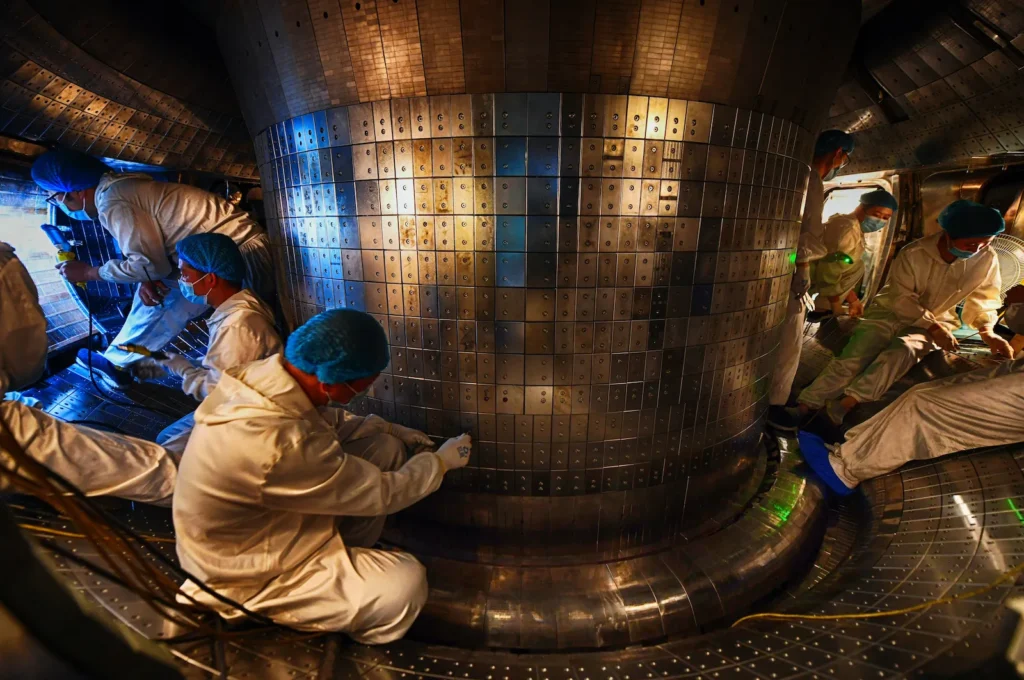
Researchers at China’s Experimental Advanced Superconducting Tokamak (EAST) crossed it. By adjusting initial gas pressure and applying electron cyclotron resonance heating during plasma startup, the team achieved stable densities of 1.3 to 1.65 times the Greenwald limit — without triggering disruption. The paper, published in Science Advances, reframes that limit not as a hard physical law but as a controllable wall-interaction problem. The research showed that density itself does not force instability once plasma interactions with the reactor wall stay within a narrow, controlled range — setting the stage for understanding how future reactors might move past those limits deliberately.
That is a conceptual shift, not just a number. Higher plasma density means a higher fusion rate — more collisions, more energy output from the same reactor volume. Until now, pushing density meant risking catastrophic shutdown. EAST has shown that the wall, not the physics, was the real constraint. And walls can be engineered.
This follows EAST’s separate record in January 2025 of maintaining steady-state high-confinement plasma for 1,066 seconds — more than doubling its own previous world record. Taken together, the two results — duration in 2025, density in 2026 — represent back-to-back advances on the two variables that matter most for a viable fusion reactor.
What this actually looks like in practice
Consider what a working fusion power plant would mean for, say, a Pacific Island nation like Fiji — currently spending a double-digit percentage of GDP on imported diesel to keep the lights on, and acutely exposed to every shock in global oil markets.
The main fuels for fusion are deuterium and tritium, both heavy isotopes of hydrogen. Deuterium can be extracted inexpensively from seawater — the amount of deuterium in one litre of water can in theory produce as much energy as the combustion of 300 litres of oil.
There is enough deuterium and lithium in the oceans to provide for the world’s energy needs for billions of years.
A fusion reactor wouldn’t need a fuel supply chain. It wouldn’t need a transmission corridor stretching back to a coalfield or a gas terminal. It would sit on-grid, generating continuous baseload power (day and night, regardless of weather) from an effectively inexhaustible source available in the ocean surrounding every Pacific island. Unlike renewables, fusion can provide reliable baseload power with a relatively small geographic footprint, and it doesn’t produce long-lived radioactive waste or present any risk of meltdown from chain reactions. Fusion reactors operate with only seconds or even microseconds worth of fuel at any moment: without active refuelling, the reactions immediately quench. There is no runaway scenario.
Scale that vision up to the industrial energy demands of a Southeast Asian economy (the steelworks, data centres, and manufacturing clusters that need reliable, high-density power around the clock) and the implications become even more significant.
CHECK OUT ‘IS AI PROPELLING INVOLUTION IN CHINA?’
Where things actually stand
Clarity matters here. The EAST advance removes one bottleneck, but does not guarantee a reactor that produces more power than it consumes.
Most experts foresee fusion contributing to the global energy mix in the 2040s or 2050s, with the path from scientific demonstration to commercial power running through experimental reactors, demonstration plants, prototype power plants, and finally commercial-scale deployment.
But the investment ecosystem is moving faster than those timelines suggest. Chinese tokamak startups Energy Singularity and Startorus Fusion are building significant war chests — Energy Singularity raised $240 million in 2025, Startorus $143 million in January 2026 — positioning themselves to capitalise on exactly the kind of scientific momentum EAST is generating. Japan, with its long fusion research heritage and world-leading high-temperature superconductor manufacturers, is developing a wide surface area of complementary innovation.
The Greenwald limit has constrained fusion reactor design for nearly four decades. China has now demonstrated, in peer-reviewed science, that it can be beaten in a practical and scalable way.
For a region staking its energy future on clean sources, it is worth tracking this story with the same rigour applied to battery storage costs or solar installation records.
The physics is getting better, engineering is catching up, and the timeline, while still long, is shortening.
Future Now Green News is a forward-thinking media platform dedicated to spotlighting the people, projects, and innovations driving the green & blue economy across Australia, Asia and Pacific region. Our mission is to inform, inspire, and connect changemakers through thought leadership and solutions-focused storytelling in sustainability, clean energy, regenerative tourism, climate action, and future-ready industries.