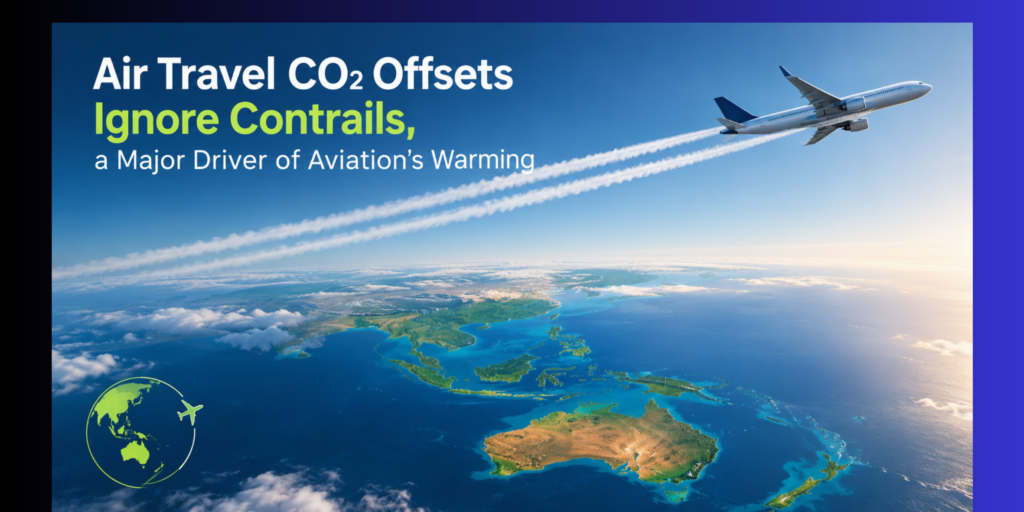

WE’VE ALL ticked the box to add a carbon offset when purchasing our air tickets – and wondered if it really makes a difference. Like carbon credits generally, it can feel consoling to keep flying as usual without the guilt. But offsets and schemes like CORSIA count only a flight’s CO2 and ignore contrails entirely – keeping in mind that Red-Eye night-time contrails have a much bigger warming effect.
Aviation’s non-CO2 effects, led by contrail cirrus (clouds), drive about two-thirds of its net warming. The uncertainty is large, but the offset may be covering the smaller share of the damage.
Bill Gates calls contrails a “mind-blowing impact for a relatively easy-to-solve problem”, claiming that rerouting just 5% of flights could eliminate up to 2% of global warming. That is the optimistic end of the evidence, but a growing number of airline trials suggest it deserves attention from the Asia-Pacific region.
Asia-Pacific takes the stage
For a region that depends on long-haul flying, from Melbourne to Singapore, Tokyo and beyond, the case is hard to ignore. The technology is mostly software and forecasting, and it is cheap compared with most carbon removal.
On 7 September 2026, Google and Cathay Pacific announced a trial of contrail avoidance on ultra-long-haul flights, with Google estimating a 40% cut in contrail warming across more than 80 flights. Does it really work? An earlier randomised trial tells a more interesting story.
When the plan is followed, it works
In a randomised controlled trial built into routine flight planning, flights eligible for avoidance had an 11.6% lower contrail formation rate than the control group. Among the 112 flights that flew the avoidance plan as intended, the reduction was 62.0%, with no statistically significant difference in fuel use.
That gap matters. It shows the technology works when followed, but also that getting every flight plan acted on is an operational challenge.
The other half of aviation’s footprint
Aircraft warm the planet in two ways: through greenhouse gas emissions and through contrails, which often grow into cirrus clouds that trap heat in the lower atmosphere. Aviation is responsible for about 3.5% of human-caused global warming, and the IPCC has estimated that contrails represent about 35% of the industry’s contribution. Contrails.org, the non-profit research group Bill Gates helped start, puts contrails at 1–2% of global warming and says adjusting 5% of flights could avoid up to 80% of it.
Much of the early evidence came from an unplanned experiment. Researchers drew on a pioneering study conducted after the 9/11 attacks, when US flights were grounded and the skies emptied of contrails.
Avoiding contrails means flying around, above or below the right patches of air, specifically humid “ice supersaturated regions” where long-lasting contrails form. Pilots already do something similar for turbulence and storms.
What the trials show
Breakthrough Energy’s Marc Shapiro has called contrail avoidance the “highest-leverage climate opportunity that we know of”, at a cost equivalent to removing carbon from the atmosphere at about US$10 a tonne or less.
The first big proof came from American Airlines. Over six months its pilots flew 70 test flights using Google’s AI-based forecasts, and satellite analysis showed contrails fell by 54%. The flights burned 2% more fuel, which could mean only 0.3% across a whole airline, for roughly US$5–25 per tonne of CO₂-equivalent. Cost remains a hurdle, though:
American Airlines reportedly paused its contrail-avoidance efforts as fuel prices rose
Governments are joining in. On 18 August, the UK government, Google and NATS launched Operation Blue Skies, a 30-month trial over the North Atlantic’s Shanwick oceanic airspace, which the organisers say accounts for roughly 5% of global contrail warming. It is the first contrail-avoidance trial across an entire block of oceanic airspace, at a cost of about £5 million.
What the Cathay trial shows
Cathay’s trial began in late 2025 and targeted more than 100 flights. The airline says it will add data from a region underrepresented in earlier research. Partners called the early results “encouraging”, but say further trials are needed. The estimate is also uneven: interventions on a single route accounted for more than 50% of the trial’s total reductions.
Contrail avoidance is not a licence to stop decarbonising aviation.
The fuel penalty is small but real, and the benefits are uneven. Night-time contrails have a much bigger warming effect, so the biggest gains may come from specific routes and conditions rather than every flight. Scientific uncertainty about contrail warming remains wide, which is why the 1–2% estimate comes as a range and why Gates’s “up to 2%” is a ceiling, not a forecast.
The open question for Australian and Pacific carriers: will they join the trials, or wait for others to do the work?
Sources: Bill Gates “Gates Notes”; Contrails.org; TechCrunch (Tim Fernholz), reporting on Marc Shapiro; Energy Monitor/Offshore Technology on the American Airlines trial; Google Research preprint “Efficacy of Scalable Airline-led Contrail Avoidance” (2026); Google blog and Cathay Pacific release (7 Sept 2026); Green Air News; AeroCorner (18 Aug 2026).
THIS ARTICLE FIRST APPEARED on LINKEDIN FNGN ” The Long View” biweekly newsletter. SUBSCRIBE >
Check out and sign up for any of our 6 Media Communications training modules: FNGN CLIMAX©MEDIA COMMS ACADEMY
Future Now Green News is an independent forward-thinking digital media platform dedicated to spotlighting the people, projects, and innovations driving the green & blue economy across Australia, Asia and Pacific region. We inform, inspire, and connect change-makers through thought leadership and solutions-focused storytelling in sustainability, clean energy, regenerative tourism, climate action, and future-ready industries.