

ON university and corporate campuses, where carbon-neutral targets are common, they shade outdoor study areas, power USB charging ports and Wi-Fi hotspots, and feed live dashboards that let students track renewable generation – At transit hubs, highway rest stops and car parks, their small footprint suits tight urban sites, and the electricity often goes straight to EV chargers while the canopy shades vehicles and helps ease the urban heat island effect – In city streets, smaller designs power standalone utilities where trenching cables through concrete would be disruptive or costly, storing daytime energy in batteries for LED streetlights at night and supporting smart-city hardware such as air quality sensors, traffic cameras and digital information displays.
Solar Trees provide shade and energy while minimising land-use
Images: Changi Airport Singapore
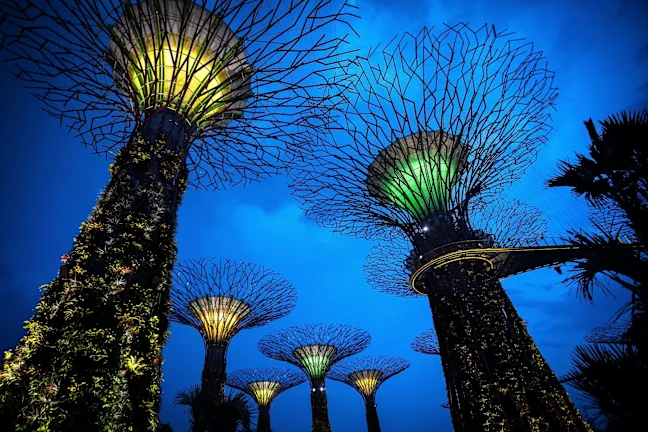
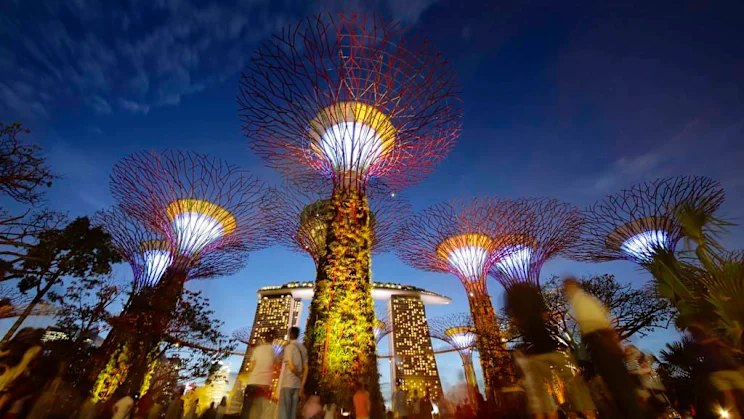
Cities across Europe, Asia, and North America utilize aesthetic solar trees in gathering areas. A prime example is Singapore’s Gardens by the Bay, which features iconic, massive “Supertrees” that mimic the function of real plants. They harvest solar energy to power their own nightly illumination and assist with venting air for the park’s glass conservatories. Singapore is being transformed from a “garden city” into a “city within a garden” and a big part of that has been the construction of the billion-dollar Gardens by the Bay development. When finally completed, it will cover 101 hectares of reclaimed land by Marina Bay.
The first stage, known as Bay South Garden, is the biggest, covering 54 hectares. The 101-hectare gardens, situated at the heart of Singapore’s Marine Bay, cost $773 million to build and house over a quarter of a million rare plants. The 18 Supertrees are a key feature. Twelve of them form the SuperTree Grove.
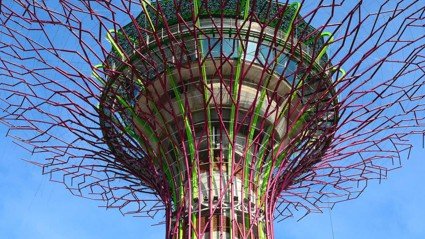
The trees are designed to imitate the canopy effect of a forest, powered by Green Energy
SOUTH KOREA is testing a way to build large-scale solar without clearing the forests that help absorb carbon. In mountainous terrain, conventional ground-mounted solar farms have traditionally meant felling trees, and research published in Scientific Reports found they can eliminate around 98 per cent of existing tree biomass, along with the carbon those forests would otherwise sequester. Researchers are now pointing to “solar trees”, tall photovoltaic systems mounted on poles, as a smarter alternative. Because the panels sit above the forest, the forest floor and understorey are left largely undisturbed, and up to 99 per cent of canopy biomass is retained.
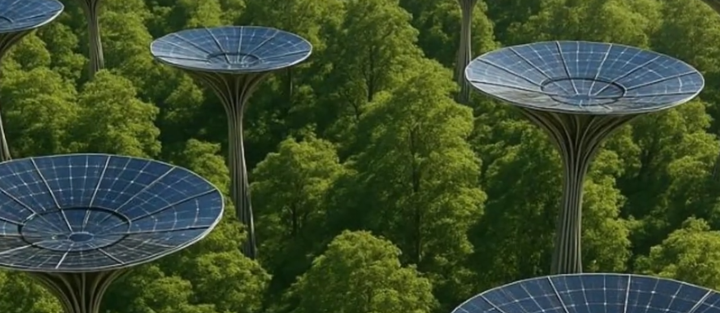
The challenge is keeping output high when panels sit among surrounding trees.
To solve it, the research team used 3D geospatial data and simulations to work out the ideal height and placement, so the panels clear the natural canopy. They found that solar trees can match the power output of conventional arrays while avoiding their environmental footprint.
It’s a promising example of how smarter design can ease the long-running tension between generating clean energy and protecting the land that helps absorb carbon.
India’s Solar Tree: A Compact Model for Farms and Communities
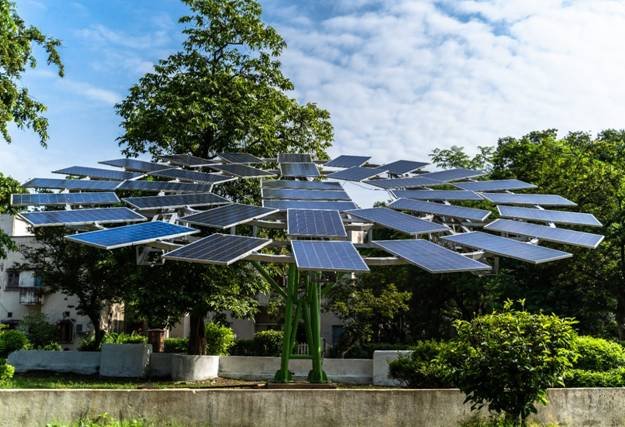
At the CSIR-CMERI residential colony in Durgapur, West Bengal, a large solar tree is generating more than 11.5 kilowatts-peak (kWp) of clean energy. Each tree carries 35 solar panels of 330 watts each and is expected to produce 12,000 to 14,000 units of electricity a year. The design maximises each panel’s exposure to sunlight while casting minimal shadow beneath, and the panel arms can be angled as needed, something fixed roof-mounted systems can’t do.
The small footprint makes the trees well suited to agriculture, where they can power irrigation pumps, e-tractors and e-power tillers. Each tree could avoid 10 to 12 tonnes of CO2 compared with fossil-fuel generation, and surplus electricity can be fed into the grid. At Rs 7.5 lakh per tree, ( $7,748.60 USD per tree) CSIR-CMERI is encouraging micro, small and medium enterprises (MSMEs) to take up production and link it to India’s PM KUSUM farmer energy scheme. The trees can also carry IoT sensors and CCTV, and connect to e-Suvidha kiosks and the eNAM agricultural marketplace, turning a power source into a platform for smart farming.
Check out and sign up for any of our 6 Media Communications training modules: FNGN CLIMAX©MEDIA COMMS ACADEMY
Future Now Green News is an independent forward-thinking digital media platform dedicated to spotlighting the people, projects, and innovations driving the green & blue economy across Australia, Asia and Pacific region. We inform, inspire, and connect change-makers through thought leadership and solutions-focused storytelling in sustainability, clean energy, regenerative tourism, climate action, and future-ready industries.