
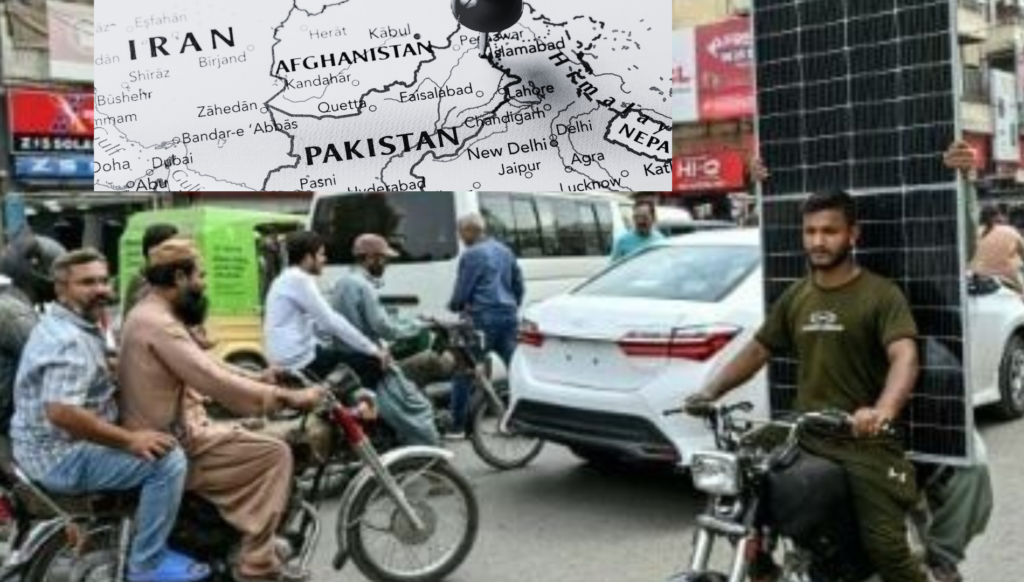

IF PAKISTAN has such extraordinary renewable potential, why isn’t international capital rushing in? The recent SOLAR. STORAGE. FLEXIBILITY. 2026 conference in Islamabad, proves that when electricity becomes too expensive or too unreliable, people don’t wait for the energy transition. They build their own.
People power.
My first and only visit to Pakistan was in the early ’90s. I was living and working in Hong Kong when a well-respected Persian, Bokhara and Tribal carpet expert asked if I wanted to join him on a buying trip. “Sure,” I said. “When do we leave?”
It was Eid. We stayed in his family’s home in Clifton, Karachi, opposite the beach — in view of the shell of a casino that never opened, built by the Hong Kong/Macau baron Stanley Ho. We flew to Islamabad and Lahore, drove the historic Elephant Trunk Trail, and turned back near K5 in a blizzard, inflight to Gilgit.
Over long dinners with his politician friends, the talk kept circling back to two things: America ghosting Pakistan after the 10-year Soviet-Afghan war; and a quieter domestic injustice — new elite housing estates drawing down water and electricity while ordinary neighbourhoods sat through regular electric blackouts and insanitary conditions. But we also spoke of something more hopeful: the resilience of Pakistanis who went abroad for world-class educations and came home determined to build something better.
Thirty years on, that same tension; elite consumption against grid scarcity, and resilience against dysfunction, still defines the country. Today it’s a civilian government operating under an authoritarian military dominance, with elected former PM Imran Khan still in prison – and the Elephant Trunk Trail replaced by China’s Belt and Road Initiative, whereby Pakistan owed roughly US$23.5 billion as of June 2025, to their largest bilateral creditor – with IMF negotiated default bailouts. Against that backdrop: how does international private equity, venture capital and private business confidently invest their IP, innovation and products into Pakistan?
A fault line redrawn
Some of that ’90s dinner-table anger traced back to the US–Pakistan covert alliance during the Soviet–Afghan War (1979–1989). When the Soviets withdrew, US strategic interest in the region declined almost overnight, leaving millions of Afghan refugees displaced in Pakistan, heavily armed militant networks with nowhere to go, and, in effect, the conditions for a Taliban state next door.
Pakistan’s position hasn’t gotten simpler since. In 2026 it’s an important intermediary in US–Iran war diplomacy, and it remains a nuclear-armed state of more than 250 million people, sitting at the junction of China, Afghanistan, Iran and India, the strategic physical link between South Asia, Central Asia and the Middle East. None of that is incidental to an investment case. When a country matters this much to everyone else’s strategy, its own timeline stops being entirely its own.
Pakistan presents a paradox for international investors: enormous potential for renewable energy and clean-tech collaboration, constrained by sovereign debt and financing risk.
A country the world is starting to watch
The recent SOLAR. STORAGE. FLEXIBILITY. 2026 conference in Islamabad — organised by Renewables First (the country’s leading energy and environment think tank), the Global Solar Council and the Pakistan Solar Association, brought together an estimated 300–350 delegates and participants, including more than 50 national and international speakers and energy-sector leaders from Pakistan and overseas, among them @John Grimes, CEO of Renewable Energy Council Asia Pacific, Australia. (John’s Youtube Interview with DAWN News Pakistan) Policymakers, regulators, utilities, financiers and technology providers gathered, as Pakistan forges on toward its Paris Agreement commitment to cut emissions 50% by 2030.
https://www.youtube.com/watch?v=uKXNLjeVmhA
@New Energy Nexus — a global non-profit backing diverse entrepreneurs in the clean energy transition through funding, acceleration and access to a global innovator network — has partnered with @Renewables First to launch Climate Innovation Pakistan (CLIP), a new national platform for homegrown climate tech.
Solar revolution meets sovereign risk
Distributed solar reached an estimated 38 GW by FY2025 — extraordinary against Pakistan’s conventional utility-scale generation. Imports surged as consumers fled expensive electricity, unreliable grid supply and rising energy costs.
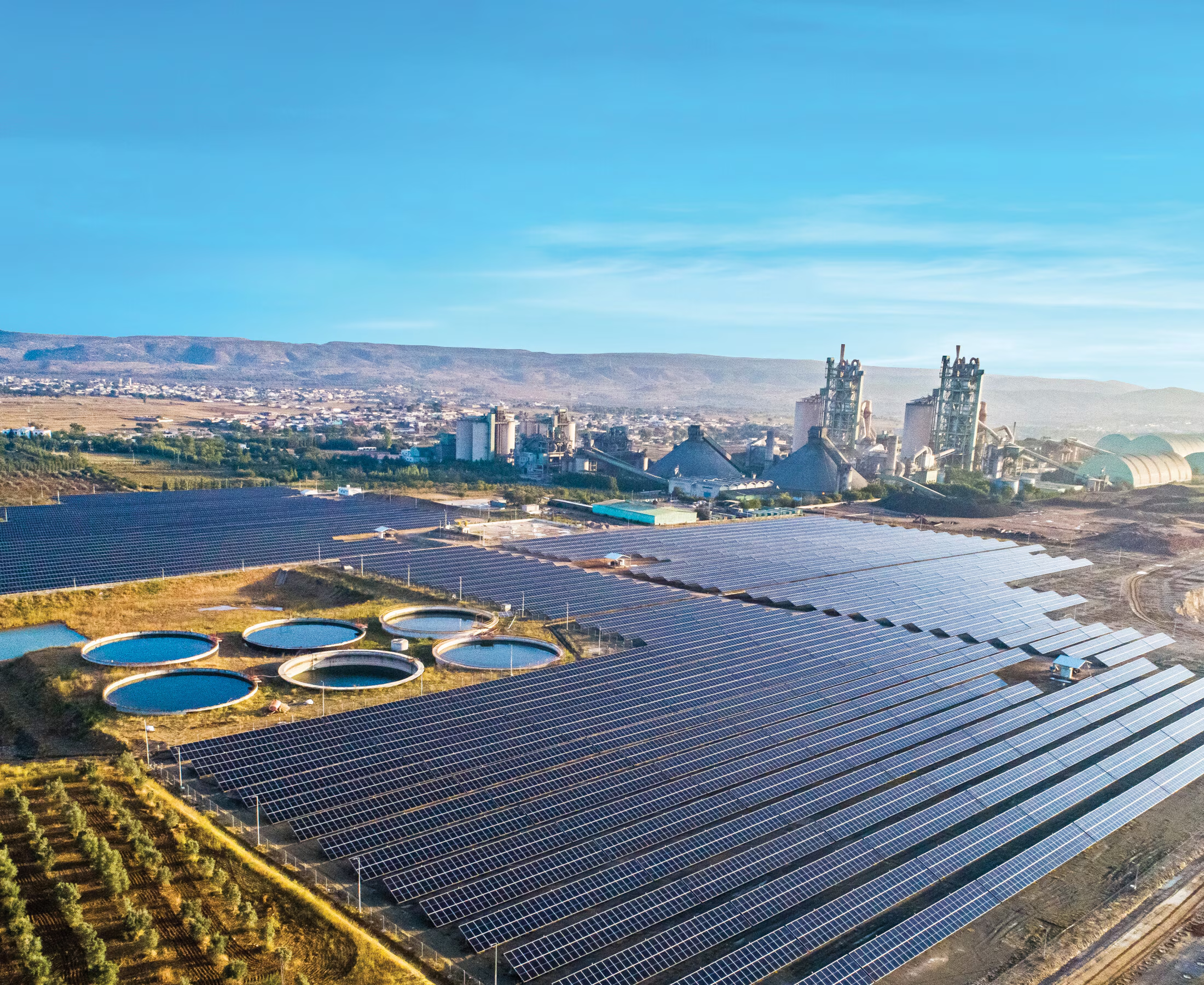
This wasn’t utility- or government-planned. It was consumer- and business-led: grid tariffs up 155% over three years, met by a global glut of Chinese panels crashing prices. Pakistanis facing high costs and poor reliability simply built their own solution rather than wait on the system. Solar now accounts for more than 25% of total electricity production, with distributed rooftop capacity outpacing the entire utility-scale sector.
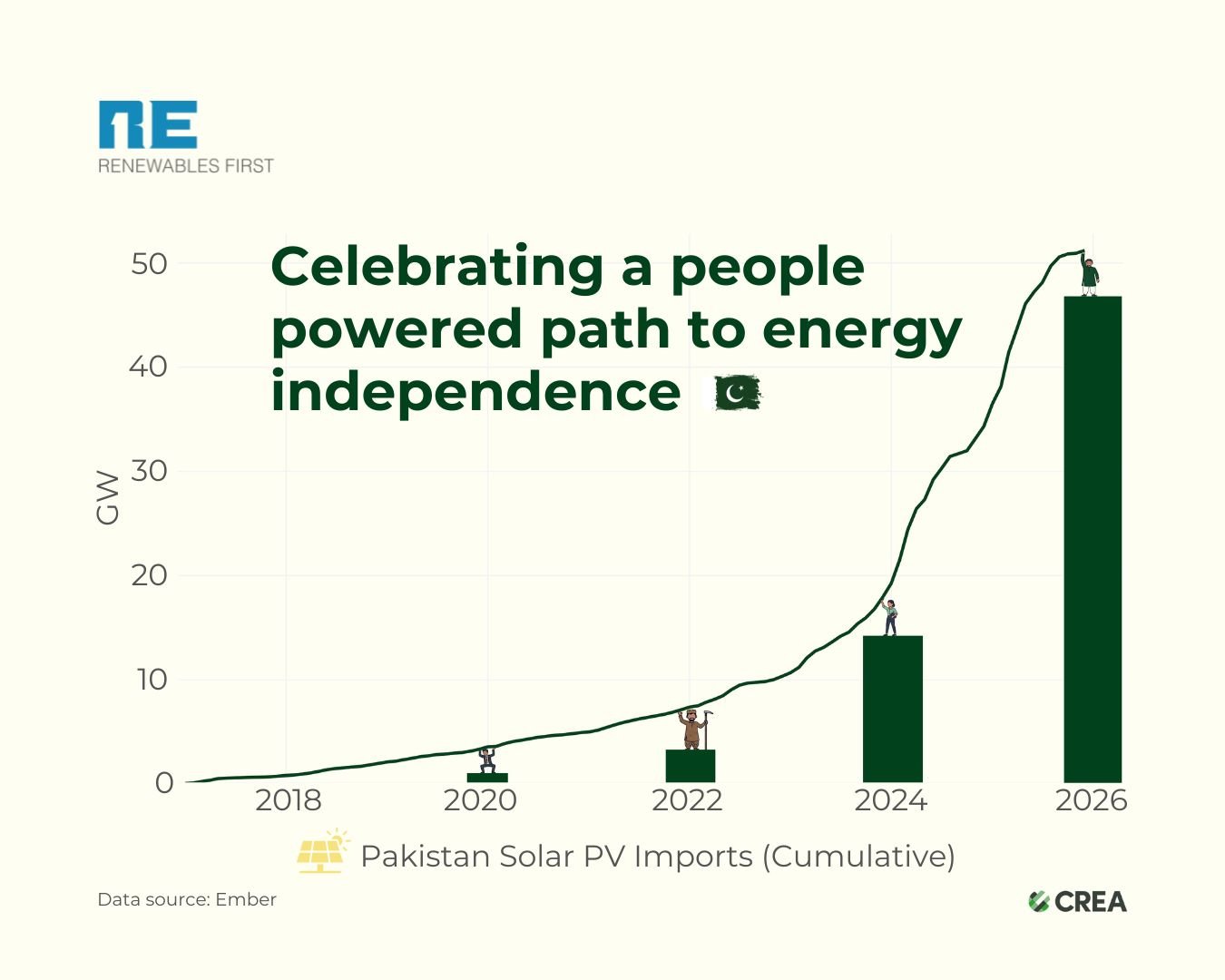
The surge created its own problems — a module glut so severe that panels are being sold at a loss domestically, prompting government proposals for an 18% import tax alongside incentives for local manufacturing. That shift is likely part of why import volumes have cooled sharply in the most recent data.
The next challenge is no longer installing more panels. It’s integrating millions of distributed systems into a functioning national grid — battery storage, demand management, smart tariffs, and new utility business models built around coordination rather than central generation.
Contract sanctity, tested
Pakistan’s power sector has been under real fiscal strain, and the government has been renegotiating Power Purchase Agreements (PPA) with independent producers to bring costs down. But in February 2025, eight development finance institutions of the World Bank’s IFC, the Asian Development Bank, the Islamic Development Bank and five others, formally objected – warning that the military-led renegotiation of wind and solar PPAs was being conducted “in a non-consultative manner” that would undermine investor confidence and discourage future private investment.
It’s a genuine tension, not a simple villain story: fixing an unsustainable fiscal position on one side, preserving the contract sanctity investors need on the other. Both are legitimate. Neither cancels the other out.
The debt overhang
China remains Pakistan’s largest bilateral creditor, owed roughly US$23.5 billion as of June 2025. Dependence on IMF support and external rollovers makes long-term investment harder to price — particularly for capital-intensive green infrastructure. The open question is whether the IMF, World Bank, Paris Club and the BRICS-backed New Development Bank can build credible financing pathways together, rather than each simply recycling the same debt in a different currency.
This is the paradox in full: Pakistan needs international capital to modernise its energy system, but international capital needs confidence in the system before it will commit. Pakistan is investable — but only with layered structural protection (offshore holding and arbitration, IP licensing over outright transfer, political risk insurance) and a local partner vetted hard. Treat it as the frontier market it is, not a standard emerging-market allocation.
THE LONG VIEW
Pakistan may end up a case study for the Global South, not because its transition was neatly planned, but because consumers moved faster than governments and utilities ever did. When electricity becomes too expensive or too unreliable, people don’t wait for the energy transition. They build their own.
The next chapter is whether Pakistan can turn that extraordinary bottom-up solar momentum into storage, flexibility, energy security and a genuinely bankable clean-energy economy.
That’s where the real investment opportunity and the real risk, now sits.
SOLAR. STORAGE. FLEXIBILITY.
“Would you invest in Pakistan’s energy transition today? What would it take?”
Check out and sign-up for any of our 6 Media Communications training programs: FNGN CLIMAX©MEDIA COMMS ACADEMY
Future Now Green News is an independent forward-thinking media platform dedicated to spotlighting the people, projects, and innovations driving the green & blue economy across Australia, Asia and Pacific region. Our mission is to inform, inspire, and connect change makers through thought leadership and solutions-focused storytelling in sustainability, clean energy, regenerative tourism, climate action, and future-ready industries.