
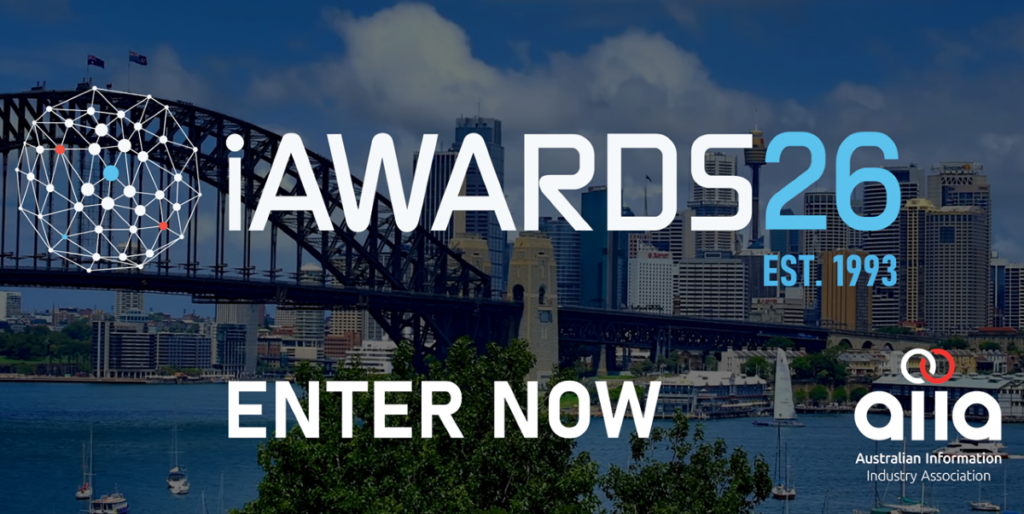

AT ICC SYDNEY last evening, the Australian Information Industry Association (AIIA) presented the 2026 iAwards season — Australia’s longest-running and most broadly scoped technology innovation program, as state and territory winners from across the country compete for national titles at the National iAwards Ceremony & Gala Dinner.
It caps a two-day judging round, held on Wednesday and Thursday this week. Chief Judge, Collins Rex, in her 6th year as chief judge, and a panel of roughly 40 industry judges, assess finalists pitching in person, before the national title-holders are announced. Rex, founder of Rex Ideas and a veteran of the iAwards judging process for 25 years, used the lead-up to the ceremony to make the case that the health of Australia’s tech sector is being undersold.
For Rex, what matters more than the topline numbers is what the innovation is actually for. She said, pointing to work solving problems in safety, productivity, resource use and healthcare rather than technology pursued for its own sake. She framed the iAwards as rare – recognising researchers and students, entrepreneurs, SMEs and established businesses alike, much of it built by people working well outside the spotlight.

Much of the best innovation is being built around practical questions. Windows into the breadth of Australian innovation that doesn’t always make the headlines.”
Rex selected Automated Drill Rig GPS Drift Detection Tool, developed collaboratively between the Curtin Institute for Data Science and BHP Western Australia Iron Ore.
A Curtin University/BHP team has developed a geospatial application that detects GPS calibration drift in mining drill rigs—an issue that can affect drilling accuracy, fragmentation, productivity, maintenance and costs. By comparing geolocated aerial imagery with drill data, the system identifies problems at individual rig level.
The technology cuts QA/QC checks from up to two hours to under five minutes, while increasing the proportion of drill holes analysed from about 2% to 80%. Across a 55-rig WA iron ore fleet, BHP estimates a 5% reduction in unplanned maintenance could save up to $962,000 annually.
Its strength is not flashy new technology, but practical innovation: sophisticated data science and geospatial analytics using existing mine data, integrated into current workflows and delivered as a self-contained Windows application suitable for tightly controlled mine-site systems.
A bigger, broader story than the headlines suggest
In comments shared publicly ahead of judging, Rex argued that Australia’s habit of measuring itself against Silicon Valley, Singapore or Europe obscures a stronger underlying picture. Australia’s tech sector is now estimated to contribute around $248.5 billion to the economy — 8.9% of GDP — with business R&D spending reaching $24.4 billion in 2023–24, up 18% in two years. Information and computing sciences account for 42% of that business R&D spend, while higher education institutions added a further $16.4 billion in R&D in 2024.
Adoption is moving quickly too: ABS figures cited by Rex show 46% of Australian businesses are now “innovation-active,” and the proportion of businesses using AI jumped from just 1% in 2022–23 to 12% in 2024–25 — rising to one in five among innovation-active businesses specifically.
She was careful not to overstate the picture. Commercialisation remains a genuine weak point, Rex said, and Australia is still working out how to turn strong research and clever technology into globally competitive businesses at scale — the difficult, unglamorous journey from promising idea to sustainable enterprise. But he argued the country needs to stop underselling what it already has.
The road to Sydney
The National iAwards Ceremony is the culmination of a two-round process. State and territory winners — determined earlier this year at ceremonies run by AIIA and its state-based partners, including WA’s INCITE Awards and Tasmania’s TasICT Awards — travel to Sydney to pitch again in person, this time against the best of every other state, with national winners and merit recipients announced at tonight’s gala.
Winners can then go on to represent Australia at the Asia-Pacific ICT Alliance (APICTA) Awards in Jakarta Indonesia in December 2026.
Ahead of tonight’s results, a number of state-level innovators have already had their moment. In Perth, the 35th INCITE Awards, WA’s 35-year-old pathway into the national iAwards, named Curtin University’s Professor Iain Murray AM as 2026 Achiever of the Year, recognising more than three decades of work widening access to technology careers for blind Australians; graduates of the centre he founded in 2002 now land jobs at a 75–90% rate, against a national blind employment rate of around 62%.
Professor Girish Dwivedi was named WA’s Pearcey Entrepreneur of the Year for turning Australian health research into globally significant medtech ventures. WAITTA chief executive Cameron Zivkovic said of this year’s field that the nominees were a reminder technology can have a genuinely positive impact, singling out Professor Murray’s award as the standout moment of the night.
In South Australia and the Northern Territory, Adelaide-based Blue Crystal Solutions took out the newly introduced Artificial Intelligence Technology category with BlueAI, a private, on-premises AI voice agent built for sectors such as government, healthcare and finance where data sovereignty is non-negotiable. The company called the win “a powerful validation” of its work in private AI and noted the significance of taking out a brand-new category introduced this year specifically to recognise Australian-made AI and machine learning research and development.
In New South Wales, Schedtris — an agentic decision-support tool for last-minute scheduling in aged and home care — was named among the state’s winners, reflecting the strong showing of practical, care-sector technology this year.
Last night’s gala dinner, opened with a keynote from NSW Parliamentary Secretary for Customer Service and Digital Government Charisma Kaliyanda, will determine which of these and other state winners go on to be named Australia’s best in each category — and which will progress to represent the country at APICTA.
Check out and signup for any of our 6 Media Communications training modules: FNGN CLIMAX©MEDIA COMMS ACADEMY
Future Now Green News is an independent forward-thinking digital media platform dedicated to spotlighting the people, projects, and innovations driving the green & blue economy across Australia, Asia and Pacific region. We inform, inspire, and connect change-makers through thought leadership and solutions-focused storytelling in sustainability, clean energy, regenerative tourism, climate action, and future-ready industries.