


What if the next great hotel isn’t a building placed in nature, but a building designed according to nature? It may look, feel and function like a living organism.
Luxury hospitality has a sameness problem. For that matter, to meaning of ‘Luxury’ is being remodelled.
That may sound like an extraordinary claim at a time when billions of dollars are being invested in branded residences, private clubs, five-star resorts and ultra-luxury hotels. Yet it is precisely the problem identified by hospitality strategist Antonia J. A. Hock after recently evaluating billions of dollars of luxury development aimed at ultra-high-net-worth buyers.
Her verdict was blunt: she was bored.
Across a major international branded-residences competition involving names such as Armani, Karl Lagerfeld, Six Senses and St. Regis, Hock found familiar formulas repeated across the market — the urban tower, the residence embedded into nature, the ecological retreat and the same predictable menu of restaurants, spas, fitness centres, libraries, gardens and cultural programming.
“Sustainability features repeated,” she observed. “Everyone has them now.”
Her criticism goes deeper than aesthetics. The problem is that luxury developers increasingly treat location, wellness, sustainability and placemaking as the proposition itself, rather than ingredients in something genuinely different. (LinkedIn)
That raises a provocative question for the next generation of hospitality:
What if luxury stopped trying to imitate nature — and started learning from it?
This is where biomimicry could become much more than an architectural trend.
From sustainable luxury to living luxury
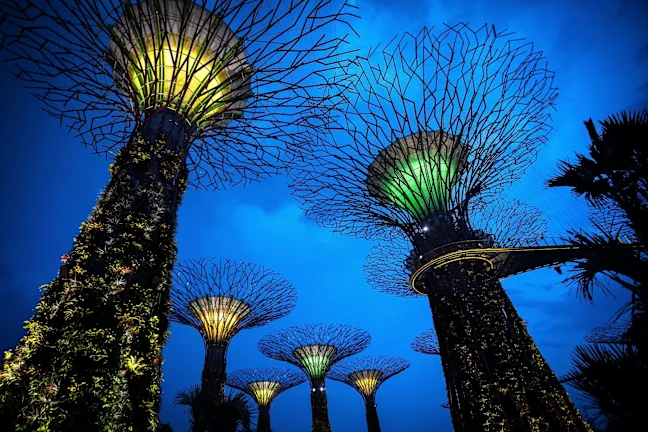
Biomimicry takes its inspiration from biological systems that have evolved over millions of years. Rather than simply copying the appearance of a leaf, shell, termite mound or bird’s nest, biomimetic design asks a more fundamental question:
How does nature solve this problem?
How does a termite mound regulate temperature? How does a tree move water? How does a mangrove survive saltwater and storms? How does a manta ray move efficiently through water?
How does an ecosystem recycle almost everything it produces?
For architecture, these questions can translate into passive cooling, natural ventilation, energy efficiency, water recycling, low-carbon materials, biodiversity and structures that work with, rather than against — their environment.
French architect Vincent Callebaut has spent years developing this philosophy. He describes his approach as “ARCHIBIOTIC” — bringing together architecture, biomimicry and information technology. His objective is not simply to make buildings greener, but to rethink how architecture can interact with living systems.
His latest hospitality project provides an extraordinary demonstration.
Meet MANTA Hotel, Singapore

At Marina Bay, Vincent Callebaut Architectures is developing MANTA HOTEL, a 65-room boutique hotel scheduled for completion in 2030.
The concept is inspired by the fluid movement of a manta ray / stingray .
But this isn’t biomimicry as decoration. The building’s hyperbolic-paraboloid balconies create a fluid silhouette while helping optimise airflow and natural ventilation. The project is designed around a low-carbon construction system using cross-laminated timber, with suspended gardens, micro-habitats and closed-loop water management.
Callebaut describes MANTA as a project that asks whether hospitality can become
 “a true laboratory for regenerative architecture”
The ambition is significant: not merely reducing the building’s environmental damage, but creating a living system capable of generating energy, restoring biodiversity and enhancing human wellbeing. (VINCENT CALLEBAUT ARCHITECTURES)

The project’s material palette is equally unconventional.
Its prefabricated façade combines recycled copper with bio-concrete incorporating coconut shells, while the CLT structure provides a lighter, lower-carbon alternative to conventional concrete and steel. The architects say these approaches could cut the project’s carbon footprint by up to 50% compared with conventional concrete construction.
The result is fascinating because the sustainability isn’t an amenity.
It is the architecture. And that distinction matters.
The HNW customer is changing
The timing may be right.
Luxury travellers are increasingly looking beyond conventional conspicuous consumption. Accor’s 2026 luxury research describes an “inward turn” among affluent travellers towards discretion, reflection, intimacy and meaning.
For high-net-worth travellers, luxury is increasingly about the absence of crowds, noise and friction — and the availability of private, highly curated experiences. (Accor Group)
Other 2026 luxury-travel research points in the same direction: meaningful experiences, personal transformation, wellbeing and connection are increasingly replacing material excess as markers of luxury. Expedia’s research describes the sector as moving towards experiences that are more meaningful, mindful and culturally rich. (Partners Expedia Group)
And wellness is becoming more sophisticated.
Forbes reported in May that affluent travellers are increasingly seeking measurable outcomes from wellness travel — including improved sleep, reduced stress and mental clarity — rather than simply booking a traditional spa treatment. (Forbes)
This changes the luxury proposition. The question is no longer:
“How luxurious is this hotel?”
It becomes:
“How does this place make me feel — and how does it change the way I live?”
Nature becomes the new scarce luxury
This could be particularly powerful across the Asia-Pacific.
Australia, Japan, Indonesia, Vietnam, New Zealand and the Pacific possess something that wealthy urban populations increasingly struggle to access: nature. Not nature printed on wallpaper. Not a “farm-to-table” restaurant. Not a decorative vertical garden.
Actual nature.
The opportunity is to create hospitality where the ecosystem becomes part of the architecture, the experience and the value proposition.
Imagine an Australian luxury retreat whose thermal regulation is inspired by termite mounds.
A Tasmanian hotel whose architecture responds to the structure of native forests. A Great Barrier Reef property designed around coral ecosystems and marine regeneration. A Japanese forest retreat where architecture follows the logic of the surrounding trees rather than imposing a conventional resort footprint. An Indonesian resort inspired by mangrove systems, where water management, biodiversity and architecture become one. A Pacific island retreat that uses biomimetic engineering to withstand extreme weather while restoring coastal ecosystems.
Suddenly the destination is no longer simply where the hotel is. The hotel becomes the destination. That is a critical distinction.
The opportunity is not “eco-luxury”
There is a danger, however, of simply creating another luxury category eg: “biomimetic luxury”, and filling it with expensive villas, spas and infinity pools.
That would miss the point. Hock’s criticism is precisely that the luxury industry has become very good at taking apparently distinctive ideas and turning them into another standardised checklist. (LinkedIn)
Biomimicry will only be genuinely disruptive if it changes the underlying product. The hotel should function differently. It should breathe differently. Use water differently. Generate energy differently. Interact with biodiversity differently. Use materials differently. And, ultimately, make the guest experience different.
The luxury lies in the rarity of the entire system.
From hotel to ecosystem
This points towards a potentially much larger opportunity. The future luxury hospitality brand may not sell rooms at all.
It could sell access to living environments. Hotels could become regenerative ecosystems. Private residences could become self-sufficient biological habitats. Wellness retreats could be designed around circadian light, clean air, natural acoustics, biodiversity and thermal comfort. Private clubs could offer access to extraordinary natural environments rather than another cigar lounge and cocktail bar.
And HNW buyers could increasingly value a property because it gives them something money cannot easily manufacture: connection to a living place.
That may become the ultimate form of quiet luxury. Not more marble. Not a larger suite. Not another famous designer label. Not another identical “eco-resort” in a spectacular location.
But architecture that could only exist there.
Asia-Pacific could lead the next luxury revolution
This is where Australia and its neighbours have an extraordinary strategic advantage.
The Asia-Pacific region contains some of the planet’s most extraordinary biological systems — rainforests, reefs, mangroves, alpine ecosystems, deserts, ancient forests and island environments.
It also contains some of the world’s wealthiest and most densely populated cities.
The tension between urban intensity and access to nature creates an enormous opportunity for hospitality developers willing to think differently.
Singapore’s MANTA Hotel is therefore interesting not because it is a futuristic-looking building.
It is interesting because it suggests a different question for the luxury industry:
What if the next great hotel isn’t a building placed in nature, but a building designed according to nature?
That is a much bigger idea. And perhaps the real future of HNW luxury is not owning more.
It is experiencing something increasingly rare: a place that cannot be replicated.
Biomimicry could provide the architectural language. Regenerative design could provide the operating system. Nature could provide the asset. And human wellbeing could become the ultimate measure of luxury. The new luxury hotel may not look like a luxury hotel at all.
(VINCENT CALLEBAUT ARCHITECTURES)
Check out and signup for any of our 6 Media Communications training modules: FNGN CLIMAX©MEDIA COMMS ACADEMY
Future Now Green News is an independent forward-thinking digital media platform dedicated to spotlighting the people, projects, and innovations driving the green & blue economy across Australia, Asia and Pacific region. We inform, inspire, and connect change-makers through thought leadership and solutions-focused storytelling in sustainability, clean energy, regenerative tourism, climate action, and future-ready industries.