
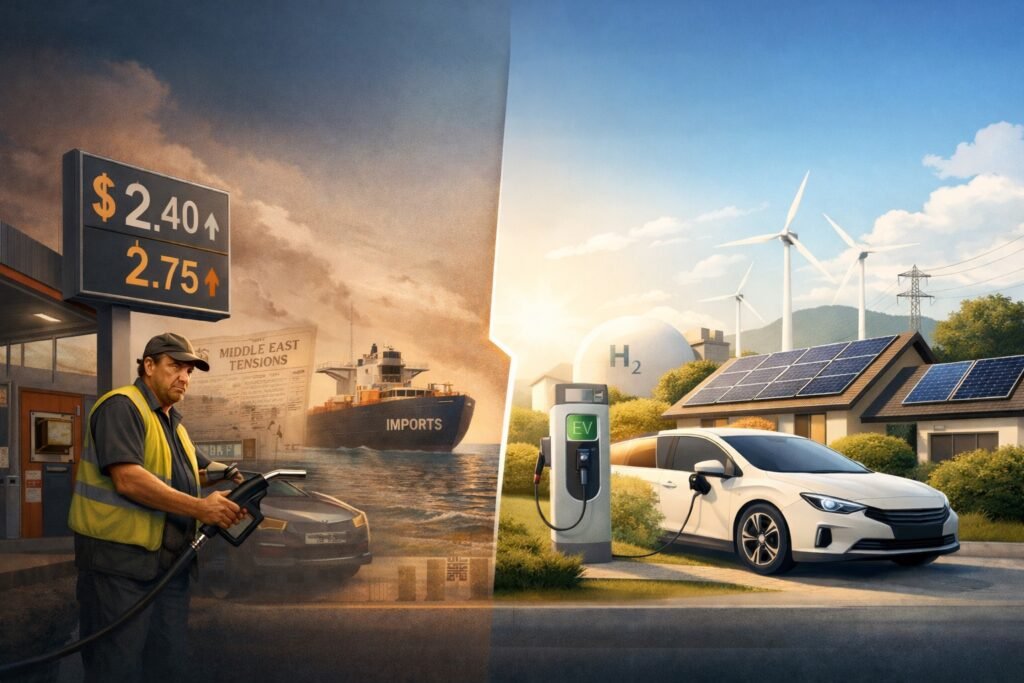

Rising prices, tightening supply and emergency measures have returned to Australia’s fuel system. The trigger may be geopolitical, but the vulnerability is homegrown… and increasingly difficult to ignore.
A Familiar Unease Returns to the Bowser
THERE is a recognisable tension returning to petrol stations across Australia.
Prices are rising quickly, and regional supply is tightening. Government has stepped in to release reserves and relax fuel standards to keep the system moving. The language of rationing — once unthinkable — has edged back into the conversation.
For many, it feels like a sudden disruption triggered by events in the Middle East. It is anything but sudden, and what we are seeing is the re-emergence of a structural weakness that has been building quietly for years.
Australia remains heavily reliant on imported refined fuels to run its transport system and much of its economy. When global supply chains are disrupted, that dependence becomes visible almost immediately.
An Energy Superpower With a Supply Problem
Australia’s self-image as an energy superpower sits uneasily alongside this reality.
The country exports vast volumes of coal and liquefied natural gas. Yet the fuels that keep trucks moving, planes flying and farms operating arrive largely by ship. Domestic refining capacity has declined steadily, leaving just two major refineries. Strategic reserves exist but remain below international benchmarks.
In practical terms, Australia sits at the end of a long and increasingly fragile supply chain.
When pressure builds upstream, the consequences are felt quickly downstream — in freight costs, agricultural inputs and, ultimately, household budgets.
Short-term Fixes, Long-term Exposure
The government’s decision to draw on fuel reserves and temporarily allow higher-sulphur petrol is a pragmatic response (and controversial one) to an immediate challenge. It may help stabilise supply in the near term, but it also highlights the limits of a system built around continuity rather than resilience.
For decades, fuel security has largely been framed as a question of stockpiles. How much can be held in reserve to buffer against disruption? That approach assumes the underlying system remains stable.
And the current moment suggests otherwise.
This week’s warnings from Treasurer Jim Chalmers in AFR underline the point. High fuel prices, he said, could persist for as long as three years, with flow-on effects for inflation already being felt across the economy. It is a reminder that what appears as a short-term shock at the pump can quickly translate into a longer and more entrenched economic pressure.
Beyond the political noise, the energy system itself is changing. No matter what your opinion is of electric vehicles, they are gradually reducing petrol demand in urban areas. Rooftop solar has altered the way households think about supply. Battery storage is moving from the margins to the centre of grid stability.
Across the region, new infrastructure is taking shape.
As Ani Allbutt outlined in FNGN last week, Asia’s emerging green shipping corridors signal how even the most complex sectors are preparing for a lower-emissions, more resilient future. The shift is not theoretical. It is underway.
Australia is part of this transition, but it is not yet setting the pace.

A Debate Increasingly Out of Step
Domestic energy policy continues to be shaped by arguments that are beginning to look dated.
Former deputy prime minister Barnaby Joyce has been among the most vocal critics of the clean energy transition, warning of risks to reliability, cost and regional economies.
Those concerns resonate in parts of regional Australia where the pace and distribution of change remain uneven. But much of the critique rests on broad assertion rather than clear evidence, while the more immediate and measurable risk — Australia’s continued dependence on imported fuels — is often left under-examined.
At a time when households and businesses are already absorbing the cost of global disruption, public commentary carries a responsibility to reflect that reality. The question is not whether the transition presents challenges. It is whether maintaining the status quo presents greater ones.
The Real Constraint is the System Itself
While parts of the political debate remain fixed on whether renewables can meet demand, the economics have continued to move. Large-scale renewables, backed by expanding battery storage, are increasingly competitive on cost and speed. The constraint is no longer generation.
It is the system.
Australia’s energy demand is heavily concentrated along the coast, while much of its renewable generation potential sits further inland or offshore. That creates a structural challenge of design, not of resource. High penetration of rooftop solar is already placing pressure on parts of the distribution network, requiring upgrades to manage voltage, frequency and reverse flows. Transmission constraints, storage requirements and the need for more sophisticated grid orchestration are becoming central issues.
In that sense, the question is no longer whether renewable energy can supply the system, but whether the system itself is being redesigned quickly enough to support it. That redesign may also include a greater role for technologies such as high-voltage DC transmission and more localised energy systems, reflecting how generation and consumption are evolving.
Beyond Electricity: The Harder Fuel Question
Electrification offers a clear pathway for passenger vehicles and urban transport and over time this will reshape oil demand in meaningful ways.
The more difficult question lies in hard to abate sectors that cannot easily electrify. Long-haul freight, aviation, mining and parts of heavy industry still rely on dense fuels. For these applications, hydrogen and hydrogen-derived fuels are returning to the discussion with greater seriousness.
Not as a universal solution, and not without economic and technical challenges, but as part of a broader system response.
Unlike oil, these fuels can be produced domestically, particularly in a country with Australia’s renewable resources. In a more fragmented global energy landscape, that capability carries strategic weight.
Energy Sovereignty Meets Energy Equity
Senator David Pocock has framed the issue in terms that connect both economics and fairness.
Reducing exposure to global fuel shocks, he argues, requires accelerating the transition to domestically produced energy, while ensuring the benefits are shared more evenly.
“Australian sun and Australian wind are never going to get stuck in the Strait of Hormuz,” he said this week.
The observation is simple, but it carries weight.
Households with rooftop solar, batteries and electric vehicles are already insulated from many of the price swings now affecting the broader market. Those without access to these technologies remain exposed.
Bridging that divide is emerging as one of the central challenges of the transition.
Australia does not lack resources, technology or investment interest. It lacks speed. Transmission projects are delayed, planning processes are slow, workforce constraints are evident, and infrastructure build-out remains uneven.
Energy sovereignty, in practical terms, depends on what can be built, where it can be built and how quickly it can be connected.
A Warning That Keeps Returning
The current disruption is unlikely to be the last.
Global energy markets are entering a period of heightened volatility, shaped by geopolitical tension, shifting trade dynamics and uneven transition pathways and Australia’s exposure to those forces is obvious.
The question is whether this moment is treated as another temporary disruption, or as a prompt to accelerate a shift already underway.
Australia cannot continue to describe itself as an energy superpower while remaining vulnerable at the petrol pump.
In the decade ahead, energy security will not be defined by how much a country exports, but by how little it needs to import.
Future Now Green News is a forward-thinking media platform dedicated to spotlighting the people, projects, and innovations driving the green & blue economy across Australia, Asia and Pacific region. Our mission is to inform, inspire, and connect changemakers through thought leadership and solutions-focused storytelling in sustainability, clean energy, regenerative tourism, climate action, and future-ready industries.