

Asia’s Next Manufacturing Powerhouse
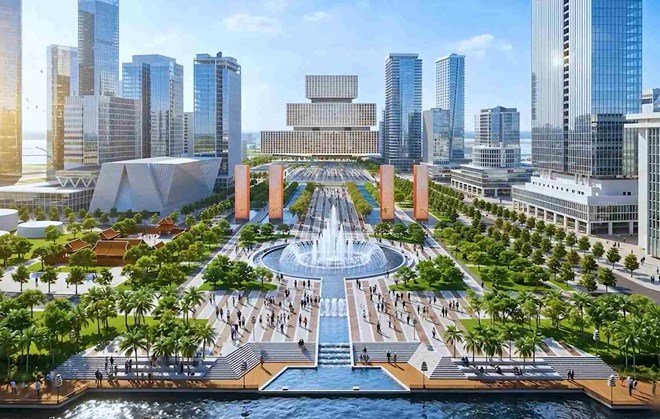
VIETNAM’S International Financial Centre, with an investment of US1.1B from the Sun Group, is more than a banking initiative – it’s the capital upgrade needed to support an already accelerating shift in manufacturing scale, supply chains, and export-led growth.
Something significant is happening in Southeast Asia, and it is moving faster than most Western business media have registered.
Vietnam, long celebrated as a low-cost alternative to China, is executing a far more sophisticated transition. It is not simply absorbing manufacturing overflow. It is building the financial architecture to fund, sustain, and scale a new industrial era. The launch of its International Financial Centre marks the moment Vietnam stopped being a supporting act and started auditioning for a leading role.
In late December 2025, Vietnam officially inaugurated the Vietnam International Financial Centre, following the passage of several legal instruments that mark a significant milestone in the country’s integration and development process after 40 years of Doi Moi reform. The VIFC follows a “one centre, two destinations” model — Ho Chi Minh City designated as the large-scale financial gateway focusing on capital markets, banking, fund management and global capital connectivity, while Da Nang serves as an innovation-driven hub specialising in fintech, wealth management and green finance.
The timing is not accidental
Vietnam has emerged as a strategic linchpin for tech manufacturing, with foreign direct investment in manufacturing surging to $24.1 billion in the first seven months of 2025 alone — representing 61% of total FDI — driven by policy incentives and supply chain diversification. FDI in manufacturing and processing reached $25.58 billion across 2024, making Vietnam one of Asia’s top reshoring destinations.
The engine behind these numbers is the “China Plus One” strategy — the now-standard corporate playbook of diversifying production away from China without abandoning it entirely. Vietnam’s cost advantage is compelling: labour costs sit at approximately $3 per hour compared to China’s $6.50, and its agile supply chains have attracted major global manufacturers seeking resilience against geopolitical tensions. Industry giants including LEGO, Foxconn, Goertek and Pegatron have already chosen Vietnam as their new manufacturing hub, drawn by membership in 18 free trade agreements — including the EVFTA, CPTPP and RCEP — opening export gateways to major markets with preferential tariffs.
Vietnam achieved a notable 8.2% GDP growth in 2025, and international institutions have projected a continued positive outlook for 2026 — with AMRO forecasting growth of 7.6% and the Vietnamese government itself targeting a 10% increase. Vietnam’s import-export turnover is expected to reach $920 billion for the first time in 2025, placing the country among the world’s top 15 economies by trade value.
What the IFC adds to this picture is crucial: capital market depth
Manufacturing at scale demands patient, long-horizon financing — the kind that comes from institutional investors, international banks, and fund managers who need a transparent, rules-based financial environment to deploy capital confidently. Until now, Vietnam had the factories but not the financial ecosystem to match. Experience from global financial centres such as Singapore and Hong Kong shows that success ultimately depends on the ability to attract, circulate and retain high-quality international capital — and that a financial centre cannot exist without multinational financial institutions, venture capital funds, and an investor community with absolute confidence in transparency.
IFC members can freely conduct investments with offshore investors who are not subject to foreign exchange controls on fund remittances, can form holding companies for offshore capital raising without complex structures, and may benefit from corporate income tax rates as low as 10% for up to 30 years for priority sectors — with significant tax holidays.
Prime Minister Pham Minh Chinh pledged to fast-track the resolution of investor difficulties through a “special process” — a one-stop, on-site mechanism with sufficient authority, escalated directly to the Prime Minister if issues fall outside delegated powers.
It would be naive to ignore the headwinds
Vietnam’s reliance on Chinese raw materials remains significant, with 40% of imported components for electronics still sourced from China — a dependency that exposes supply chains to cross-border disruption. Infrastructure bottlenecks, a shortage of skilled workers for advanced manufacturing, and a legal framework still being refined present genuine risks for investors making long-term commitments. FDI flows into Vietnam slowed somewhat in 2025, reflecting investor caution amid US tariff decisions and broader cooling of global FDI.
Yet the trajectory is unmistakable. Vietnam’s IFC initiative is closely tied to its broader investment promotion strategy, particularly Resolution 50, which emphasises foreign direct investment and technology transfer — with the rollout targeting regional financial centre status by 2035 and a global one by 2045.
For Australian businesses, this is not a story to observe from a distance
Vietnam is Australia’s sixth-largest trading partner, the two countries share a Comprehensive Strategic Partnership, and the manufacturing corridors now being built in Ho Chi Minh City and its surrounding provinces represent the kind of early-stage opportunity that rewards those who arrive before the crowd. The IFC is the signal that Vietnam is no longer just an option in the supply chain conversation. It intends to own part of that conversation — and it is building the financial plumbing to make that ambition permanent.
Check out and signup for any of our 6 training programs: FNGN CLIMAX©MEDIA COMMS ACADEMY
Future Now Green News is a forward-thinking media platform dedicated to spotlighting the people, projects, and innovations driving the green & blue economy across Australia, Asia and Pacific region. Our mission is to inform, inspire, and connect changemakers through thought leadership and solutions-focused storytelling in sustainability, clean energy, regenerative tourism, climate action, and future-ready industries.