

EV owners have spoken, and the market is moving faster. In fact, it’s already showing up in the cost of staying behind.
As fuel prices push higher and volatility returns to global energy markets, the economics of internal combustion are being re-exposed in real time. For households and businesses alike, the cost of mobility is once again front of mind.
But this moment is not just about oil, and it arrives as electric vehicles move through a more profound transition from incremental improvement to structural change.
In Australia, researchers from CSIRO, RMIT and the University of Melbourne have demonstrated a working quantum battery prototype, a technology that, if scaled, could fundamentally alter charging times. At the same time, China’s BYD is rolling out ultra-fast charging systems capable of delivering significant range in minutes, not hours.
And on the ground, a new national ownership survey suggests the experience of EV drivers is already outpacing the debate.

The data is clearer than the narrative
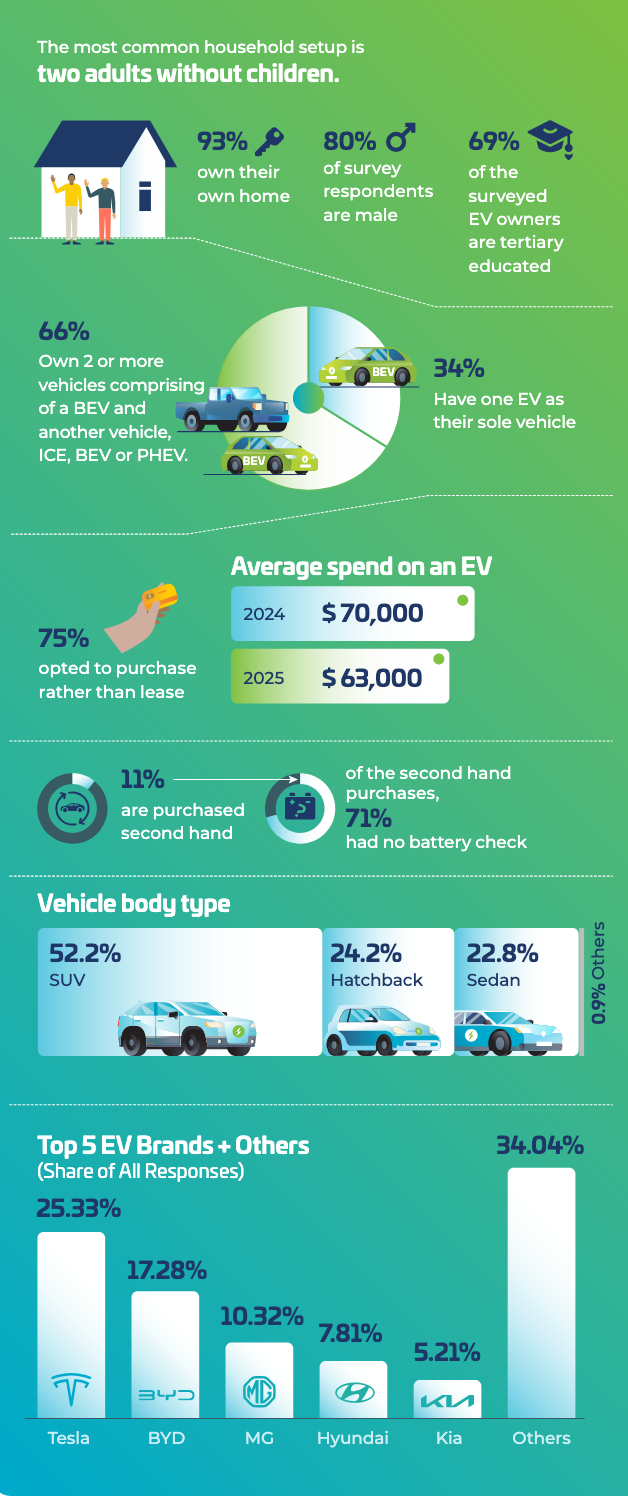
The 2025 EV Ownership Survey, conducted by the Electric Vehicle Council in partnership with the University of Sydney, surveyed more than 1800 Australian EV owners.
Its findings are straightforward.
Around 70% of respondents reported reducing fuel costs by more than 60%, while nearly three-quarters spend less than $300 per year on maintenance.
This is not marginal efficiency but it reflects a different mechanical system — one with fewer moving parts, lower servicing requirements and a fundamentally different cost profile. Over time, those differences accumulate.
Charging happens where people live
Public charging infrastructure continues to dominate discussion, but the survey points elsewhere.
More than 90% of EV owners have access to home charging, and the majority rely on it regularly.
A significant proportion also pair EV ownership with rooftop solar, aligning vehicle charging with household energy generation.
This is where the system begins to shift.
EVs are integrating into a broader energy ecosystem — not just replacing petrol cars — one that increasingly sits at the household level.
The concern that fades after purchase
Range anxiety has long shaped perceptions of EV ownership but the data suggests it is largely a pre-purchase concern.
Once drivers transition, reported concerns around range, charging availability and cost drop sharply. The anticipated friction does not persist in daily use.
This gap between expectation and experience remains one of the most significant barriers to wider adoption.
While technology continues to advance, the next inflection point may be more practical.
The survey indicates that 59% of leased EVs are expected to enter the second-hand market within six years, which is an interesting pipeline, indeed, and makes for polarising discussion around the whole “second-hand EV” debate.
Upfront cost remains the primary constraint for many buyers. A growing used EV market has the potential to expand access significantly, bringing a broader segment of the population into the transition.
Technology is accelerating in parallel
Alongside shifting ownership dynamics, the technology itself is moving quickly.
The quantum battery work emerging from Australia remains early-stage, but it challenges assumptions about charging speed at a fundamental level.
Meanwhile, BYD’s rollout of high-capacity charging infrastructure demonstrates how quickly theoretical capability can translate into deployed systems.
The comparison between refuelling and recharging — long framed as a limitation — is narrowing.
A system beginning to realign
Policy settings continue to play a role, particularly in supporting early adoption through incentives and tax settings.
But the transition is no longer being driven by policy alonem, as a feedback loop is forming: real-world ownership validates the experience; lower operating costs reinforce the decision; infrastructure expands in response; and technology continues to improve.
Each element strengthens the next.
Electric vehicle adoption in Australia is accelerating, but it remains early in the overall fleet transition.
The significance of the latest ownership data is not that it predicts the future but, more importantly, it reflects the present.
EVs are no longer defined solely by potential. They are increasingly defined by experience, and that experience is proving more practical, more economical and more integrated than many expected.
Future Now Green News is a forward-thinking B2B media platform dedicated to spotlighting the people, projects, and innovations driving the green & blue economy across Australia, Asia and Pacific region. Our mission is to inform, inspire, and connect changemakers through thought leadership, investigative journalism, and storytelling in sustainability, clean energy, regenerative tourism, climate action, and future-ready industries.