

Interview with DOUG HARTMANN, HART BIOENERGY managing director – leading bioenergy innovations with biofuels, bio technologies and green chemistry.
AS climate change, war, community displacement, and food and energy insecurity reshape our world, could the Fourth Industrial Revolution (4IR) find its answers in nature itself through biomimicry?
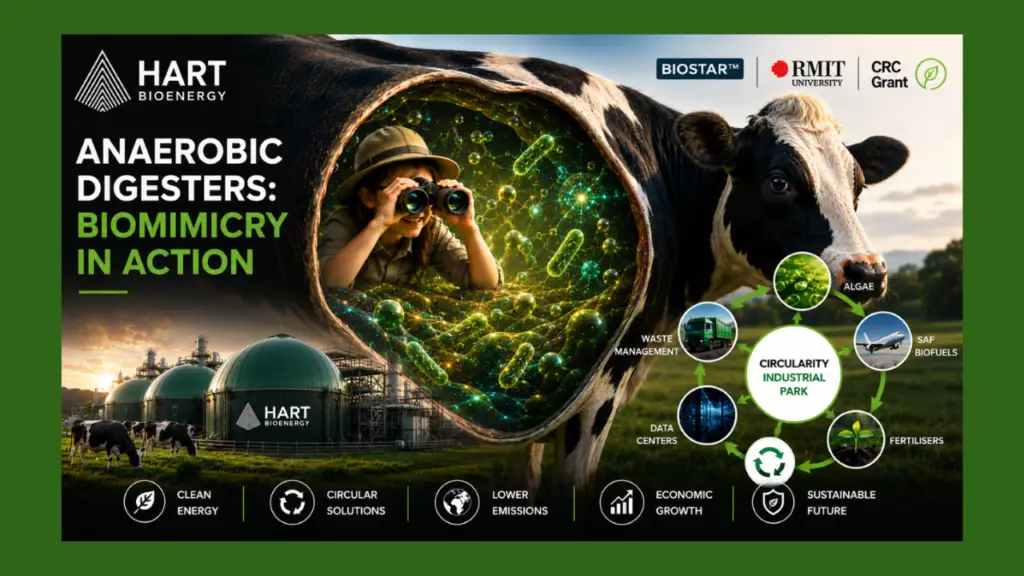
HART BIOENERGY is at the forefront of this 4IR revolution — replicating a cow’s biological digestive process through scalable Anaerobic Digester (AD) Plants – a compelling economic solution while abating methane emissions, turning organic waste into renewable energy, thermal heat and high-value nutrients to create new revenue streams and reducing emissions. Particularly when in times of war and cross-border supply chains disruption; fertilisers for farmers now up to $1mil for a crop.
AD’s are also part of the broader 4IR movement where industrial systems stop behaving like extractive machines and start behaving more like forests, wetlands, reefs or soil systems. Biomimicry-circularity in action – mimicking biology and nature’s designs, processes, and ecosystems to solve human problems.
 “An anaerobic digester harnesses one of nature’s oldest and most effective recycling systems- Organic Biology”
DOUG HARTMANN
FN: The uptake of AD’s waste education coupled with government policy in Australia, has been slow. Necessity is the mother of invention. Climate change is an urgent motivator.
DH: Yes, it is slow in Australia. AD’s need to be included in the education on waste as a valuable circular economy, with financial benefits back into communities. Anaerobic Digesters are already widely used worldwide, with around 50 million household-scale simplistic digester systems operating across Asia and Africa, converting organic waste into biogas for cooking, heating and lighting while recycling nutrients back into food production. In addition, more than 100,000 modern commercial-scale plants operate globally, particularly in Europe, the UK, Scandinavia and the US, reducing methane emissions while generating renewable energy, strengthening farm productivity and improving energy security.
HART Bioenergy’s modular anaerobic digestion systems, built to Australian high standards, can be adapted for developing agricultural economies such as Vietnam and Thailand – but also for Australia communities in remote rural areas and scaled for dense urban developments for local councils offering significant opportunities to create value – 1% cost of total budget, neutralized into revenue dollar value by increasing recycling rate and reducing cost going into landfill. Across Australia, it is becoming increasingly difficult, expensive and politically challenging to approve new landfill sites, particularly near major population centers. Governments are instead prioritising waste reduction, recycling, FOGO (food & garden organics), resource recovery, waste-to-energy and circular economy initiatives. However, the end-user / consumer lacks full education, and push back is common.
Based on successful Scandinavian community models, multiple farms and urban communities, can share a centralised facility, reduce emissions while generating renewable energy, carbon credits and nutrient-rich fertilisers that strengthen farm productivity, energy security and rural economies. Creating a circular economy solution from waste.
FN: Human waste is a global problem. How do Anaerobic Digestors work?
DH: An anaerobic digester harnesses one of nature’s oldest and most effective recycling systems. When organic matter such as leaves, plants or animal waste decomposes in an oxygen-free environment—such as the bottom of a pond—naturally occurring microorganisms break down the material, converting sugars, starches and other organic compounds into biogas, primarily methane and carbon dioxide.
One of Australia’s earliest commercial anaerobic digestion installations began in 1998 at Berrybank Piggery; a 20,000-head pig farm in Windermere, Victoria, introducing covered anaerobic pond technology, generating 40kW from pig waste. Since upgrades, capacity has more than tripled. Recognising digestate as a commercial asset, they developed Grow Better – a branded nursery and soil products range that demonstrates the broader value chain anaerobic digestion can unlock. Clearer policy frameworks around energy certification, carbon credits and biomethane origin – aligned federally and across states – would create genuinely viable, lasting commercial pathways.
For millions of years, this process has occurred naturally across the planet. The bubbles rising from wetlands, ponds and marshes are often methane—a flammable gas and valuable source of energy. Anaerobic digestion simply captures and manages this natural process in a controlled environment, allowing the methane-rich biogas to be collected and used as a renewable alternative to fossil natural gas.
At its core, anaerobic digester is biomimicry in action. It replicates nature’s circular economy, where plants and animals decompose, nutrients are recycled, and new life grows from the remains of the old. The captured biogas provides renewable energy, while the nutrient-rich digestate left behind is returned to the land as fertiliser, supporting future agricultural production.
FN: So where does the Cow model come into it?
COW’S have one of nature’s most efficient waste-conversion systems”.
DOUG HARTMANN
DH: Hart Bioenergy Anaerobic digester mimics the biological processes that occur inside a cow’s rumen. As one of nature’s most efficient waste-conversion systems, it replicates what happens in the gut of every ruminant, which nature has been doing exactly this for 3.5 billion years – acting essentially as a giant, sealed stomach, the process yields two valuable resources: biogas (for renewable energy) and digestate (for natural fertilizer). Within the rumen, microorganisms, enzymes and acids break down plant material, opening cell walls and converting complex carbohydrates, sugars and starches into simpler compounds that the animal can use for energy. An anaerobic digester replicates this natural process in a sealed, oxygen-free environment. Microorganisms break down organic waste through a series of stages, ultimately producing biogas—primarily methane and carbon dioxide—which can be captured and used as renewable energy. The remaining nutrient-rich digestate can then be returned to the soil as a valuable fertiliser, completing a circular ecosystem.
Our feedstock is waste from industry and households from almost any discarded organic waste that naturally decomposes – the key is carbon-rich or nutrient-rich biological material — not plastics, metals, or toxic chemicals. Any animals, meat processing – aquaculture too which is very promising in energy production and nutrients big opportunities- beverage industries, juice manufacturers, dairy affluence and milk, cheese, yogurt production – COFO commercial food organics and FOGO food & garden organics- Councils are very interested as they can offset the cost with revenue generating products. Particularly energy to power the recycling plants and local businesses. Basically, anything ORGANIC that can turn into energy. Not Wood.. it’s a different technology.
FN: Your BioSTAR™ systems achieve digestion in 8 days versus the industry standard of 21. What’s the biological insight behind that?
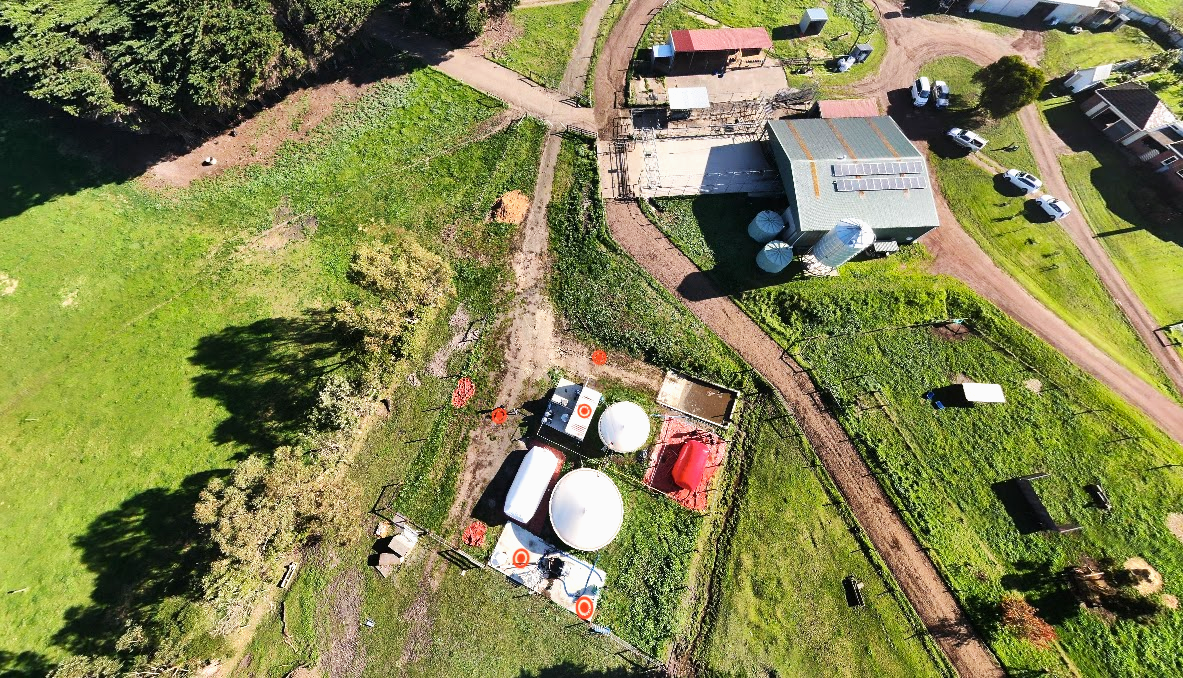
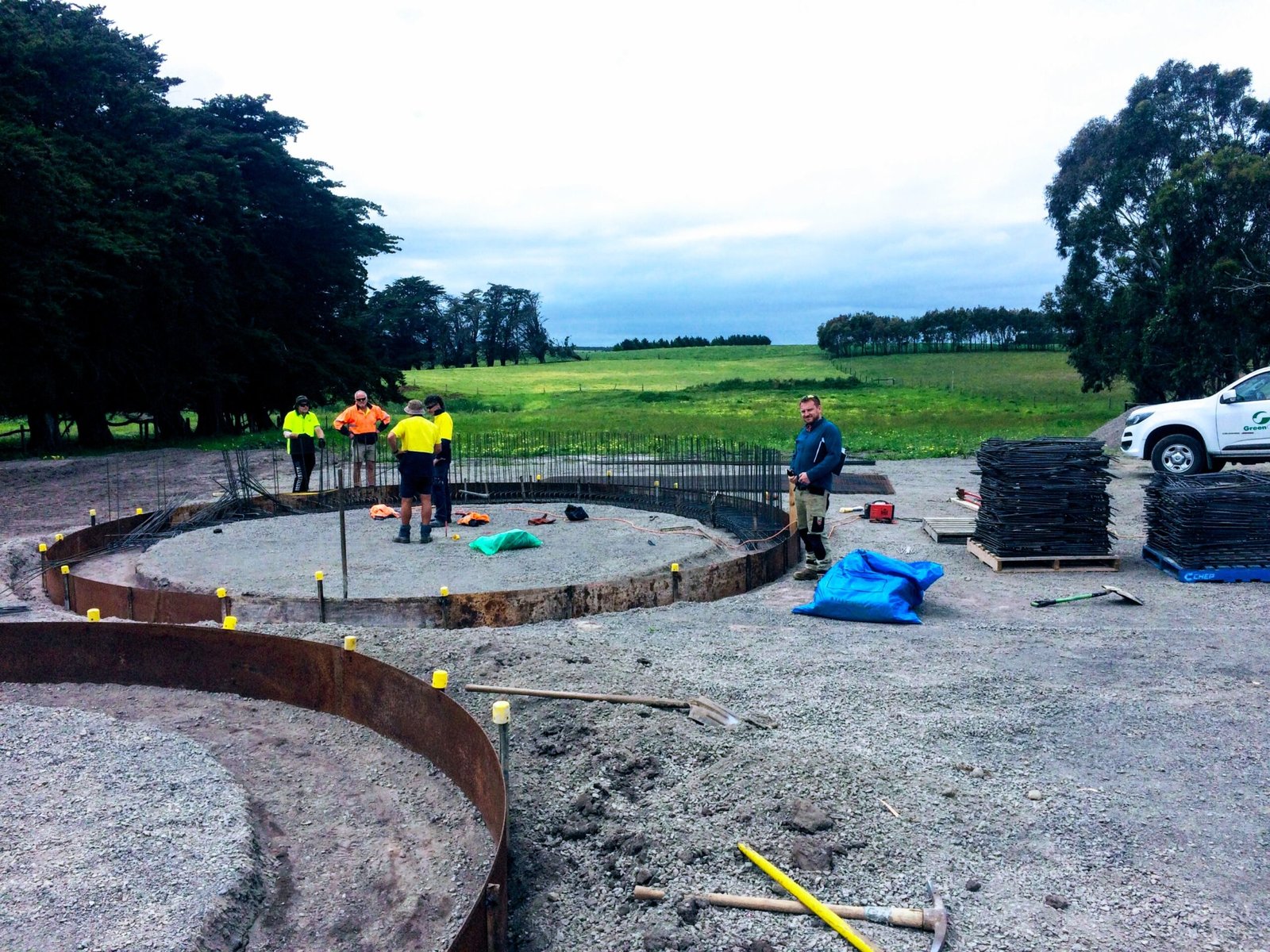
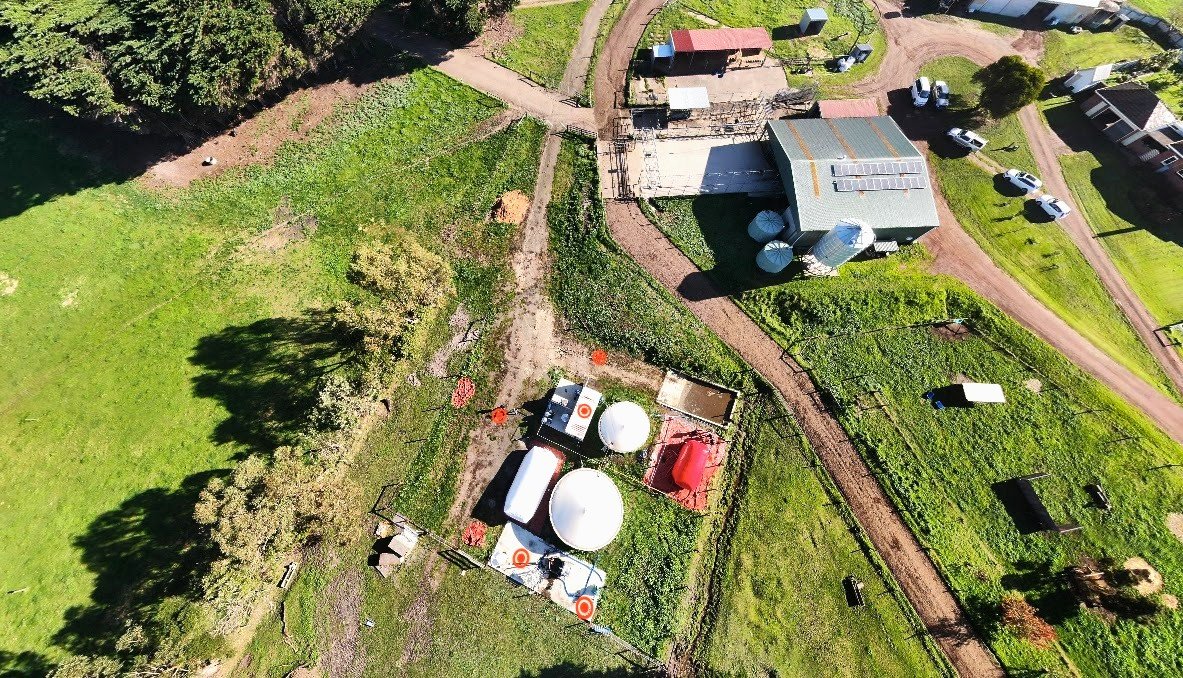
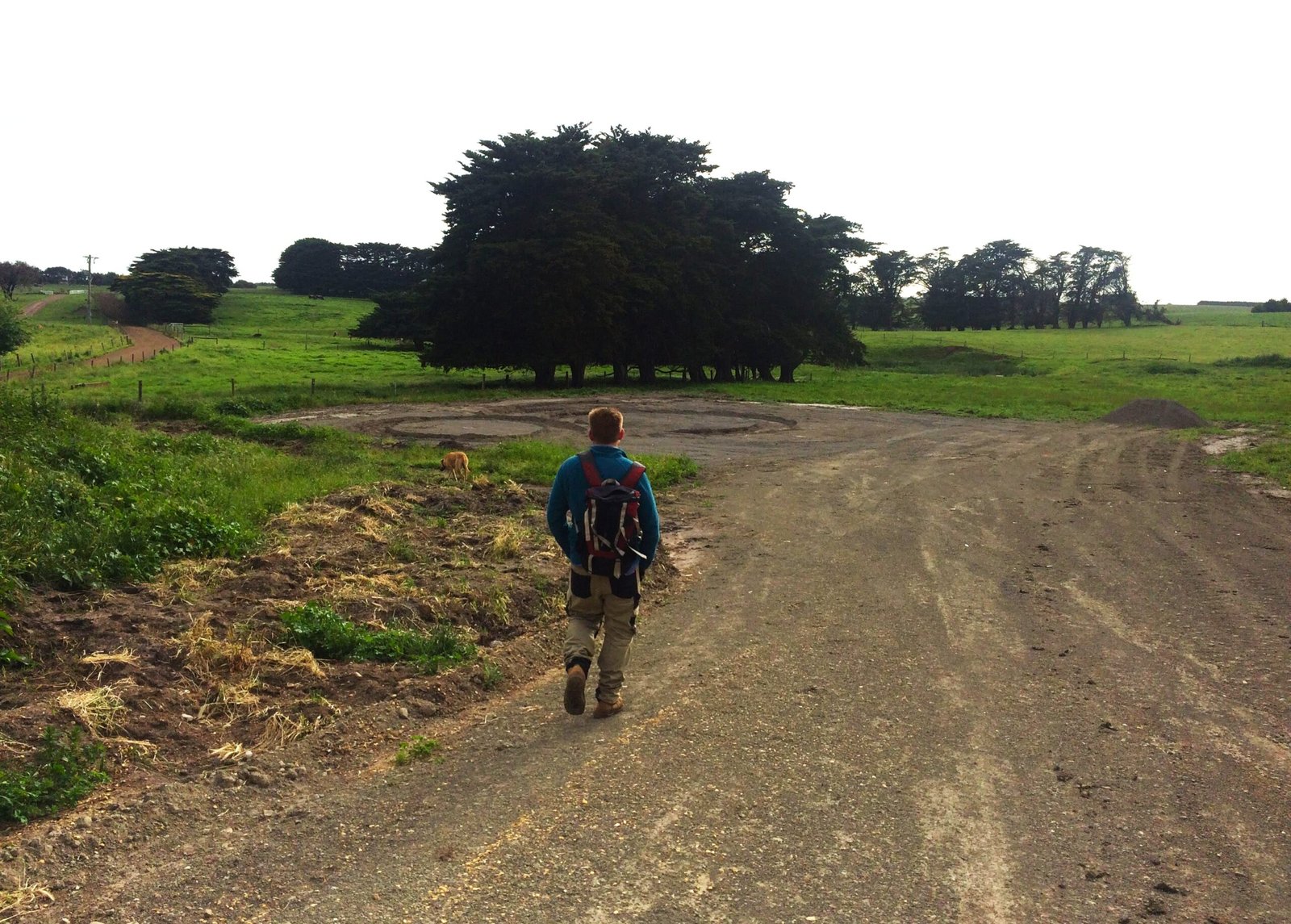
DH: BioSTAR™ was originally developed for a dairy farm, where we began asking a simple question: if a cow can process feed in a matter of hours, why does a conventional anaerobic digester often take 21 days or more to achieve the same biological outcome?
The answer lies in understanding and replicating nature’s efficiencies. A cow doesn’t simply rely on its stomach. Chewing physically breaks down the material, while saliva introduces enzymes that begin the digestion process before the feed even reaches the rumen. Inside the rumen, a highly balanced microbial ecosystem rapidly converts complex organic matter into energy.
We applied those same biological principles to BioSTAR™, focusing on how different feedstocks are prepared, treated and introduced into the system to accelerate microbial activity. Different organic materials require different approaches, additives and operating conditions to optimise digestion rates.
Like a living organism, an anaerobic digester must also be carefully managed. If a cow consumes too much feed too quickly, acids can build up and disrupt digestion. The same applies to a digester. DOUG HARTMANN
Maintaining the right balance of temperature, pH, nutrients and feedstock loading is critical. That’s why BioSTAR™ uses sophisticated automation and biological monitoring to continuously optimise conditions for the microbial community.
In many ways, managing an anaerobic digester is like working with a living ecosystem—or having a dietitian for billions of microorganisms. By understanding how nature achieves rapid and efficient digestion, we’ve been able to reduce processing times from around 21 days to as little as eight days, improving productivity while reducing capital and operating costs.
FN: Founded in 2019, Hart Bioenergy has been busy mulching through Australia’s organic waste. Share with us some milestones and projects.
DH: We kicked off by joining Australia EnergyLAB start up accelerator headed up by Megan Fisher with mentors of Ed Lynch-Bell and Charles Rendig. A valuable resource in understanding the transition from tech / science/ innovation to business.
Before 2019, after building an anaerobic digestion system for a dairy farm, we asked why the technology thrived in Denmark, Europe and the US yet struggled in Australia. Part of the answer was awareness — overseas, strong government support drove widespread adoption, while here, understanding remained limited. More critically, Anaerobic digestion isn’t merely an engineering challenge — it’s a biological one. You’re not just building tanks; you’re creating a home for billions of microorganisms that drive the entire process. Our philosophy became biology-first: optimise conditions for microbial health, and energy production, nutrient recovery and long-term performance naturally follow.
We have won consulting business – lots of planning work- on projects in Queensland, Victoria, NSW, South Australia and recently Hobart Tasmania, who are very motivated on repurposing waste. One project on the boards in Victoria, is very exciting. A circularity boutique industrial park. The energy from our AD will produce energy and heat, potentially for a data-center, as well as waste management deflected from landfill. (Reach out to Richard Sympson to get involved)
FN: Your partnership with RMIT signals a research-to-market pipeline. What questions are still being solved — what’s the frontier in biogas technology right now?
DH: Through our Cooperative Research Centers (CRC) grant for start-ups and scale-ups, we’re partnering with RMIT’s biology researchers to accelerate commercialisation of emerging technologies. Central to this is our three-year government-funded Algae Photo Bioreactor (APBR) project. Poultry and meat processing generate wastewater rich in ammonia, nitrogen and nitrates. Rather than treating these as waste, we’re exploring how algae can capture and convert them into fertilisers, proteins, omega-3 oils and other high-value bioproducts, often worth more than the energy output alone.
Algae also need CO₂ to grow. Since biogas typically contains 30–40% carbon dioxide, integrating algae cultivation directly utilises that CO₂ stream, enabling carbon-neutral or potentially carbon-negative systems.
Beyond nutrients, algae-derived products create additional regulatory pathways for digestate recovery across Australian states, supporting genuine circular production systems. We’re also collaborating with RMIT on sustainable aviation fuel pathways from biogas and renewable feedstocks, connecting previously untapped waste streams into integrated bioeconomy solutions.
The future of biogas isn’t simply producing methane. It’s building complete circular ecosystems where every output of energy, nutrients, biomass, carbon, delivers measurable value from the same system.
HART BIOENGERY is open to brainstorming waste solutions across most industries, for measurable results and revenues. Reach out to Doug Hartmann for a cuppa and a highly resourceful chat.
Sub context:
The First Industrial Revolution (roughly 1760–1840) was a pivotal transition from agrarian, hand-crafted economies to mechanized, factory-based manufacturing, driven by the steam engine and water power. 2nd Industrial Revolution (Late 19th Century) Introduced electrical power through petroleum and assembly lines, enabling mass production. 3rd Industrial Revolution (Late 20th Century): Marked the Digital Revolution, utilizing electronics and IT to automate production. The Fourth Industrial Revolution (4IR) actively merges the digital, physical, and biological worlds, with biomimicry representing an evolutionary leap.
MORE ABOUT HART BIOENERGY
Check out and signup for any of our 6 training programs: FNGN CLIMAX©MEDIA COMMS ACADEMY
Future Now Green News is a forward-thinking media platform dedicated to spotlighting the people, projects, and innovations driving the green & blue economy across Australia, Asia and Pacific region. Our mission is to inform, inspire, and connect changemakers through solutions-focused storytelling in sustainability, clean energy, climate action, and future-ready industries.