


Airport master planning increasingly needs energy storage built in from the outset, not added as an afterthought once fossil-fuel dependence is already locked into the design.
Common technical standards for airport microgrids, distributed energy systems and battery integration across jurisdictions remain a work in progress globally. As Western Sydney International airport opens its runways later this year and New Tashkent, Uzbekistan, moves from groundbreaking toward operational reality, the three projects — one Australian, one Central Asian, and one in India all greenfield built around the same premise — will offer some of the clearest evidence yet of whether that lesson has actually been learned across the region.
For years, solar panels and battery banks at airports were filed under sustainability — a corporate responsibility line item, good for a press release, rarely central to how an airport actually ran. That framing is now out of date. A growing body of operational evidence suggests energy storage systems (ESS) are shifting from optional add-on to core infrastructure, as fundamental to a modern airport’s planning as runways or baggage systems — a shift industry body Uniting Aviation recently laid out in detail, and one playing out right now on Australian tarmac as much as anywhere in Asia.
Cochin International Airport in India
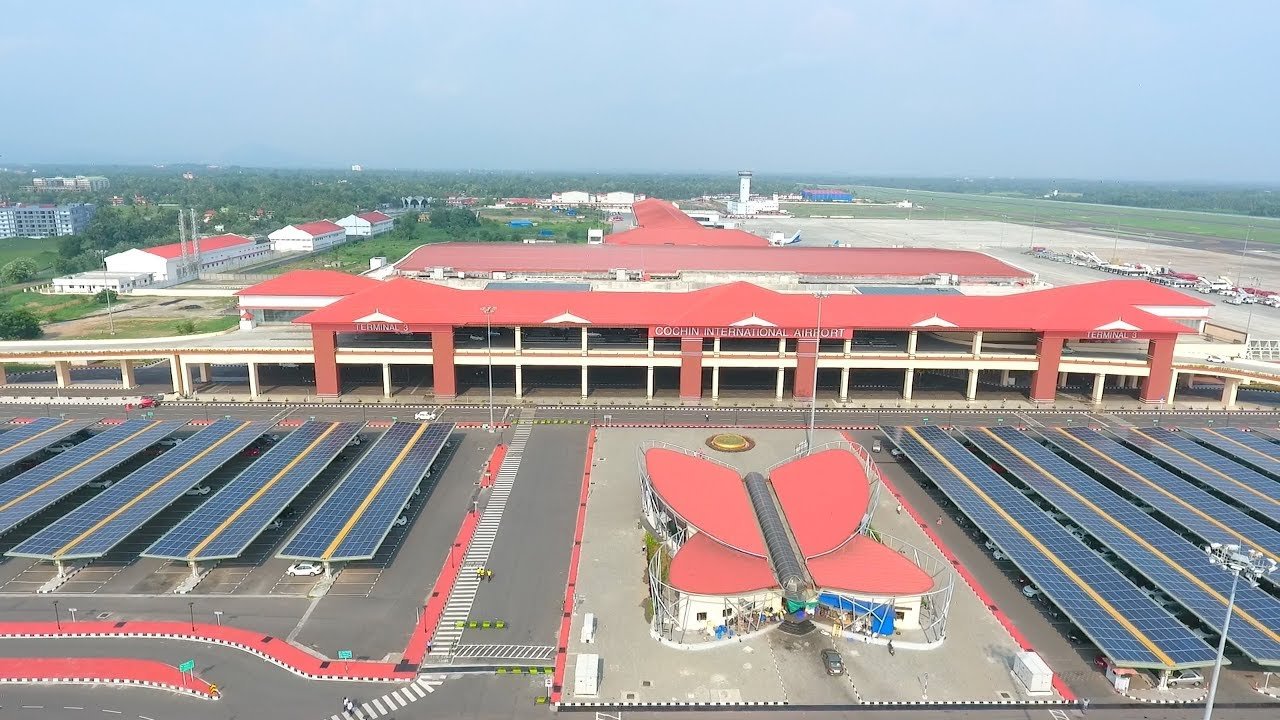
The clearest illustration of the old model’s limits is Cochin International Airport in India, long celebrated as the world’s first fully solar-powered airport. Cochin’s achievement was real: extensive investment in photovoltaic infrastructure let it meet its own electricity needs while cutting its carbon footprint sharply. But Cochin’s experience also exposed the limitation baked into solar power at any facility that never stops operating. Sunlight arrives on its own schedule, concentrated in daylight hours; aircraft, passengers and ground operations do not observe the same hours. That mismatch between when clean power is generated and when it’s actually needed is exactly the problem battery storage exists to solve — and it’s the problem Rome Fiumicino Airport addressed directly with its Pioneer project, a Battery Energy Storage System rated at 2.5 MW and 10 MWh, sized to bank surplus solar by day and discharge it when demand runs ahead of production.
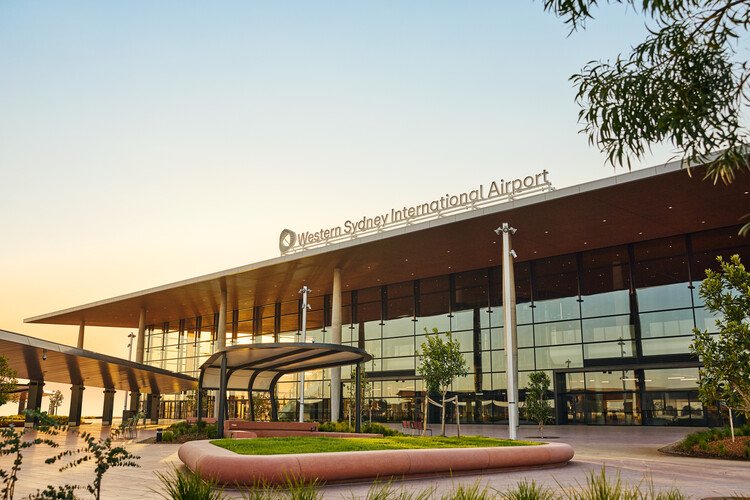
Western Sydney International (Nancy-Bird Walton) Airport
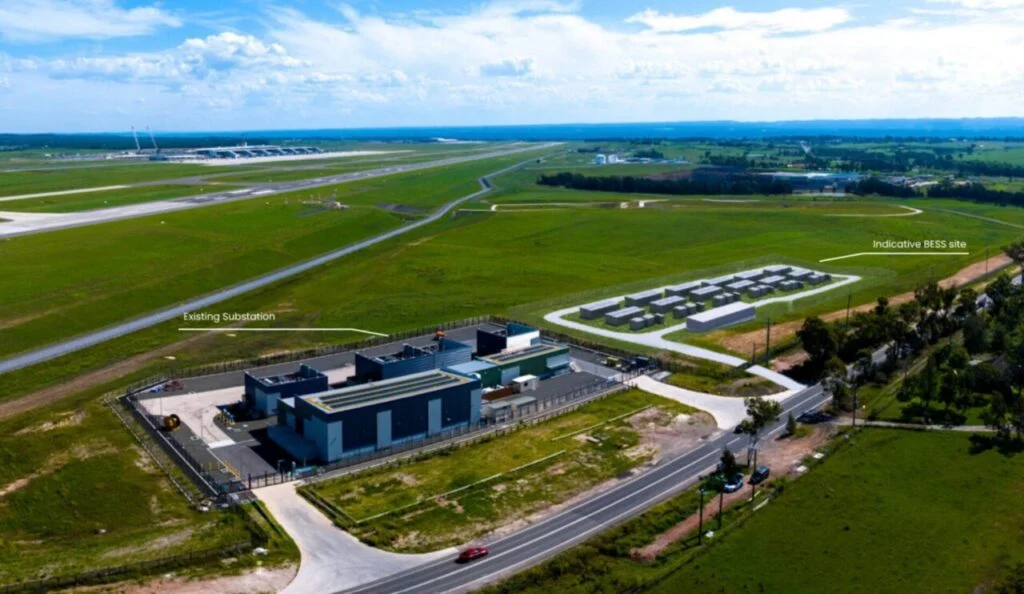
Australia now has its own, considerably larger version of that same idea — arriving as a greenfield build rather than a retrofit. Western Sydney International (WSI) (Nancy-Bird Walton) Airport, Australia’s first new airport in more than 50 years, will run on 100 per cent renewable electricity from the moment passenger operations begin in October 2026. Australian-owned energy company CleanPeak Energy is investing more than $50 million to build a 9 MWp rooftop solar system — atop an existing 4.5 MW array — paired with a 30 MW/120 MWh Battery Energy Storage System, under a 15-year supply agreement covering all of the airport’s electricity needs; CleanPeak began supplying power to the site on 1 May 2026.
“This project is about unlocking what’s possible when large-scale energy infrastructure is designed, financed and operated as an integrated energy system to power critical assets like airports without compromising performance,” said CleanPeak CEO Philip Graham.
WSI is pairing that energy build with an almost entirely electrified ground support equipment fleet, developed with Melbourne-based Freightquip, across 34 already-installed chargers.
What makes WSI notable isn’t just the scale, it’s the sequencing.
Unlike Melbourne Airport’s 12 MW solar farm or Brisbane and Darwin airports’ rooftop arrays, all retrofitted onto operations built around grid dependence, WSI designed its energy system before a single passenger walked through the terminal. Storage and generation was planned together, from the outset, rather than bolted on once a mismatch between supply and demand already exists.
That distinction is why industry analysts are increasingly describing ESS in infrastructure terms rather than sustainability terms.
Framed correctly, battery storage doesn’t just support an airport’s climate targets, but strengthens operational resilience, underwrites energy security against grid disruption, and lays the groundwork for the airport’s next big transition: electrification of ground vehicles, gate equipment and, eventually, aircraft themselves. An airport with meaningful on-site storage capacity starts to resemble a microgrid, or even, in some formulations, a small virtual power plant capable of supporting the surrounding electricity network rather than only drawing from it.
Uzbekistan is running the same experiment at even greater scale

The New Tashkent International Airport, on which the country broke ground in October 2025, is a $2.5 billion first-phase development built by a consortium of Vision Invest (Saudi Arabia), Sojitz Corporation (Japan) and Incheon International Airport Corporation (South Korea) alongside state-owned Uzbekistan Airports. Designed to handle up to 20 million passengers annually, scaling toward 46 million in later phases, officials have been explicit that it will be fully powered by renewable energy sources.
It’s positioned as the first green airport built to this standard anywhere in Central Asia, alongside a parallel agreement with Vision Invest and US-based Air Products to explore sustainable aviation fuel production for the site.
Unlike Cochin or Fiumicino, which retrofitted renewable and storage capacity onto airports already built around fossil-fuel-era assumptions, both WSI and New Tashkent have the rarer advantage of designing their energy architecture from a blank site. Whether that translates into genuine strategic infrastructure of solar and battery storage sized and sited to function as an integrated microgrid from day one — or simply a renewables target bolted onto conventional grid dependence, will determine how much of the Cochin-to-Fiumicino lesson each project actually absorbs. WSI’s answer, so far, looks like the former: an integrated 15-year energy contract with storage embedded before opening day. New Tashkent’s answer is still being written.
For the wider Asia-Pacific region where airport construction is proceeding at a pace matched by few other parts of the world, the throughline is the same one Uniting Aviation draws from Fiumicino and Cochin – locking in renewable energy sources from the outset in the design, away from fossil fuel and inherent carbon emissions.
Sources: Uniting Aviation (IATA); reneweconomy.com.au; CleanTechnica; Energy Magazine; karryon.com.au; Gazeta.uz; AeroTime; The Astana Times; Times of Central Asia.
About: About CleanPeak Energy www.cleanpeakenergy.com.au
Check out and signup for any of our 6 Media Communications training programs: FNGN CLIMAX©MEDIA COMMS ACADEMY
Future Now Green News is a forward-thinking media platform dedicated to spotlighting the people, projects, and innovations driving the green & blue economy across Australia, Asia and Pacific region. Our mission is to inform, inspire, and connect changemakers through thought leadership and solutions-focused storytelling in sustainability, clean energy, regenerative tourism, climate action, and future-ready industries.