

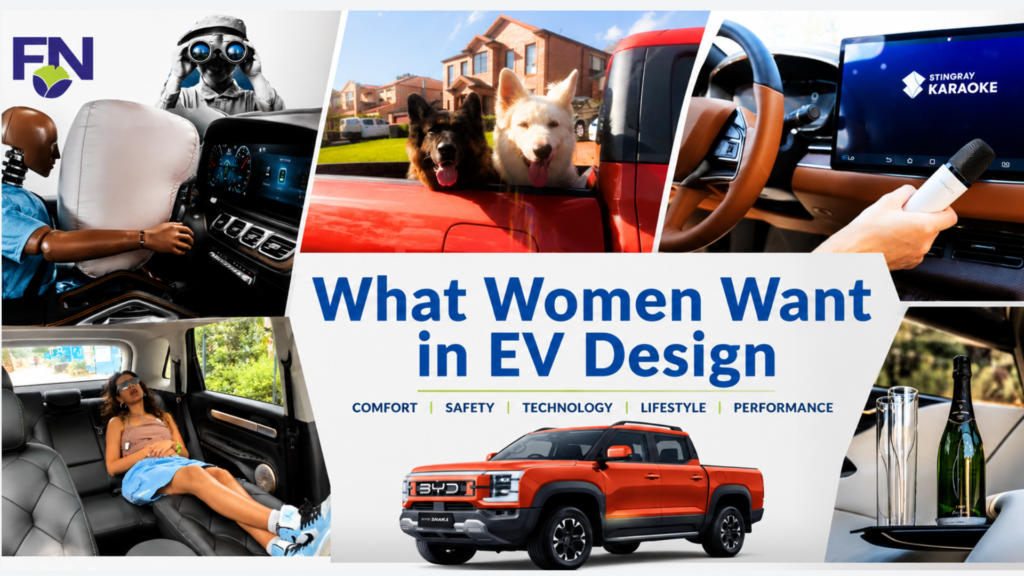

IN the recent Australia ABC TV Foreign Correspondent coverage of Beijing Auto show, EV’s are the norm. But more so, is the evolving Lifestyle stable of a cubby feast of beds, fridges, dining tables and TVs with Karaoke entertainment. A nostalgic reminder of where it all began with the Lifestyle wheels of the humble surfers + friends VW Combi van – a home away from home.
This week FNGN interviewed EV women drivers; Tala Kaplinovsky, a Sydney scientist, USA Ice Skating champion, and mother of two in her Tesla Model Y and BYD (Build Your Dearms) Shark- “It is a mobile office, a changing room, snack bar, toy box and emergency supply cupboard”- and for Megan Young, holding a private pilot’s licence, a heavy vehicle driving licence, who works for Australasia’s largest bus operator, Kinetic, as Training Facilitator / Education Specialist Victoria and Tasmania – her chosen electric car, a BMW i3 – “Before I made my purchase, I think I took every EV available on the Australian market out for a test drive’. For comfort, customisation, and sheer luxury styling, Megan is passionate about Electric Vehicles.
“It is a mobile office, a baby changing room, snack bar, toy box and emergency supply cupboard.”
FOR more than a century, cars have been designed largely by men, for men. The average male body has been the template shaping the dimensions and layout of everything from car seats and dashboard layouts to wheel and pedal alignments to crash-test dummies. But, as the automotive industry shifts gears towards electric vehicles (EVs), something interesting is happening. Women are increasingly influencing not only make and model purchases at the point of sale, but their wants and needs are being taken into account while ideas are still on the drawing board.
And it’s about time.
Having cars designed around average male size and body-shape doesn’t just effect women’s personal comfort and driving style, it can literally mean the difference between life or death.
The dangerous idiocy of crash test dummies
Developed in 1978, the standard crash test dummy has been modelled on a 5’9″, 171-pound man. Female crash-test dummies, not introduced until 2003, were simply scaled-down versions of male bodies rather than reflecting genuine differences in female anatomy, muscle distribution and seating position. These ‘female’ dummies represented only the smallest five percent of women and typically played the role of a passenger, rather than the driver.
In real-life head-on vehicle crashes, research has shown that women are 73 percent more likely than men to be seriously injured and 17 percent more likely to be killed. This is despite significant advances in automotive and road safety. Many safety experts now argue that designing around male physiology has unintentionally placed women at greater risk.
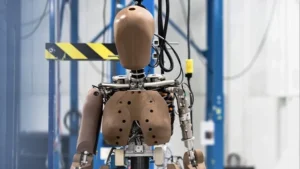
In November 2025, the US Department of Transport unveiled a new generation crash dummy — THOR-05F — equipped with more than 150 sensors, many of which recorded impacts on the legs, where female drivers have an almost 80 percent higher injury risk. Unfortunately, this advanced dummy won’t be used in mandatory testing until for at least another 12 months. 2027–28. This means that the safety of every Australian woman driving a new car today is at risk, simply as the result of a flawed testing model.
Back to the drawing board
The rapidly growing market and increased production of electric and hybrid vehicles, presents automotive designers and manufacturers with a golden opportunity to rethink the family car completely, from bonnet to boot. Without the constraints imposed by traditional petrol engines and transmissions, designers are free to completely reimagine both interior ‘cabin’ space and exterior styling, and the driver/machine interface.
Women have long played a major role in household purchasing decisions. Various consumer studies consistently estimate that women influence or make around 70–80 per cent of household purchasing decisions across major consumer categories, including vehicles. While they may not always be the registered owner, women are often the person weighing up practicality, safety, running costs and how a vehicle will fit into everyday family life.
According to Sydney scientist, USA Ice Skating champion, and mother of two, Tala Kaplinovsky, the purchase of each of the two EV cars owned by she and her husband, also a scientist and working with a First Nations lands council, was very much a joint decision, with Tala undertaking much of the background research.
“Our first EV is a Tesla model Y 2024 and overall, we’ve been very happy with it,” she said. “But now that our family has grown, we wanted an EV that would offer greater versatility — a car that would comfortably fit two car seats, compartmentalise two large dogs, and be able to easily fit all the paraphernalia that comes with transporting very young children. Prams and car seats do not easily fit in the Tesla.
“With the purchase of a BYD Shark 6 and Tesla Model Y we now have the best of both worlds”.
According to Tala, the BYD Shark 6 feels very female-friendly to drive and ride in.

“It is widely acknowledged that the seatbelt placement in Tesla vehicles is uncomfortable at best and dangerous at worst,”
she said.
“And, although the Shark does not have assisted autopilot, it does have voice control for hands-free operation of windows, climate settings, navigation, media systems and phone calls.
”The Shark turns on a dime!”
Although the initial decision to go down the EV road was powered by a strong sense of environmental responsibility, Tala says that it also made economic sense. Yes, she says, EVs are more expensive (and EV tyres cost more, too, she added ruefully). “But there are many savings to be gained: maintenance is absolutely minimal and we are unperturbed by rising petrol prices.”
Kings of the road
Traditional automative design (and their marketing campaigns) have tended to reflect outdated assumptions about what drivers’ value. The emphasis has been on powerful engines; high speed and rapid acceleration (despite restrictive road rules); sporty styling; large and impressive dashboard displays; and aggressively masculine aesthetics.
Recent consumer research of EVForward® however, suggests that design—both inside and out—is often a deciding factor in buying an EV, and ranks ahead of technical specifications, such as battery range, in importance.
Manufacturers are responding with warmer materials, lounge-like seating, flexible storage and calmer cabin environments. Several makers now offer interchangeable interior trims, ambient lighting themes, customisable digital displays and a wider range of colours and finishes than traditional vehicles ever provided.
But there’s still plenty of room for improvement.
“Anyone with young children knows that the family car is not just a means of transport from A to B,” said Tala.
“It is a mobile office, a changing room, snack bar, toy box and emergency supply cupboard.”
Fold flat work surface, built-in UV protection screens, more USB-C ports, removable storage bins, easier access for installing child seats, automatic emergency braking with better pedestrian/cyclist detection, 360 degree high-definition camera, rain-sensing high-performance wipers. These are just some of the small innovations that would make a remarkable difference to daily life.
Fortunately for EV owner Megan Young, who works for Australasia’s largest bus operator, Kinetic in executive management, some of those ‘wish list’ features have already been incorporated into the design of her chosen electric car — a BMW i3.

Holding a pilot’s licence and a heavy vehicle driving licence, Megan takes road driving very seriously. Like her employer – which is also our region’s largest owner and operator of battery electric buses – Megan is passionate about electric vehicles. She said….
“Before I made my purchase, I think I took every EV available on the Australian market out for a test drive. For comfort, customisation, and sheer luxury styling, the BMW was the winner for me”.
Among other features, the i3 comes with wireless phone charging (for compatible devices), automated parking assist, ambient interior lighting, rain-sensing wipers, and heated and folding power mirrors. Counter-opening clamshell doors create a B pillar-free frame not only delivers increased side window visibility, but also makes getting in and out of the back seat much easier.
“The interior feels like a living room, and the exterior – with its unique grille and light configuration – has personality plus. I’m very happy with this car!” Megan said.

What women want is what the EV market needs
Electric vehicles offer a thrilling opportunity for ‘out of the box’ thinking and a chance to deliver cars that are geared towards the needs and demands of modern households in all their varieties.
If EV design is being driven by women’s priorities—safer, more practical, more environmentally responsible and more adaptable—then the future of motoring looks better for everyone.