
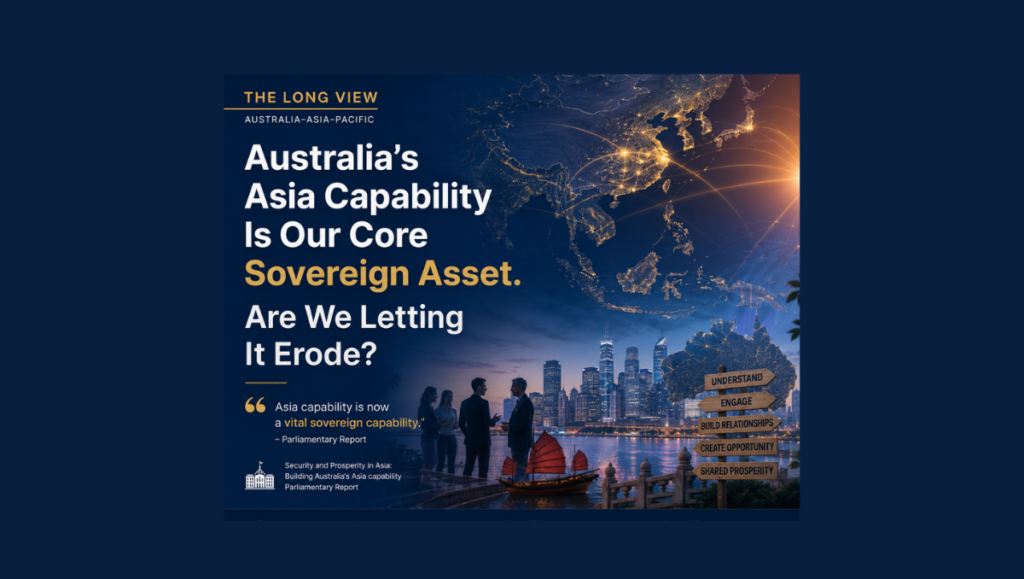

A RECENT Australian parliamentary report led by Committee Chair Tim Watts MP, Security and Prosperity in Asia: Building Australia’s Asia capability, recognises Australians have been slow to confront our future security, prosperity and regional engagement which depends on rebuilding deep capability in Asian languages, cultures, histories and societies; and, importantly – ‘going out’ – into Asia.
Going there. Meeting people. Listening. Observing. Building relationships. Doing business.
The uncomfortable numbers
The parliamentary inquiry uncovered a particularly disturbing and serious disconnect between Australia’s strategic ambitions and the capability our education system is producing. For business leaders, the numbers are confronting.
Only 7% of ASX 200 board members and senior executives were assessed as sufficiently Asia-capable. Boards scored an average of just 6.42 out of 30 on Asia-capability measures. Senior executive teams scored even lower — 3.79 out of 30. If this were a gap in cybersecurity, energy security or defence readiness, it would be treated as a national capability problem. So why isn’t it? Perhaps because “knowing Asia” is still too often treated as soft knowledge. It isn’t.
Asia capability belongs on the balance sheet
The Business Council of Australia told the inquiry that Australian companies need people who understand the politics, economics, opportunities and practical realities of Asian markets, combined with the cultural intelligence to understand how business actually gets done.
That is not a soft skill. It is commercial intelligence. And commercial intelligence is an asset.
Commercial intelligence is built from experience.
If Australian SMEs, start-ups and scale-ups want to explore Asian markets, they need opportunities to meet prospective buyers, investors, distributors, partners and other businesses. They need to get out of the Australian ecosystem. And one of the most practical places to start is at an Asian trade expo.
Australia has around 27 million people. Asia has billions.
So, if you are an Australian SME, start-up or scale-up, how do you get ahead of the eight and prosper beyond the relatively small Australian domestic ecosystem? Why keep looking only towards the United States or within our own domestic market when some of the world’s largest and fastest-changing commercial ecosystems are right on our doorstep?
Macau and the Greater Bay Area
Roughly a nine-hour flight from Melbourne, it offers Australian businesses a very different environment in which to explore, learn, connect and test opportunities. So, what are we waiting for?
FNGN Macau GBA Trade Mission 20 – 24 Oct 2026 FutureNow Green News Aust-Asia are leading a cost all-inclusive Australia trade mission to Macao Trade and investment Forum with 1300+ exhibitors to include Portugues-speaking countries of Brazil, Africa, and Portugal – the doorway to China and Greater Bay area with 88 mil consumers.
All inclusive : Flights, Hotel at The Parisian Macao, MIF Expo & Conference, Business-Match introductions, Hengqin Site Tours, and Meet n Greet reception with Austcham Macao, ++ more.
Macao International Trade and investment Forum
ani@futurenowgreennews.com
Australia’s strategic contradiction
Australian businesses cannot build meaningful relationships across Asia simply by reading market reports or attending webinars. They need to go out. Australia’s ability to understand, engage and forge relationships across Asia is becoming more than a desirable capability.
Australia lives with a strange strategic contradiction by insisting that the Indo-Pacific is central to our security, prosperity and future. We spend billions on defence, negotiate trade agreements, court Asian investment, and want Australian businesses selling into Southeast Asia, India, China, Japan and Korea.
Yet we have allowed one of the capabilities underpinning all of this to erode:
Our ability to understand Asia and engage confidently on the ground as Business Owners..
It is a sovereign capability.
Asia capability starts with curiosity
University degree in Asian studies is obviously a bonus, but being curious in life and your business is essential to your survival. Stay curious. Attend Asian trade shows. Walk the exhibition floor. Talk to potential buyers. Observe how people communicate and negotiate.
Sit in an Asian community shopping precinct and listen — even if you don’t understand every word. Watch Asian films with subtitles. Try unfamiliar cuisines. Learn some of the language. And pay attention to body language, hierarchy, etiquette and the subtle signals that can communicate respect — or disrespect — before a business conversation has properly begun.
Because culture can determine whether a relationship gets off the ground.
The parliamentary inquiry heard a striking illustration from Australian technology company Arrow Digital.
An Australian delegation travelled to Bangalore to meet senior Indian government officials. One founder walked into the boardroom and, without realising it, sat at the head of the table — a position that, in that cultural context, was determined by hierarchy.
To an Australian visitor unfamiliar with the protocol, it might have seemed trivial. It wasn’t.
As Arrow Digital told the inquiry, “Deals can be won or lost on culture”. That anecdote makes the commercial case more persuasively than another government strategy document ever could. Because Asia capability isn’t about being “nice” or culturally polite. It is about understanding the environment in which business actually happens.
Don’t just read about Asia. Go.
A trade mission does not have to begin with a multimillion-dollar export strategy. It can begin with four questions:
Who is there?
What are they buying?
Who could we partner with?
And is there a genuine opportunity for our business?
That is why trade exhibitions can be so valuable. They compress an enormous amount of market intelligence into a few days. You can see competitors. Meet potential partners. Test your proposition. Observe consumer behaviour. Discover technologies. Understand pricing.
And, perhaps most importantly, begin building relationships that may take months or years to develop.
For businesses that have been asking, “How do we actually start exploring Asia?”, this is one practical answer.
This is an opportunity to get out and look, listen, meet people and start building your own Asia capability.
MACAU- GBA – HENGQIN : This is where our FNGN Australia–Macau Trade Mission, 20–24 October 2026, comes into the picture.
We are taking a small Australian business delegation to the Macao International Trade & Investment Fair (MIF) — an international platform bringing together 1300+ exhibitors and business interests from Macau, mainland China, the Greater Bay Area and Portuguese-speaking markets.
For an Australian SME, the attraction isn’t simply Macau itself. It is the opportunity to step into a much larger commercial ecosystem and see it for yourself.
The program includes MIF, business-matching introductions, Hengqin site-visits, Australian business networking and a reception with AustCham Macao, alongside accommodation, flights and on ground costs as part of the package.
Australia’s biggest underused Asia asset may already be here
The Asian-Australian communities. International graduates. Bilingual professionals. Diaspora business networks. Australians who have lived and worked across the region. This should not be filed away simply as evidence of multicultural diversity.
It is strategic economic capital. Perhaps the question is not only:
How do we send more Australians to Asia? But also:
How do we make better use of the Asia that is already inside Australia?
Universities have an enormous responsibility here. But business does too. The parliamentary report warns that graduates need genuine career pathways once their study is completed. As the Business Council of Australia argued, expertise is created through education. But if there is no pathway into business afterwards, Australia has a problem. Why should a young Australian spend years mastering Mandarin, Indonesian, Japanese, Korean or Hindi language and cultural fluency if the Australian labour market does not value that capability? That is not simply an education failure.
It is a market failure.
Australia wins on so many domestic fronts. Now ‘Go-Out’
Australia’s geography gives us an extraordinary strategic advantage. But geography alone does not create influence. Our curiosity to dream of what’s possible outside of our domestic comfort zone is what makes the difference.
That means Australia needs to stop talking about Asia capability as something belonging principally to government, universities or foreign policy.
It belongs to Australian business too.
Australia’s Asia capability will not be rebuilt by talking about Asia. It will be rebuilt by Australians going out, engaging, learning, building relationships, and doing business – closing deals.
Is your business is curious about Asia?
FNGN – Macau International Trade & Investment Mission | 20–24 October 2026 is the place to start.
For information:
ani@futurenowgreennews.com
Check out and signup for any of our 6 Media Communications training modules: FNGN CLIMAX©MEDIA COMMS ACADEMY
Future Now Green News is an independent forward-thinking digital media platform dedicated to spotlighting the people, projects, and innovations driving the green & blue economy across Australia, Asia and Pacific region. We inform, inspire, and connect change-makers through thought leadership and solutions-focused storytelling in sustainability, clean energy, regenerative tourism, climate action, and future-ready industries.