
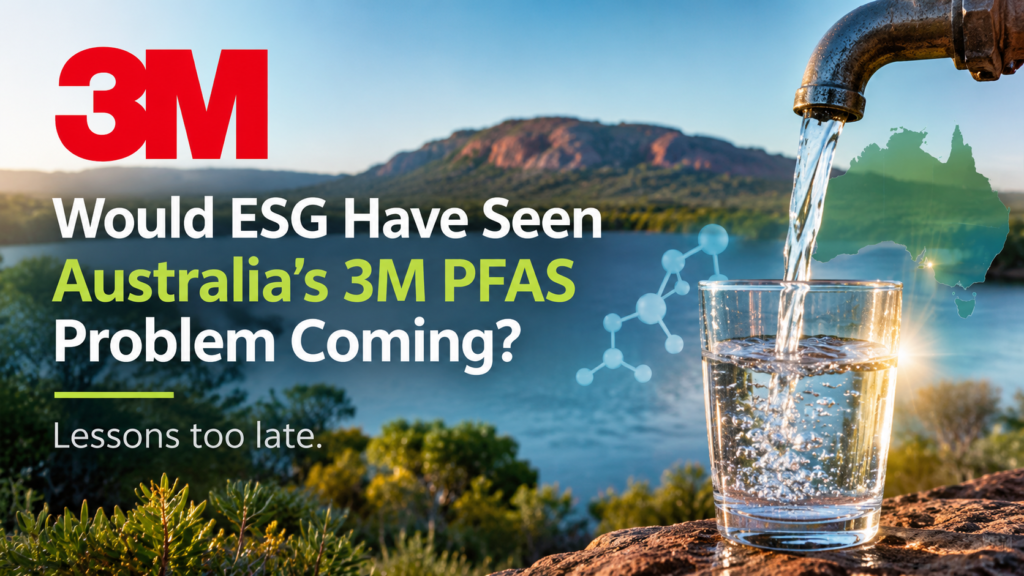

THE A$2 billion 3M case raises a bigger environmental question bubbling underground: are we measuring the right risks before they surface as ecological liabilities?
Australia’s PFAS National Environmental Management Plan (NEMP) monitors PFAS chemicals on the global market – but the environmental reporting gap between measuring known pollutants and identifying emerging risks, before they become environmental liabilities, is abhorrent.
Currently in the Australia Federal Courts, the Commonwealth’s 1,600-page statement of claim alleges that 3M had information about the persistence and environmental effects of PFAS compounds decades ago. 3M has said it will defend the case with ‘Climate reporting is not the same thing as environmental reporting’. PFAS challenges the idea, ‘that durability is automatically environmentally desirable’. Sometimes a material’s greatest commercial strength of its resistance to heat, water and chemical breakdown, can become its greatest environmental weakness.
In 2021, the OECD inventory confirmed Chemical Abstracts Service (CAS) Registry Numbers to be more than 4,700 PFAS. While the U.S. EPA’s broader structural definition puts the theoretical PFAS family at more than 12,000 chemical substances – illustrating the scale of the challenge facing regulators trying to identify and manage ‘forever chemicals’.
The Commonwealth says it has already spent more than $1 billion investigating, managing and remediating PFAS contamination at Defence sites. The Government is seeking to recover those costs as part of the 3M proceedings.
For decades, PFAS chemicals did an extraordinarily effective job.
They helped firefighters put out petroleum and aviation fires. They resisted heat, water and grease. They became part of an industrial world that valued performance, durability and reliability.
There was just one problem. They did not go away.
Today, those same characteristics that made PFAS so useful have made them one of the world’s most persistent environmental contaminants. They can remain in soil and groundwater for decades. They can move through water systems, cross property boundaries and accumulate in living organisms.
And now Australia is confronting the environmental legacy.
The Commonwealth is pursuing 3M over PFAS contamination associated with firefighting foam used at 28 Defence bases, seeking $2 billion in damages. The allegations are before the Federal Court and 3M has said it will defend the case.
But for The Long View FutureNow Green News, the more interesting question sits beyond the courtroom:
Could a better system of environmental reporting have made the risk visible earlier?
From the 1970s’ largely voluntary, incident-focused environmental reporting, EPA-style reporting has evolved into more systematic, publicly accessible disclosure of toxic releases, pollution prevention and environmental performance, and now increasingly incorporates measurable climate, emissions and broader sustainability data.
The chemicals that refused to disappear
PFAS — per- and polyfluoroalkyl substances — are not one chemical but a large family of manufactured substances. Their extraordinary chemical stability made them commercially valuable. It also makes environmental remediation extraordinarily difficult.
At Williamtown in New South Wales, near a RAAF base where PFAS-containing firefighting foam was used from the 1970s until 2004, contamination has become part of everyday life.
Resident Lindsay Clout told the ABC that groundwater remains unusable for drinking and other activities.
“We don’t use it for washing, putting in swimming pools, any recreation use,” he said.
That sentence captures something that can disappear inside a corporate sustainability report.
Environmental contamination is not simply a number. It changes what people can do with the land beneath their homes. It changes how water can be used. It can affect agriculture, property values, ecosystems and community confidence.
And because PFAS persists, the environmental story can continue long after the product itself has disappeared from commercial use.
From useful product to environmental legacy
The Commonwealth’s 1,600-page statement of claim alleges that 3M had information about the persistence and environmental effects of PFAS compounds decades ago.
The allegations are contested and the court has not determined the facts. But the documents raise an important environmental question.
When does knowledge about a chemical’s environmental persistence become a material sustainability risk?
The Commonwealth alleges that internal 3M research included evidence about persistence, toxicity and environmental contamination. It cites, among other documents, historical testing and environmental reports.
3M disputes the Commonwealth’s case and says it voluntarily announced a global phase-out of PFOS and PFOA manufacturing in 2000 and ceased sales of the products at issue in Australia around two decades ago.
The legal arguments will ultimately be tested in court.
But the environmental lesson is already visible. A product can solve an immediate human problem while creating a much longer ecological one. That is the kind of long-tail environmental risk that conventional financial reporting can struggle to capture.
What does ESG actually see?
Australia’s mandatory sustainability reporting framework currently has a very specific focus.
AASB S2, Australia’s mandatory climate-related disclosure standard, requires relevant entities to disclose material climate-related risks and opportunities. The broader AASB S1 standard covers sustainability-related financial risks and opportunities more generally, including environmental issues, but it is currently voluntary.
So PFAS exposes an important distinction.
Climate reporting is not the same thing as environmental reporting.
A company can report its greenhouse-gas emissions while potentially carrying other environmental risks involving chemicals, water, waste, biodiversity, contaminated land or ecosystem damage.
Those risks may never appear in a carbon inventory. Yet they can eventually become financially material. That is precisely what makes PFAS such an interesting ESG case study.
The question is not whether ESG reporting would magically have prevented contamination. It is whether a sufficiently broad environmental-risk framework could have forced earlier attention to:
What chemicals are we putting into the environment?
And perhaps the most important question:
What is the environmental cost of a product that is exceptionally good at not breaking down?
When environmental risk becomes financial risk
PFAS also demonstrates how quickly an ecological problem can move across the economy.
First comes contamination. Then monitoring. Then restrictions on water use. Then remediation. Then property impacts. Then litigation. Then billions of dollars of potential costs.
A separate Victorian Supreme Court action involving hundreds of businesses and organisations could also result in claims running into billions of dollars, according to ABC reporting.
This is where the environmental and financial worlds collide.
A chemical initially designed to make firefighting more effective can ultimately create liabilities involving water, land, remediation and property.
The science is still evolving
The science around human health effects remains complex. The environmental persistence of PFAS is well established, but individual health effects, exposure pathways and causation involve continuing scientific research.
Professor Martyn Kirk of the Australian National University told the ABC that research involving communities around Defence bases found higher PFAS levels in people’s blood and evidence of higher cholesterol and some kidney-function markers.
But his research did not find elevated mortality or cancer rates for the majority of the outcomes examined. His observation about the environmental legacy is perhaps even more important.
 You can go back and find it in the water even though it was applied three or four decades ago,” he told the ABC.
And that is the extraordinary characteristic of PFAS.
Time does not necessarily make the environmental problem disappear. The people living with the legacy
For communities, the environmental consequences are tangible. Katherine GP and clinic owner Anjali Palmer welcomed the Commonwealth’s action against 3M, saying:
The damage done to the environment and to people’s health has been so concerning for residents.”
At Fullerton Cove near Newcastle, Lindsay Clout described a community still dealing with groundwater restrictions decades after PFAS-containing foam was used nearby.
The issue has therefore become something larger than chemical regulation. It is about the relationship between industrial innovation and environmental responsibility. How long should a community have to live with the consequences of a product after that product has disappeared from the market?
And who has the responsibility to monitor the environmental consequences over that entire period?
The missing environmental balance sheet
This may be the most important question for the next generation of corporate sustainability reporting. We have become increasingly sophisticated at measuring carbon. We measure tonnes of CO₂. We calculate emissions intensity. We set net-zero targets. We model climate scenarios. But environmental risk is much bigger than carbon.
What about chemicals that remain in groundwater?
What about soil contamination? What about biodiversity loss? What about water quality? What about waste streams that remain hazardous for decades? What about materials that cannot realistically be recovered or safely destroyed?
These are environmental assets and liabilities too. Yet they are much harder to fit into a neat annual sustainability report. PFAS suggests that the next evolution of ESG may need to become much more materials- and ecosystem-literate.
The circular-economy problem hiding inside PFAS
There is also a powerful circular-economy lesson. The conventional economic model is remarkably good at measuring the beginning of a product’s life. Raw material. Manufacturing. Sale. Revenue. Profit.
But a truly circular economy asks what happens afterwards.
Can the material be recovered? Can it be safely reused? Can it be destroyed? Does it accumulate? Does it enter water, soil or biological systems?
PFAS challenges the idea that durability is automatically environmentally desirable.
Sometimes a material’s greatest commercial strength — its resistance to heat, water and chemical breakdown — can become its greatest environmental weakness.
That is a lesson extending far beyond PFAS.
The Long View: PFAS therefore offers a warning for the next era of ESG.
Carbon is measurable. Environmental consequences are much harder.
The next generation of sustainability reporting may need to look beyond emissions and ask a more fundamental question:
What is the full environmental life of everything we make?
Because the true sustainability test of a product may not be how efficiently we manufacture it. But how we integrate through circularity to protect our planet.
Check out and signup for any of our 6 Media Communications training modules: FNGN CLIMAX©MEDIA COMMS ACADEMY
Future Now Green News is an independent forward-thinking digital media platform dedicated to spotlighting the people, projects, and innovations driving the green & blue economy across Australia, Asia and Pacific region. We inform, inspire, and connect change-makers through thought leadership and solutions-focused storytelling in sustainability, clean energy, regenerative tourism, climate action, and future-ready industries.