

An Australian gold-transforming fungus could offer clues for cleaner mineral exploration, e-waste recovery and biomimicry
Nature provides the blueprint. Engineering provides the scale.
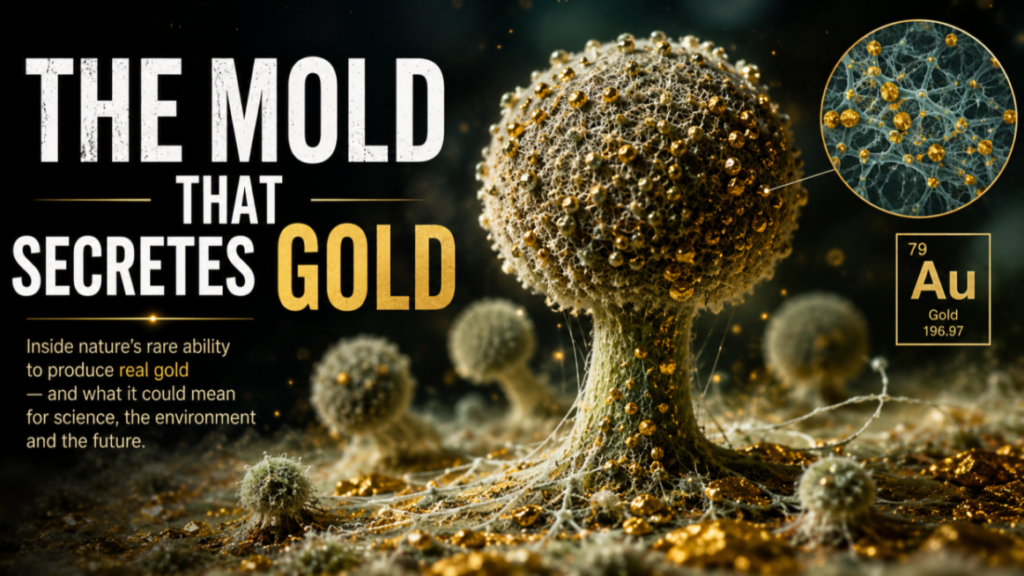
It sounds like something from an alchemist’s laboratory: a fungus grows through soil and somehow ends up covered in gold. But the Australian discovery behind the headlines is more interesting than the idea of a “mold that secretes gold”.
The fungus does not manufacture gold. It has evolved the ability to interact with gold already present in its environment — changing its chemical form, mobilising it, concentrating it and precipitating it again as microscopic particles.
That raises a much bigger question for the green economy:
What if we could learn from the way biology interacts with minerals instead of relying solely on energy-intensive industrial processes to extract them?
The answer could have implications for mineral exploration, electronic waste and advanced materials.
Nature’s microscopic mineral processor
In 2019, researchers from CSIRO, Curtin University, the University of Western Australia and Murdoch University reported the discovery of a gold-oxidising fungus near Boddington in Western Australia. The researchers isolated a strain of Fusarium oxysporum from gold-bearing soil and named it Fusarium oxysporum TA_pink1.
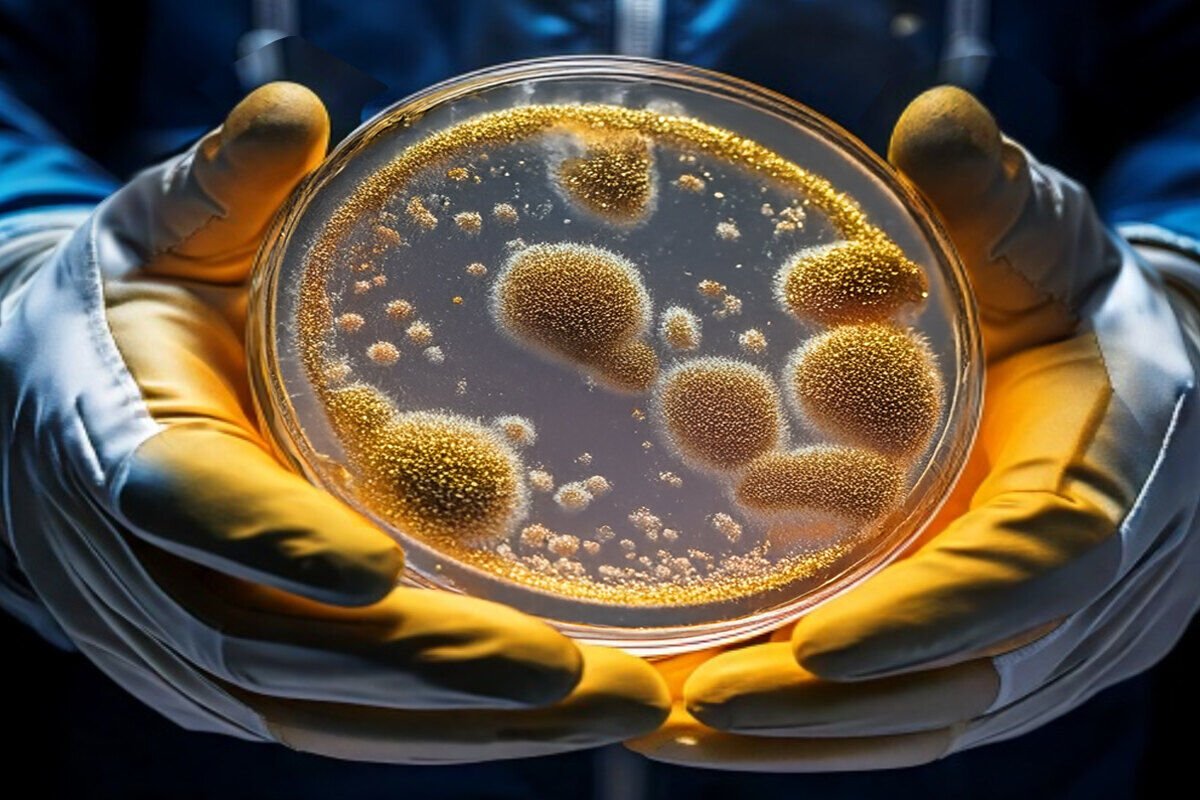
Image: MetalTech
Gold is famously resistant to chemical change. Yet the fungus was able to alter the chemistry around gold particles through compounds generated by its metabolism.
The process is surprisingly sophisticated. The fungus produces reactive oxygen species, including superoxide, which can oxidise elemental gold. Other compounds released by the fungus can bind the resulting gold ions, making them more mobile. The gold can subsequently be reduced again and precipitated as tiny particles.
Microscopic analysis revealed nanometre-scale gold particles associated with the fungal hyphae — the thread-like structures that make up the fungus. In effect, the fungus performs a miniature sequence of mineral processing:
oxidise → bind → mobilise → concentrate → reduce → re-form.
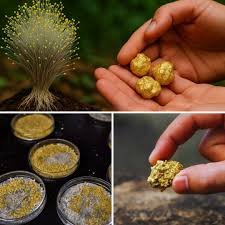
It is not biological alchemy. It is chemistry performed by a living system. And that’s what makes the discovery interesting for innovation.
- Could biology help us find minerals underground?
The first potential application is not recovering gold. It is finding it. Conventional mineral exploration can involve extensive geological mapping, sampling, drilling and infrastructure before a deposit is confirmed. Drilling is essential to understanding what lies underground, but it is also expensive, resource-intensive and potentially disruptive.
The fungal discovery suggests another possibility: the biology living at the surface may contain information about geological processes occurring below it.
The Australian researchers found relationships between indigenous fungal diversity and gold concentration in the soils they studied. Certain microbial communities appeared particularly associated with the gold-bearing environment.
That raises the prospect of using microorganisms as biological indicators of mineralisation. Instead of looking only at the chemistry of soil and rock, exploration scientists could also ask:
What is the biology telling us?
A future exploration system could potentially analyse microbial communities, fungal abundance, metabolites or genetic signatures and combine that information with conventional geological and geochemical data. The objective would not be to replace drilling. It would be to improve the intelligence used to decide where drilling is most worthwhile. This is where the discovery begins to look less like an oddity and more like biomimicry. Nature has effectively developed a network of living sensors responding to their chemical environment.
Could we learn to read those sensors?
- From mining the Earth to mining our waste
The second problem is even more immediate. Modern society has created another enormous source of minerals: electronic waste. Gold, silver, copper, palladium and other valuable materials are embedded in phones, computers, circuit boards and electronic equipment. Yet enormous quantities of these materials are discarded every year. Recovering them can require complex chemical and thermal processes.
Fungi offer a radically different biological toolkit.
Research into fungal metal recovery has shown that fungi can participate in several stages of the process. They can help mobilise metals through biochemical leaching, bind metals to their biomass, accumulate them and precipitate them as nanoparticles.
Laboratory research with Aspergillus niger, for example, has demonstrated gold mobilisation from discarded circuit boards. In one experiment, a fungal consortium mobilised substantially more gold than a single fungal strain.
The significance is not that we are about to replace conventional e-waste recycling with mushrooms. It is that fungi demonstrate a potentially useful sequence for selective biological metal recovery.
Imagine an urban mining system inspired by the fungus:
e-waste → biological leaching → selective binding → concentration → metal recovery → new products.
The gold does not have to come from a new mine. It can come from yesterday’s computer. That is a powerful circular-economy proposition.
- Biomimicry: don’t copy the fungus — copy the strategy
This is where the story becomes particularly relevant to biomimicry. Biomimicry is often misunderstood as simply copying something found in nature. The more powerful approach is to understand what problem nature has solved and how.
The fungus has solved a difficult chemical problem.It interacts with a highly stable metal using relatively subtle biological chemistry. It mobilises the metal, controls its movement and ultimately contributes to its re-formation as tiny particles.
Engineers could therefore investigate not only the organism itself but the mechanisms behind its behaviour.
Which molecules are doing the work? Which enzymes or metabolites are involved?Can those chemical reactions be reproduced without the organism? Can they be incorporated into a reactor, membrane, sensor or recycling process?
That could lead to bio-inspired mineral processing rather than simply “fungal mining”. A commercial system might ultimately use purified fungal compounds, engineered microbes, enzymes or synthetic materials that imitate biological metal-binding and transformation processes.
- Nature’s route to advanced materials
There is a further possibility. Fungi have also demonstrated an ability to produce gold nanoparticles from dissolved gold compounds.Nanoparticles behave differently from bulk metals and have potential applications in sensing, catalysis, medicine and advanced materials.
The significance is not simply that fungi can make nanoparticles. It is that biological systems can create sophisticated materials under relatively mild conditions. Industrial manufacturing often relies on high temperatures, pressure and chemical inputs. Biological systems can perform complex transformations under very different conditions.
That creates a fundamental biomimicry question:
Can we manufacture some materials by learning how living systems assemble them?
The answer will vary from material to material, but fungi are increasingly being investigated as biological platforms for metal transformation and nanomaterial production.
The bigger idea: mining less intelligently
None of this means fungus will replace mining.
The world will continue to need enormous quantities of metals for renewable energy, electrification, batteries, communications infrastructure and digital technologies. In many cases, new mineral extraction will remain unavoidable. It is whether we can make the entire minerals system smarter.
Can biology help us identify deposits with less unnecessary exploration? Can microorganisms help recover metals from waste? Can biological chemistry reduce the energy or chemical intensity of some recovery processes?
Can nature-inspired systems help manufacture advanced materials more efficiently?
Rather than seeing nature as something standing in the way of extraction, what if nature itself becomes part of the technology? How to work with minerals rather than simply overpower them?
That is the essence of biomimicry — and potentially a new chapter in the circular economy.
Check out and sign up for any of our 6 Media Communications training modules: FNGN CLIMAX©MEDIA COMMS ACADEMY
Future Now Green News is an independent forward-thinking digital media platform dedicated to spotlighting the people, projects, and innovations driving the green & blue economy across Australia, Asia and Pacific region. We inform, inspire, and connect change-makers through thought leadership and solutions-focused storytelling in sustainability, clean energy, regenerative tourism, climate action, and future-ready industries.