
Pacific nations were already spending a fortune on imported fuel. A Middle East oil shock has made that bill a security risk. Now Pacific leaders are pitching renewables as an investable market.
PACIFIC COUNTRIES SPEND between 10% and 25% of GDP on fossil-fuel imports.
That is more than the regional averages of 8% on education and 6% on health. About 80% of the region’s energy comes from imported oil products. In 2026 that dependence turned from a budget problem into an emergency.
Conflict in the Middle East has pushed the region toward an energy crisis. By April, Tuvalu and the Marshall Islands had declared energy emergencies, and Pacific Islands Forum leaders agreed to activate the Biketawa Declaration, a regional high-alert framework. Several other governments, including Fiji, Vanuatu and Nauru, brought in national mitigation measures.
UNSW researcher Dr Wesley Morgan says a supply disruption quickly means “more expensive electricity, transport and food” for island households, stating:
In Fiji alone, the annual cost of imported refined fuels could rise by around US$375 million if elevated oil prices persist, more than the country’s annual healthcare budget.
Morgan’s report, Counting the Cost of Fossil Fuels in the Pacific, was released in August, just before the Forum leaders met in Palau. It covers 21 countries. It estimates that replacing diesel generators would need 2.2 gigawatts of renewable generation and 8,800 megawatt-hours of storage, costing about US$650 million a year. The savings of about US$700 million a year would repay that investment in little more than a decade.
“We’re used to talking about renewable energy in the Pacific as a moral issue,” Morgan says, but the economic case is now “overwhelming”. The report puts actual renewable finance at about US$216 million in 2024, so the annual gap is more than US$400 million. Tuvalu’s climate change minister, Dr Maina Talia, said additional investment would be needed to reach the goal.
Why electricity is already a bankable market
Pacific households already pay about US$0.47 per kilowatt-hour, almost three times the global average. The Asian Development Bank and the International Finance Corporation both link these tariffs to diesel dependence, small markets and fuel-transport costs. Investors are not asking poor customers to pay more for clean power. They are replacing the most expensive electricity in the world.
The mechanism is the long-term Power Purchase Agreement (PPA). A private developer builds the project, a utility buys the output for decades, and lenders treat the contracted revenue as infrastructure. Concessional loans, grants and political-risk guarantees absorb the risks private capital won’t carry alone.
Infrastructure public-private partnerships
Solomon Islands’ 15MW Tina River Hydropower Project was the first large infrastructure public-private partnership in the country. Its financing eventually topped US$200 million from six institutions. It is expected to cut Solomon Islands’ imported diesel dependence by almost 70%.
Timor-Leste has now taken the model further. In July, the ADB, the World Bank Group, Canada and JICA backed the country’s first utility-scale solar and battery project. It is a 73.7MW solar plant with an 80.2MWh battery system run by an EDF–Itochu venture. Funding totals US$85.7 million, from the ADB (US$33.4 million), the World Bank (US$40.2 million) and Japan (US$12.2 million), plus 20-year political-risk insurance. The power is sold to the state utility under a 25-year PPA. Construction has started, with completion expected by 2028. The World Bank Group’s David Freedman called it “a landmark project” for a more affordable energy future.
Palau: from ambition to a prospectus
The Forum leaders’ meeting in Palau produced some of the first concrete steps. Palau’s President, Surangel Whipps Jr, launched a regional prospectus to fund Pacific energy projects, with the aim of making the region 100% renewable-powered. It targets about US$2 billion for priority projects.
Prime Minister Anthony Albanese said Australia’s commitment to the Pacific is “unshakeable” and linked renewables to the fuel disruptions. Australia pledged A$1.89 million toward a new Pacific Renewable Energy Commissioner, whose job is to advocate for investment and help governments and investors bring projects forward. Climate and Energy Minister Chris Bowen said the commissioner would help Pacific nations navigate the government and private support available around the world and put it into place. Albanese and Whipps also marked a battery milestone at Palau’s Ngatpang solar plant. A further A$16.4 million upgrade will double storage, lift renewables to 25% of Palau’s generation and displace more than a million litres of diesel a year.
The A$1.89 million is small against a US$650 million annual need, so the real test is whether private money follows. Credibility is also an issue. Australia’s approval of a Queensland coal mine expansion drew widespread rejection around the summit, and a UNEP report showing the world will overshoot 1.5 degrees prompted disappointment and outrage from Pacific leaders.
Pre-COP and the road to Antalya
The pre-COP in Fiji and Tuvalu ran from 5 to 8 October. It was co-hosted by Fiji and Australia, ahead of COP31 in Antalya, Türkiye, in November. COP31 President-designate Murat Kurum said holding it in the Pacific was deliberate because the region is “the frontline of the climate crisis.” Bowen, who will serve as COP31 President of Negotiations, said the Pre-COP gave the Pacific “the best chance of hearing their voice.”
Whipps told the Pre-COP leaders’ plenary that the Pacific wants finance delivered at the speed required, with direct, grant-based investment replacing slow climate finance and debt. He called for a new Pacific Renewable Energy Drive at COP31.
What happens next
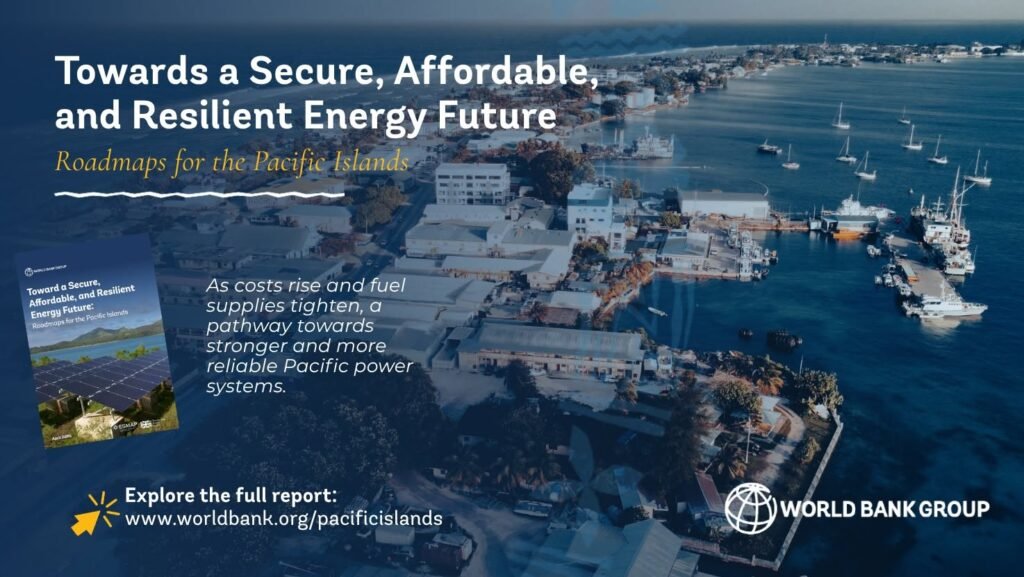
The World Bank Pacific Report: The Pacific has ambitious renewable energy targets. Now comes the work of turning ambition into investment. Our new report, Toward a Secure, Affordable, and Resilient Energy Future, identifies US$2 billion in energy investment needs through 2030. Clear rules and competitive procurement can reduce risk, attract credible developers and deliver more affordable power.
The barriers have not gone away. Projects are small, transport and construction are expensive, and currency, political and offtaker risks are real. Bundling several islands into one portfolio, standardising PPAs and using development banks to prepare projects and share early risk looks like the most credible route to scale.
The fuel crisis has changed the argument. The Pacific is no longer asking investors to create a market, because the market already exists in the diesel bill. Palau has a prospectus, Timor-Leste has a bankable template, and the region will have a Commissioner. The open questions are who builds, who finances and who captures the returns.
CHECK-OUT AND SIGN UP for any of our 6 Media Communications training modules to get Your Voice Heard & Your Projects Seen In The Media : FNGN CLIMAX©MEDIA COMMS ACADEMY
Future Now Green News is an independent forward-thinking digital media platform dedicated to spotlighting the people, projects, and innovations driving the green & blue economy across Australia, Asia and Pacific region. We inform, inspire, and connect change-makers through thought leadership and solutions-focused storytelling in sustainability, clean energy, regenerative tourism, climate action, and future-ready industries.