
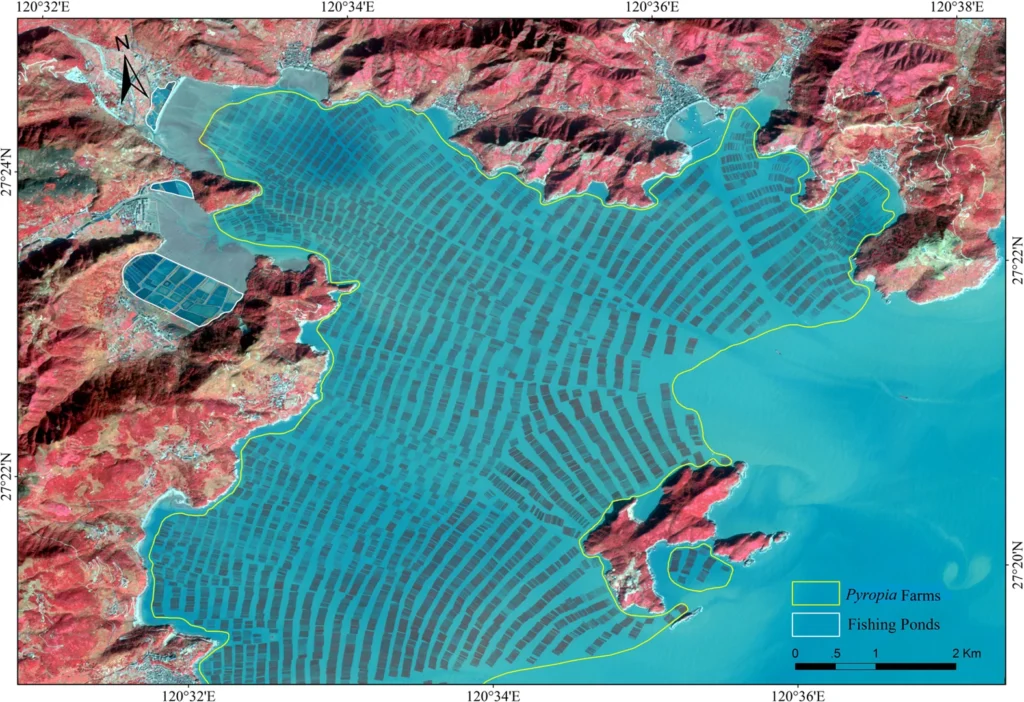

CHINA DOMINATES the world’s seaweed industry. Their seaweed farms visible from space. Australia holds the patent. The question nobody has answered is: does that matter?
The global seaweed industry is undergoing a transformation unlike anything in its ten-thousand-year history. What was once a commons – freely harvested from coastlines across the Pacific Rim, eaten by Aboriginal Australians, traded by Māori, and served to Chinese emperors – is now the frontier of one of the most consequential intellectual property contests of the clean economy era.
At the center of that contest sits an unlikely protagonist: a small red seaweed called Asparagopsis, native to Australian waters, that can slash cattle methane emissions by up to 80 per cent.
THE NUMBERS THAT EXPLAIN EVERYTHING
The global commercial seaweed market was valued at USD $19.79 billion in 2025 and is projected to nearly double to USD $40.85 billion by 2034. Asia Pacific holds a 77 per cent share of that market, with China’s seaweed sector alone valued at USD $12.34 billion in 2026.
China does not merely participate in the seaweed economy. It dominates it. China produces approximately 60 per cent of global farmed seaweed by weight. A dominance built, as one industry analysis notes, on “decades of coastal cultivation infrastructure and policy support.”
Individual Chinese seaweed farms are so vast they are visible from space, spanning more than 35 square kilometres along the Fujian and Shandong coastlines. China controls 90 per cent of global kelp production and 71 per cent of global Undaria pinnatifida production.
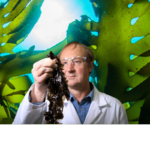
Against this backdrop, Australia’s CSIRO, the federal government’s national science agency holds global intellectual property for the use of Asparagopsis seaweed as a livestock feed ingredient, FutureFeed, protected by patents covering the method of methane reduction, the productivity improvement application, and the process of manufacturing the supplement in edible oil form.
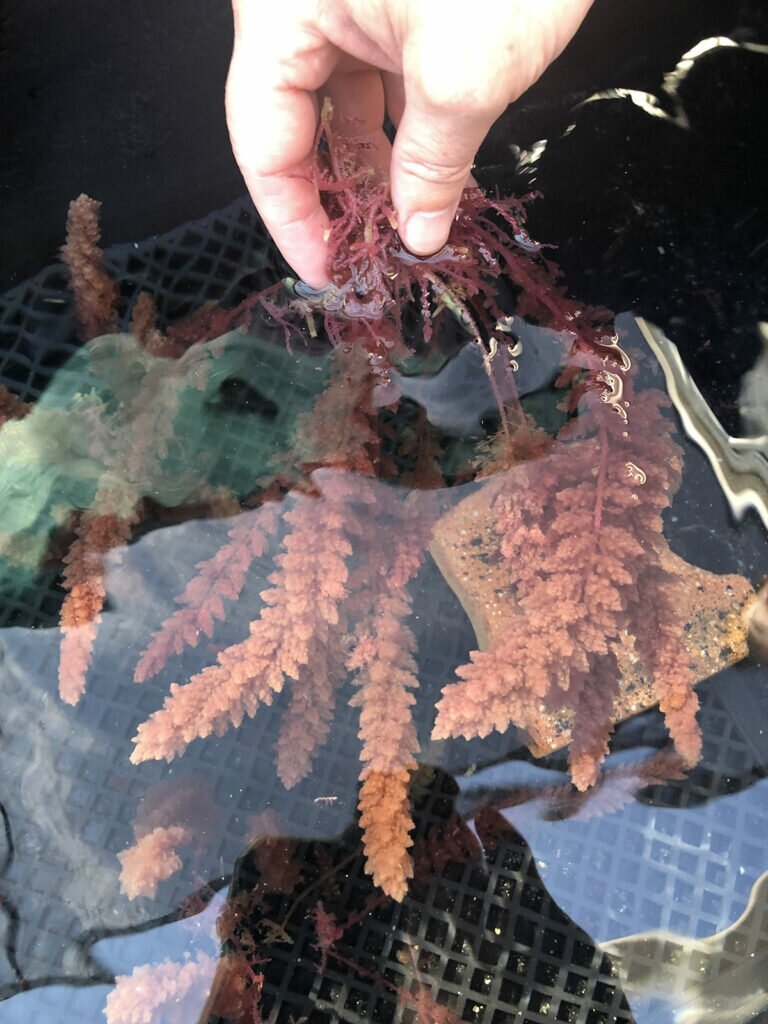
FutureFeed, the CSIRO spin-off established in August 2020 to commercialise the technology, has to date licensed nine producers and processors across Australia, New Zealand, Hawaii and Europe. CSIRO Chief Executive, at the time, Dr Larry Marshall, described FutureFeed at its launch as “science solving the seemingly unsolvable reducing the emissions but not the profits.”
Then-Minister for Industry, Science and Technology Karen Andrews went further, calling it “a game-changer, not only for livestock production, but also for our environment with the potential to create an entirely new industry, while supporting jobs in the Australian agriculture sector.”
What neither said, and what nobody in the official announcements addressed, is what happens when the world’s largest seaweed producer, with its own sophisticated biotech sector and a beef industry of enormous scale, encounters a Western patent on a native marine species.
THE CHINA QUESTION
Would a Chinese seaweed company pay a FutureFeed license fee to sell Asparagopsis as a cattle feed supplement in China’s beef sector?
Technically, yes, if China’s growing IP enforcement machinery is applied. And to be fair to China, that machinery is genuinely improving.
On April 23, 2026, the State Council Information Office held a press conference on China’s intellectual property development, led by Rui Wenbiao, Deputy Director of China’s National Intellectual Property Administration (CNIPA). The CNIPA’s 2026 Intellectual Property Administrative Protection Work Plan has announced special enforcement actions explicitly targeting biotechnology, new energy, and green technology sectors, precisely the categories that seaweed innovation falls into. China’s IP Power Nation framework, completed its first-stage objectives under the 14th Five-Year Plan, and is now extending its ambitions into 2026.
The UNCTAD’s landmark March 2026 report on seaweed trade acknowledged the sector’s rapid expansion, while also noting that

Rules have not kept pace with the sector’s rapid expansion. Regulatory frameworks remain incomplete and fragmented, especially for new uses of seaweed.
That gap between intent and reality is where the FutureFeed question becomes genuinely difficult. Foreign companies operating in biotech and green materials sectors in China are still advised to register their IP directly with Chinese authorities, maintain a robust in-country protection system, and expect that enforcement will be slower and less predictable than in Australia, New Zealand, or Japan. In practice, this creates a two-speed world: regions that pay licensing fees, and regions that may not.
BEIJING’S STRATEGIC PLAYBOOK
This is not accidental. Beijing recognises that the blue economy, critical minerals, and biological resources are the next frontier of strategic competition. Patenting seaweed processing methods, extraction technologies, and farming systems is part of the same strategic playbook as dominating rare earth processing or electric vehicle battery supply chains.
China leads global seaweed patent applications with 9,148 filings – a far ahead of South Korea’s 2,253 and Japan’s 1,551. Australia and New Zealand do not feature in the top five. China is not filing patents on seaweed out of environmental idealism. It is because biological resources, at scale, are a form of strategic sovereignty.
As UNCTAD noted in its 2026 seaweed report:
Among the top exporters, China dominates seaweed derivatives, which account for about 95% of its exports.” The pattern is deliberate. China does not export raw seaweed; it exports processed, value-added derivatives, capturing the margin at every stage of the value chain.
THE DEEPER QUESTION
The bromoform compound that gives Asparagopsis its methane-reducing power is naturally occurring chemistry.
The method of stabilising and delivering it in an edible oil supplement is patented. Whether Chinese courts would enforce an Australian patent on a method of using a native marine organism to reduce cattle emissions is a question that has not yet been tested in any jurisdiction.
It is, however, a question with a precedent. In pharmaceuticals, “method of use” patents on naturally occurring compounds have faced sustained challenge in developing world jurisdictions – most famously during the HIV antiretroviral disputes of the early 2000s, when South Africa and Brazil asserted the right to manufacture generic versions of patented drugs under compulsory licensing provisions. The seaweed IP landscape is not yet at that point of tension. But the architecture of the dispute is recognisably similar.
For Australian innovators, the honest assessment is this: FutureFeed’s technology is genuinely world-leading, its science is rigorous, and its potential climate impact is extraordinary. CSIRO estimates that if just 10 per cent of global livestock producers adopted Asparagopsis supplementation, the emissions reduction would be equivalent to removing 100 million cars from the world’s roads.
But realising that potential at planetary scale requires adoption in China – the world’s largest beef consuming nation. And adoption in China requires either enforceable licensing, voluntary compliance, or a diplomatic and commercial framework that does not yet exist.
WHAT A SOVEREIGN BLUE ECONOMY ACTUALLY LOOKS LIKE
China’s approach offers a model worth studying – not necessarily emulating, but understanding. China’s seaweed aquaculture is now explicitly embedded in its national climate strategy: seaweed cultivation is classified as a blue carbon sink, with government-backed financial incentives for long-term farming.
The academic literature notes, however, that despite this strategic ambition, China’s seaweed sector “is still dominated by small and middle-scale companies and individual fishermen” suggesting that the gap between strategic intent and ground-level implementation runs in both directions.
For Australia and New Zealand, the path forward is neither naive optimism about IP enforcement nor retreat from global licensing ambition. It is the harder work of embedding seaweed innovation into bilateral trade frameworks, into the Quad’s critical minerals and clean technology agenda, and into the ASEAN economic partnership agreements that are currently being renegotiated.
It is also and this is the part that official statements have been slowest to acknowledge the work of ensuring that the communities whose coastlines, traditional knowledge, and ecological stewardship made this science possible are recognised as more than backdrop to a patent filing.
Check out and signup for any of our 6 training programs: FNGN CLIMAX©MEDIA COMMS ACADEMY
Future Now Green News is a forward-thinking media platform dedicated to spotlighting the people, projects, and innovations driving the green & blue economy across Australia, Asia and Pacific region. Our mission is to inform, inspire, and connect changemakers through thought leadership and solutions-focused storytelling in sustainability, clean energy, regenerative tourism, climate action, and future-ready industries.