
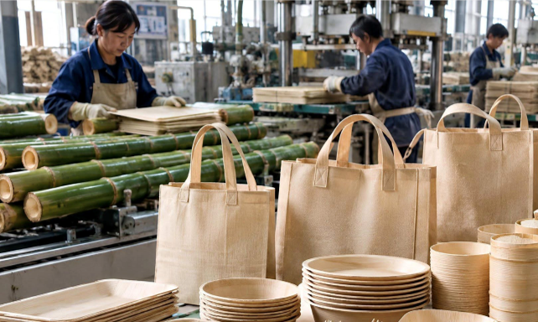

A plastic substitute that began as a diplomatic initiative now sits inside the country’s next Five-Year Plan, backed by standards, factories and finance. No half measures.
When China scales something, it is rarely a market accident. Bamboo is a clear case. The straws and takeaway boxes look like a consumer trend, but behind them is a layered state strategy: policy first, then standards, investment and industry.
From initiative to infrastructure
China announced the Bamboo as a Substitute for Plastic (BASP) initiative in June 2022 as part of its Global Development Initiative, in partnership with the International Bamboo and Rattan Organisation (INBAR).
The domestic push followed in October 2023, when four national agencies published a three-year action plan with six objectives and 23 specific actions. It targeted daily necessities, industrial products and building materials, and aimed by 2025 to establish a preliminary industrial system, lift the added value of major products by more than 20 per cent against 2022, and improve bamboo utilisation by 20 per cent.
It also called for about 10 demonstration bases in bamboo-rich regions to conduct research and develop product standards.
Delivery has followed. A 2024 standards system covered 140 items in nine categories, and in January 2025 China led the first ISO standard for bamboo drinking straws.
By early 2024, more than 20 industrial bases were under construction or planned across 17 major bamboo-producing provinces. This year, according to China Daily, BASP was formally written into the 15th Five-Year Plan (2026-30), shifting it from a time-limited campaign to a long-term national strategy.
Where the money and R&D are going
China has the resource base: about 7.56 million hectares of bamboo forest, roughly a fifth of the global total. The industry is already large. The forestry administration reported that output value passed 520 billion yuan (about US$77.5 billion) by the end of last year, with more than 10,000 processing enterprises, 29 million people employed and over 15,000 product varieties. In 2023 the same agency projected that output value would surpass 1 trillion yuan by 2035. One report describes the sector as shifting from labour-intensive to technology-intensive.
The clearest example is in Huaihua, Hunan. The city made bamboo a strategic priority in 2024, local banks began prioritising bamboo loans, and more than 45,000 hectares of plantations gained Forest Stewardship Council certification. A local firm, Hunan Lead Goal New Materials, now runs a bamboo-fibre moulding base with 120,000 tonnes of annual capacity and holds TÜV Austria’s OK compost HOME certification.
The ambitions go well beyond packaging. Bamboo-fibre composites for car interiors passed expert review in October 2025 and are now mass-produced in nearly 20 vehicle models. Another Huaihua company makes high-density bamboo boards for truck flooring, sold to clients including Mercedes-Benz and DHL, at prices more than ten times the value of the raw material. Demand is lifting rural incomes too: raw bamboo prices have risen from about 400 to 600 yuan per tonne, and more than 100,000 farmers in the region have seen incomes increase. In June, the China Express Association set a target of 50 per cent average annual growth in bamboo-based express packaging, reaching at least 1 billion units by 2030.
So the instinct is right. Policy sets the direction, standards create the market, and finance, regional industrial bases and manufacturing R&D build the supply chain.
The caveats
Bamboo is not automatically safe or sustainable, and the word on a label can mislead. A Czech study published in Food Control screened 33 bio-based dishes and found melamine in 20 of 21 bamboo-labelled samples, with migration exceeding EU legal limits in six products. The researchers explained that most bamboo-labelled tableware uses melamine-formaldehyde resin as the binder, with bamboo serving only as a filler. Germany’s Federal Institute for Risk Assessment has warned against using “bamboo ware” for hot drinks and meals, as it can release more formaldehyde and melamine than conventional melamine tableware.
These findings concern a particular product class, not China’s fibre-based packaging as such. But the reporting I found doesn’t say which binders and additives the newer BASP products use, and that is exactly what determines safety and end-of-life. Most of the headline figures also come from the Chinese government and state media, and company claims on cost and performance are unverified. Processing energy, chemicals, transport and disposal still need independent lifecycle assessment before “bamboo” can be read as “low-carbon”.
Plastic is a large and growing problem.
The IUCN estimates more than 460 million tonnes are produced every year, with some 20 million tonnes entering the environment. More than 130 countries now restrict plastics, and the EU’s new packaging regulation began applying in August. China is betting that a renewable domestic feedstock can be industrialised to meet that demand, and to export the products and the standards that come with it.
For Australia and the Asia-Pacific, the lesson is less about bamboo than about method. Substituting materials at scale takes coordinated policy, credible standards, patient finance and processing capacity. Whether others can replicate that, and whether the products hold up under independent scrutiny, is the story to watch.
Check out and sign up for any of our 6 Media Communications training modules: FNGN CLIMAX©MEDIA COMMS ACADEMY
Future Now Green News is an independent forward-thinking digital media platform dedicated to spotlighting the people, projects, and innovations driving the green & blue economy across Australia, Asia and Pacific region. We inform, inspire, and connect change-makers through thought leadership and solutions-focused storytelling in sustainability, clean energy, regenerative tourism, climate action, and future-ready industries.